



 Chat with AI
Exam 17: Oligopoly

Exam 1: Ten Principles of Economics439 Questions
Exam 2: Thinking Like an Economist617 Questions
Exam 3: Interdependence and the Gains From Trade527 Questions
Exam 4: The Market Forces of Supply and Demand698 Questions
Exam 5: Elasticity and Its Application595 Questions
Exam 6: Supply, Demand, and Government Policies644 Questions
Exam 7: Consumers, Producers, and the Efficiency of Markets549 Questions
Exam 8: Application: The Costs of Taxation511 Questions
Exam 9: Application: International Trade493 Questions
Exam 10: Externalities524 Questions
Exam 11: Public Goods and Common Resources433 Questions
Exam 12: The Design of the Tax System551 Questions
Exam 13: The Costs of Production420 Questions
Exam 14: Firms in Competitive Markets543 Questions
Exam 15: Monopoly637 Questions
Exam 16: Monopolistic Competition587 Questions
Exam 17: Oligopoly496 Questions
Exam 18: The Markets for the Factors of Production564 Questions
Exam 19: Earnings and Discrimination490 Questions
Exam 20: Income Inequality and Poverty457 Questions
Exam 21: The Theory of Consumer Choice440 Questions
Exam 22: Frontiers of Microeconomics441 Questions
Select questions type


Scenario 17-4.
Consider two cigarette companies, PM Inc. and Brown Inc. If neither company advertises, the two companies split the market and earn $50 million each. If they both advertise, they again split the market, but profits are lower by $10 million since each company must bear the cost of advertising. Yet if one company advertises while the other does not, the one that advertises attracts customers from the other. In this case, the company that advertises earns $60 million while the company that does not advertise earns only $30 million.
-Refer to Scenario 17-4. If these two companies collude and agree upon the best joint strategy,
(Multiple Choice)
4.9/5  (83)
(83) Which of the following prohibits executives of competing firms from even talking about fixing prices?
(Multiple Choice)
5.0/5 (93)
(93) Table 17-21
The Chicken Game is named for a contest in which drivers test their courage by driving straight at each other. John and Paul have a common interest to avoid crashing into each other, but they also have a personal, competing interest to not turn first to demonstrate their courage to those observing the contest. The payoff table for this situation is provided below. The payoffs are shown as (John, Paul).
 -Refer to Table 17-21. What is Paul's dominant strategy?
 (Multiple Choice)
4.8/5 (79)
(79) Some people consider the NCAA (National Collegiate Athletic Association)
to be a in the market for college athletics.
(Short Answer)
4.7/5 (90)
(90) Table 17-21
The Chicken Game is named for a contest in which drivers test their courage by driving straight at each other. John and Paul have a common interest to avoid crashing into each other, but they also have a personal, competing interest to not turn first to demonstrate their courage to those observing the contest. The payoff table for this situation is provided below. The payoffs are shown as (John, Paul).
-Refer to Table 17-21. If Paul chooses Turn, what will John choose to do and what will John's payoff equal?
-Refer to Table 17-21. If Paul chooses Turn, what will John choose to do and what will John's payoff equal? (Multiple Choice)
4.8/5 (80)
(80) The game that oligopolists play in trying to reach the oligopoly outcome is similar to the game that the two prisoners play in the prisoners' dilemma.
(True/False)
4.8/5 (76)
(76) A distinguishing feature of an oligopolistic industry is the tension between
(Multiple Choice)
4.7/5 (94)
(94) Table 17-8
For a certain small town, the table shows the demand schedule for water. Assume the marginal cost of supplying water is constant at $4 per bottle.
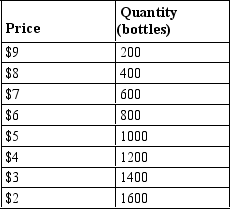 -Refer to Table 17-8. If there were many suppliers of bottled water, what would be the price and quantity?
 (Multiple Choice)
4.8/5 (81)
(81) Table 17-35
Suppose that two coal mining companies - Allied and Barclay - own adjacent land suitable for excavating coal mines. The profits that each firm earns depends on both the number of mines it excavates and the number of mines excavated by the other firm. The table below lists each firm's individual profits:
Allied
Excavate one mine Excavate two mines
 -Refer to Table 17-35. Is there a Nash equilibrium? If so, describe it.
 (Essay)
5.0/5 (80)
(80) In a particular town, Comvision and Veriview are the only two providers of cable TV service. Comvision and Veriview constitute a
(Multiple Choice)
4.7/5 (77)
(77) Table 17-9
The table shows the demand schedule for a particular product.
 -Refer to Table 17-9. Suppose the market for this product is served by two firms that have formed a cartel. What price will the cartel charge in this market if the marginal cost of production is $0?
 (Multiple Choice)
4.9/5 (78)
(78) Scenario 17-4.
Consider two cigarette companies, PM Inc. and Brown Inc. If neither company advertises, the two companies split the market and earn $50 million each. If they both advertise, they again split the market, but profits are lower by $10 million since each company must bear the cost of advertising. Yet if one company advertises while the other does not, the one that advertises attracts customers from the other. In this case, the company that advertises earns $60 million while the company that does not advertise earns only $30 million.
-Refer to Scenario 17-4. PM Inc.'s dominant strategy is to
(Multiple Choice)
4.8/5 (78)
(78) Table 17-2
Imagine a small town in which only two residents, Abby and Brad, own wells that produce safe drinking water. Each week Abby and Brad work together to decide how many gallons of water to pump. They bring water to town and sell it at whatever price the market will bear. To keep things simple, suppose that Abby and Brad can pump as much water as they want without cost so that the marginal cost is zero. The weekly town demand schedule and total revenue schedule for water is shown in the table below:
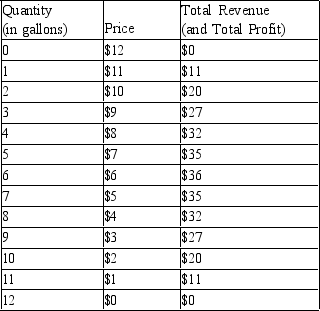 -Refer to Table 17-2. Suppose that Abby and Brad work together to operate as a profit-maximizing monopolist. What price will they charge for water?
 (Multiple Choice)
4.9/5 (78)
(78) After initial success, the OPEC cartel saw the price of oil and the revenues of its members decline due, in part, to
(Multiple Choice)
4.9/5 (87)
(87) Table 17-14
This table shows a game played between two players, A and B. The payoffs in the table are shown as (Payoff to A, Payoff to B).
 -Refer to Table 17-14. Which outcome is the Nash equilibrium in this game?
 (Multiple Choice)
4.9/5 (77)
(77) Consider a market served by a monopolist, Firm A. A new firm, Firm B, enters the market and, as a result, Firm A lowers its price to try to drive Firm B out of the market. This practice is known as
(Multiple Choice)
4.8/5 (68)
(68) Which of the following would be most likely to contribute to the breakdown of a cartel in a natural resource (e.g., bauxite) market?
(Multiple Choice)
4.9/5 (56)
(56) 
Filters
- Essay(0)
- Multiple Choice(0)
- Short Answer(0)
- True False(0)
- Matching(0)