



 Chat with AI
Exam 17: Oligopoly

Exam 1: Ten Principles of Economics439 Questions
Exam 2: Thinking Like an Economist617 Questions
Exam 3: Interdependence and the Gains From Trade527 Questions
Exam 4: The Market Forces of Supply and Demand698 Questions
Exam 5: Elasticity and Its Application595 Questions
Exam 6: Supply, Demand, and Government Policies644 Questions
Exam 7: Consumers, Producers, and the Efficiency of Markets549 Questions
Exam 8: Application: The Costs of Taxation511 Questions
Exam 9: Application: International Trade493 Questions
Exam 10: Externalities524 Questions
Exam 11: Public Goods and Common Resources433 Questions
Exam 12: The Design of the Tax System551 Questions
Exam 13: The Costs of Production420 Questions
Exam 14: Firms in Competitive Markets543 Questions
Exam 15: Monopoly637 Questions
Exam 16: Monopolistic Competition587 Questions
Exam 17: Oligopoly496 Questions
Exam 18: The Markets for the Factors of Production564 Questions
Exam 19: Earnings and Discrimination490 Questions
Exam 20: Income Inequality and Poverty457 Questions
Exam 21: The Theory of Consumer Choice440 Questions
Exam 22: Frontiers of Microeconomics441 Questions
Select questions type


Table 17-26
Two prescription drug manufacturers (Firm A and Firm B) are faced with lawsuits from states to recover the healthcare related expenses associated with side-effects from its drugs. Each drug manufacturer has evidence that indicates that taking its prescription drug causes liver failure. State prosecutors do not have access to the same data used by drug manufacturers and thus will have difficulty recovering full costs without the help of at least one of the drug manufacturer's studies. Each firm has been presented with an opportunity to lower its liability in the suit if it cooperates with attorneys representing the states.
 Refer to Table 17-26. Pursuing its own best interests, Firm A will concede that taking their prescription drug
causes liver failure
e. only if Firm B concedes that taking its drug causes liver failure.
f. only if Firm B does not concede that taking its drug causes liver failure.
g. regardless of whether Firm B concedes that taking its drug causes liver failure.
h. None of the above. In pursuing its own best interests, Firm A will in no case concede that taking its prescription drug causes liver failure.
ANSWER: d
POINTS: 1
DIFFICULTY: Difficulty: Moderate
LEARNING OBJECTIVES: ECON.MANK.15.84 - LO: 17-2
NATIONAL STANDARDS: United States - BUSPROG: Analytic
TOPICS: DISC: Game Theory
KEYWORDS: BLOOM'S: Application
NOTES: r
-Refer to Table 17-26. Which of the following statements is correct?
Refer to Table 17-26. Pursuing its own best interests, Firm A will concede that taking their prescription drug
causes liver failure
e. only if Firm B concedes that taking its drug causes liver failure.
f. only if Firm B does not concede that taking its drug causes liver failure.
g. regardless of whether Firm B concedes that taking its drug causes liver failure.
h. None of the above. In pursuing its own best interests, Firm A will in no case concede that taking its prescription drug causes liver failure.
ANSWER: d
POINTS: 1
DIFFICULTY: Difficulty: Moderate
LEARNING OBJECTIVES: ECON.MANK.15.84 - LO: 17-2
NATIONAL STANDARDS: United States - BUSPROG: Analytic
TOPICS: DISC: Game Theory
KEYWORDS: BLOOM'S: Application
NOTES: r
-Refer to Table 17-26. Which of the following statements is correct? (Multiple Choice)
4.9/5  (77)
(77) Some business practices that appear to reduce competition, such as resale price maintenance, may have legitimate economic purposes.
(True/False)
4.8/5 (92)
(92) Policymakers should be aggressive in using their powers to place limits on firm behavior, because business practices that appear to reduce competition never have any legitimate purposes.
(True/False)
4.9/5 (74)
(74) Explain how the output effect and the price effect influence the production decision of the individual oligopolist.
(Essay)
4.7/5 (81)
(81) Scenario 17-5
Assume that a local restaurant sells two items, salads and steaks. The restaurant's only two customers on a particular day are Mr. Carnivore and Ms. Leafygreens. Mr. Carnivore is willing to pay $20 for a steak and $7 for a salad. Ms. Leafygreens is willing to pay only $8 for a steak, but is willing to pay $12 for a salad. Assume that the restaurant can provide each of these items at zero marginal cost.
-Refer to Scenario 17-5. If the restaurant is unable to use tying, what is the profit-maximizing price to charge for a steak?
(Multiple Choice)
4.7/5 (75)
(75) Table 17-6
Imagine a small town in which only two residents, Kunal and Naj, own wells that produce safe drinking water. Each week Kunal and Naj work together to decide how many gallons of water to pump, to bring the water to town, and to sell it at whatever price the market will bear. Assume Kunal and Naj can pump as much water as they want without cost so that the marginal cost of water equals zero.
The weekly town demand schedule and total revenue schedule for water are shown in the table below.
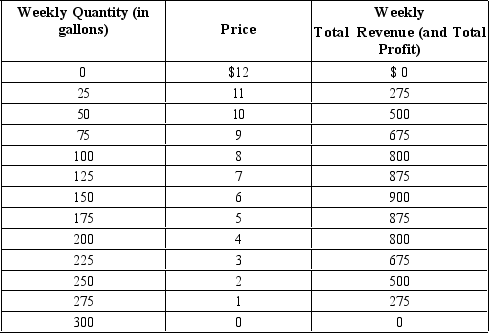 -Refer to Table 17-6. As long as Kunal and Naj operate as a profit-maximizing monopoly, what will their combined weekly revenue amount to?
 (Multiple Choice)
4.8/5 (97)
(97) Which of the following groups or entities has the authority to initiate legal suits to enforce antitrust laws?
(Multiple Choice)
4.8/5 (64)
(64) Figure 17-2. Two companies, Acme and Pinnacle, each decide whether to produce a good quality product or a poor quality product. In the figure, the dollar amounts are payoffs and they represent annual profits for the two companies.  -Refer to Figure 17-2. If this game is played only once, then the most likely outcome is that
 (Multiple Choice)
4.8/5 (75)
(75) Table 17-21
The Chicken Game is named for a contest in which drivers test their courage by driving straight at each other. John and Paul have a common interest to avoid crashing into each other, but they also have a personal, competing interest to not turn first to demonstrate their courage to those observing the contest. The payoff table for this situation is provided below. The payoffs are shown as (John, Paul).
 -Refer to Table 17-21. If John chooses Turn, what will Paul choose to do and what will Paul's payoff equal?
 (Multiple Choice)
4.8/5 (82)
(82) Any market that is served by an oligopoly is in effect served by a monopoly.
(True/False)
4.9/5 (82)
(82) The likely outcome of the standard prisoners' dilemma game is that
(Multiple Choice)
4.9/5 (72)
(72) Table 17-11
Only two firms, ABC and XYZ, sell a particular product. The table below shows the demand curve for their product. Each firm has the same constant marginal cost of $8 and zero fixed cost.
 -Refer to Table 17-11. How much less do each of these firms earn in the Nash equilibrium than if they jointly maximize profits?
 (Multiple Choice)
4.8/5 (83)
(83) Figure 17-5. Two companies, ABC and QRS, are sellers in the same market. Each company decides whether to charge a high price or a low price. In the figure, the dollar amounts are payoffs and they represent annual profits for the two companies.  -Refer to Figure 17-5. If the two companies make their pricing decisions independently, then it is likely that ABC will
 (Multiple Choice)
4.8/5 (62)
(62) Table 17-15
This table shows a game played between two players, A and B. The payoffs in the table are shown as (Payoff to A, Payoff to B).
 -Refer to Table 17-15. Which of the following outcomes represents a Nash equilibrium in the game?
 (Multiple Choice)
4.7/5 (83)
(83) Which of the following examples illustrates an oligopoly market?
(Multiple Choice)
4.8/5 (65)
(65) Table 17-4
The table shows the town of Mauston's demand schedule for gasoline. For simplicity, assume the town's gasoline seller(s) incur no costs in selling gasoline.
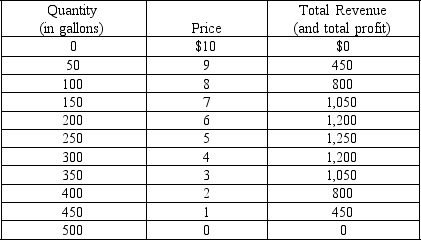 -Refer to Table 17-4. If the market for gasoline in Mauston is a monopoly, then the profit-maximizing monopolist will charge a price of
 (Multiple Choice)
4.9/5 (88)
(88) In the game in which two oil companies own adjacent oil fields, the companies will not use the oil efficiently because
(Multiple Choice)
4.9/5 (77)
(77) Table 17-18
This table shows a game played between two firms, Firm A and Firm B. In this game each firm must decide how much output (Q) to produce: 10 units or 12 units. The profit for each firm is given in the table as (Profit for Firm A, Profit for Firm B).
 -Refer to Table 17-18. The dominant strategy For Firm A is to produce
 (Multiple Choice)
4.8/5 (77)
(77) Table 17-24
Two firms are considering going out of business and selling their assets. Each considers what happens if the other goes out of business. The payoff matrix below shows the net gain or loss to each firm.
 -Refer to Table 17-24. Which firm's dominant strategy is to sell?
 (Multiple Choice)
4.7/5 (87)
(87) 
Filters
- Essay(0)
- Multiple Choice(0)
- Short Answer(0)
- True False(0)
- Matching(0)