



 Chat with AI
Exam 17: Oligopoly

Exam 1: Ten Principles of Economics439 Questions
Exam 2: Thinking Like an Economist617 Questions
Exam 3: Interdependence and the Gains From Trade527 Questions
Exam 4: The Market Forces of Supply and Demand698 Questions
Exam 5: Elasticity and Its Application595 Questions
Exam 6: Supply, Demand, and Government Policies644 Questions
Exam 7: Consumers, Producers, and the Efficiency of Markets549 Questions
Exam 8: Application: The Costs of Taxation511 Questions
Exam 9: Application: International Trade493 Questions
Exam 10: Externalities524 Questions
Exam 11: Public Goods and Common Resources433 Questions
Exam 12: The Design of the Tax System551 Questions
Exam 13: The Costs of Production420 Questions
Exam 14: Firms in Competitive Markets543 Questions
Exam 15: Monopoly637 Questions
Exam 16: Monopolistic Competition587 Questions
Exam 17: Oligopoly496 Questions
Exam 18: The Markets for the Factors of Production564 Questions
Exam 19: Earnings and Discrimination490 Questions
Exam 20: Income Inequality and Poverty457 Questions
Exam 21: The Theory of Consumer Choice440 Questions
Exam 22: Frontiers of Microeconomics441 Questions
Select questions type


Table 17-7
The information in the table below shows the total demand for internet radio subscriptions in a small urban market. Assume that each company that provides these subscriptions incurs an annual fixed cost of $20,000 (per year) and that the marginal cost of providing an additional subscription is always $16.
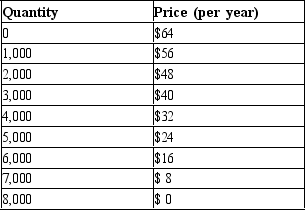 -Refer to Table 17-7. Assume that there are two profit-maximizing internet radio providers operating in this market. Further assume that they are not able to collude on the price and quantity of subscriptions to sell. How much profit will each firm earn when this market reaches a Nash equilibrium?
 (Multiple Choice)
4.8/5  (83)
(83) Table 17-3
Imagine a small town in a remote area where only two residents, Maria and Miguel, own dairies that produce milk that is safe to drink. Each week Maria and Miguel work together to decide how many gallons of milk to produce. They bring milk to town and sell it at whatever price the market will bear. To keep things simple, suppose that Maria and Miguel can produce as much milk as they want without cost so that the marginal cost is zero. The weekly town demand schedule and total revenue schedule for milk is shown in the table below:
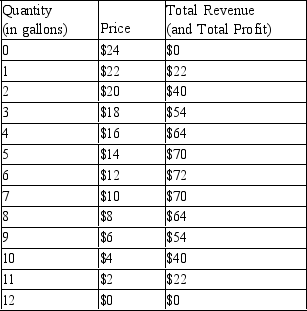 -Refer to Table 17-3. Suppose the town enacts new antitrust laws that prohibit Maria and Miguel from operating as a monopoly. How much profit will Miguel and Maria each earn once they reach a Nash equilibrium?
 (Multiple Choice)
4.7/5 (88)
(88) Describe the output and price effects that influence the profit-maximizing decision faced by a firm in an oligopoly market. How does this differ from output and price effects in a monopoly market?
(Essay)
5.0/5 (81)
(81) Table 17-29
Suppose that two firms, Wild Willy's Wonderdrink (Firm W) and Hyper Hank's Hydration (Firm H), comprise the market for energy drinks. Each firm determines that it could lower its costs and increase its profits if both firms reduced their advertising budgets. But for the plan to work, each firm must agree to refrain from advertising. Each firm believes that advertising works by increasing the demand for the firm's energy drinks, but each firm also believes that if neither firm advertises, the cost savings will outweigh the lost sales. The table below lists each firm's individual profits:
Firm W
Breaks agreement Maintains agreement
and advertises and does not advertise
 -Refer to Table 17-29 Does either Firm W or Firm H have a dominant strategy?
 (Multiple Choice)
4.8/5 (80)
(80) Table 17-5
The information in the table below shows the total demand for premium-channel digital cable TV subscriptions in a small urban market. Assume that each digital cable TV operator pays a fixed cost of $200,000 (per year) to provide premium digital channels in the market area and that the marginal cost of providing the premium channel service to a household is zero.
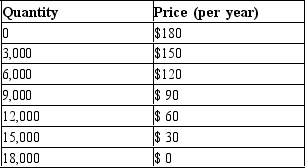 -Refer to Table 17-5. Assume there are two profit-maximizing digital cable TV companies operating in this market. Further assume that they are not able to collude on the price and quantity of premium digital channel subscriptions to sell. How many premium digital channel cable TV subscriptions will be sold altogether when this market reaches a Nash equilibrium?
 (Multiple Choice)
4.9/5 (81)
(81) Table 17-11
Only two firms, ABC and XYZ, sell a particular product. The table below shows the demand curve for their product. Each firm has the same constant marginal cost of $8 and zero fixed cost.
 -Refer to Table 17-11. If this market were perfectly competitive instead of oligopolistic, what would the price be?
 (Multiple Choice)
4.9/5 (86)
(86) Table 17-27
Each year the United States considers renewal of Most Favored Nation (MFN) trading status with Farland (a mythical nation). Historically, legislators have made threats of not renewing MFN status because of human rights abuses in Farland. The non-renewal of MFN trading status is likely to involve some retaliatory measures by Farland. The payoff table below shows the potential economic gains associated with a game in which Farland may impose trade sanctions against U.S. firms and the United States may not renew MFN status with Farland. The table contains the dollar value of all trade-flow benefits to the United States and Farland.
 -Refer to Table 17-27. Assume that trade negotiators meet to discuss trade policy between the United States and Farland. If neither party to the negotiation is able to trust the other party, then
 (Multiple Choice)
4.7/5 (66)
(66) An agreement among firms regarding price and/or production levels is called
(Multiple Choice)
5.0/5 (66)
(66) Table 17-11
Only two firms, ABC and XYZ, sell a particular product. The table below shows the demand curve for their product. Each firm has the same constant marginal cost of $8 and zero fixed cost.
-Refer to Table 17-11. What is the socially efficient quantity of the product?
-Refer to Table 17-11. What is the socially efficient quantity of the product? (Multiple Choice)
4.8/5 (72)
(72) As a group, oligopolists would always earn the highest profit if they would
(Multiple Choice)
4.8/5 (80)
(80) Figure 17-4. Aaron and Ed are roommates. After a big snowstorm, their driveway needs to be shoveled. Each person has to decide whether to take part in shoveling the driveway. At the end of the day, either the driveway will be shoveled (if one or both roommates take part in shoveling), or it will remain unshoveled (if neither roommate shovels). With happiness measured on a scale of 1 (very unhappy) to 10 (very happy), the possible outcomes are as follows:
 -Refer to Figure 17-4. If this game is played only once, then which of the following outcomes is the most likely one?
 (Multiple Choice)
4.8/5 (79)
(79) Table 17-13
Two home-improvement stores (Lopes and HomeMax) in a growing urban area are interested in expanding their market share. Both are interested in expanding the size of their store and parking lot to accommodate potential growth in their customer base. The following game depicts the strategic outcomes that result from the game. Increases in annual profits of the two home-improvement stores are shown in the table below.
 14.
-Refer to Table 17-13. Pursuing its own best interest, Lopes will
14.
-Refer to Table 17-13. Pursuing its own best interest, Lopes will (Multiple Choice)
4.9/5 (68)
(68) Chrissy and Marvin are competitors in a local market and each is trying to decide if it is worthwhile to advertise. If both of them advertise, each will earn a profit of $10,000. If neither of them advertise, each will earn a profit of $20,000. If one advertises and the other doesn't, then the one who advertises will earn a profit of $30,000 and the other will earn $14,000. To earn the highest profit, Chrissy
(Multiple Choice)
4.9/5 (85)
(85) Two CEOs from different firms in the same market collude to fix the price in the market. This action violates the
(Multiple Choice)
4.9/5 (73)
(73) Table 17-4
The table shows the town of Mauston's demand schedule for gasoline. For simplicity, assume the town's gasoline seller(s) incur no costs in selling gasoline.
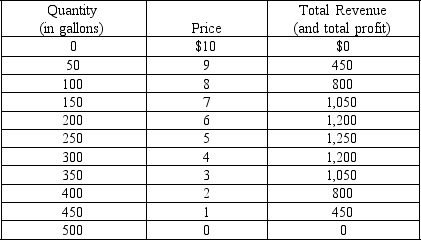 -Refer to Table 17-4. If there are exactly two sellers of gasoline in Mauston and if they collude, then which of the following outcomes is most likely?
 (Multiple Choice)
4.9/5 (94)
(94) Lori and Maya are competitors in a local market. Each is trying to decide if it is better to advertise on TV, on radio, or not at all. If they both advertise on TV, each will earn a profit of $10,000. If they both advertise on radio, each will earn a profit of $14,000. If neither advertises at all, each will earn a profit of $20,000. If one advertises on TV and other advertises on radio, then the one advertising on TV will earn $16,000 and the other will earn $6,000. If one advertises on TV and the other does not advertise, then the one advertising on TV will earn $30,000 and the other will earn $4,000. If one advertises on radio and the other does not advertise, then the one advertising on radio will earn $24,000 and the other will earn $8,000. If both follow their dominant strategy, then Lori will
(Multiple Choice)
4.9/5 (95)
(95) If Levi Strauss & Co. were to require every retailer that carried its clothing to charge customers $42 for each pair of jeans, Levi Strauss & Co. would be practicing
(Multiple Choice)
4.8/5 (91)
(91) 
Filters
- Essay(0)
- Multiple Choice(0)
- Short Answer(0)
- True False(0)
- Matching(0)