



 Chat with AI
Exam 17: Oligopoly

Exam 1: Ten Principles of Economics439 Questions
Exam 2: Thinking Like an Economist617 Questions
Exam 3: Interdependence and the Gains From Trade527 Questions
Exam 4: The Market Forces of Supply and Demand698 Questions
Exam 5: Elasticity and Its Application595 Questions
Exam 6: Supply, Demand, and Government Policies644 Questions
Exam 7: Consumers, Producers, and the Efficiency of Markets549 Questions
Exam 8: Application: The Costs of Taxation511 Questions
Exam 9: Application: International Trade493 Questions
Exam 10: Externalities524 Questions
Exam 11: Public Goods and Common Resources433 Questions
Exam 12: The Design of the Tax System551 Questions
Exam 13: The Costs of Production420 Questions
Exam 14: Firms in Competitive Markets543 Questions
Exam 15: Monopoly637 Questions
Exam 16: Monopolistic Competition587 Questions
Exam 17: Oligopoly496 Questions
Exam 18: The Markets for the Factors of Production564 Questions
Exam 19: Earnings and Discrimination490 Questions
Exam 20: Income Inequality and Poverty457 Questions
Exam 21: The Theory of Consumer Choice440 Questions
Exam 22: Frontiers of Microeconomics441 Questions
Select questions type


The oligopoly price will be greater than marginal cost but less than the monopoly price when
(Multiple Choice)
4.9/5  (70)
(70) As the number of firms in the oligopoly grows very large, the
(Multiple Choice)
4.8/5 (79)
(79) Table 17-1
Imagine a small town in which only two residents, Rochelle and Alec, own wells that produce safe drinking water. Each week Rochelle and Alec work together to decide how many gallons of water to pump. They bring the water to town and sell it at whatever price the market will bear. To keep things simple, suppose that Rochelle and Alec can pump as much water as they want without cost so that the marginal cost of water equals zero. The weekly town demand schedule and total revenue schedule for water is shown in the table below:
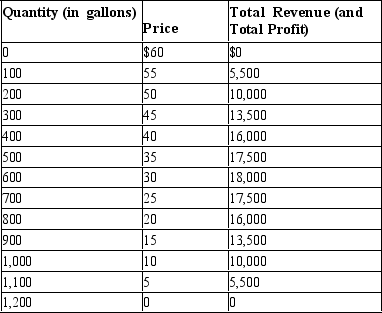 21.
-Refer to Table 17-1. If Rochelle and Alec operate as a profit-maximizing monopoly in the market for water, how much profit will each of them earn?
21.
-Refer to Table 17-1. If Rochelle and Alec operate as a profit-maximizing monopoly in the market for water, how much profit will each of them earn? (Multiple Choice)
4.8/5 (81)
(81) Scenario 17-2.
Imagine that two oil companies, BQ and Exxoff, own adjacent oil fields. Under the fields is a common pool of oil worth $144 million. Drilling a well to recover oil costs $5 million per well. If each company drills one well, each will get half of the oil and earn a $67 million profit ($72 million in revenue - $5 million in costs). Assume that having X percent of the total wells means that a company will collect X percent of the total revenue.
-Refer to Scenario 17-2. If each firm is permitted to drill two wells at most, the firms are in a Nash equilibrium when
(Multiple Choice)
4.9/5 (81)
(81) Table 17-21
The Chicken Game is named for a contest in which drivers test their courage by driving straight at each other. John and Paul have a common interest to avoid crashing into each other, but they also have a personal, competing interest to not turn first to demonstrate their courage to those observing the contest. The payoff table for this situation is provided below. The payoffs are shown as (John, Paul).
 -Refer to Table 17-21. What is (are) the Nash equilibrium (equilibria) in this Chicken game?
 (Multiple Choice)
5.0/5 (78)
(78) Hot dog vendors on the beach fail to cooperate with one another on the quantity of hot dogs they should sell to earn monopoly profits. A consequence of their failure is that, relative to the outcome the vendors would like, (i) the quantity of hot dogs supplied is closer to the socially optimal level.
(ii) the price of hot dogs is closer to marginal cost.
(iii) the hot dog market at the beach is less competitive.
(Multiple Choice)
4.9/5 (84)
(84) The practice of selling a product to retailers and requiring the retailers to charge a specific price for the product is called
(Multiple Choice)
4.8/5 (76)
(76) Oligopolists may well be able to reach their preferred, cooperative outcome if
(Multiple Choice)
4.9/5 (75)
(75) Figure 17-1  -Refer to Figure 17-1. Suppose this market is served by two firms who each face the marginal cost curve shown in the diagram. The marginal revenue curve that a monopolist would face in this market is also shown. If the firms are able to collude successfully,
 (Multiple Choice)
4.8/5 (94)
(94) A law that encourages market competition by prohibiting firms from gaining or exercising excessive market power is
(Multiple Choice)
4.7/5 (79)
(79) Table 17-1
Imagine a small town in which only two residents, Rochelle and Alec, own wells that produce safe drinking water. Each week Rochelle and Alec work together to decide how many gallons of water to pump. They bring the water to town and sell it at whatever price the market will bear. To keep things simple, suppose that Rochelle and Alec can pump as much water as they want without cost so that the marginal cost of water equals zero. The weekly town demand schedule and total revenue schedule for water is shown in the table below:
21.
-Refer to Table 17-1. Suppose the town enacts new antitrust laws that prohibit Rochelle and Alec from operating as a monopoly. How many gallons of water will be produced and sold once Rochelle and Alec reach a Nash equilibrium?
21.
-Refer to Table 17-1. Suppose the town enacts new antitrust laws that prohibit Rochelle and Alec from operating as a monopoly. How many gallons of water will be produced and sold once Rochelle and Alec reach a Nash equilibrium? (Multiple Choice)
4.7/5 (72)
(72) Suppose that Bieber and Rihanna are duopolists in the music industry. In May, they agree to work together as a monopolist, charging the monopoly price for their music and producing the monopoly quantity of songs. By June, each singer is considering breaking the agreement. What would you expect to happen next?
(Multiple Choice)
4.9/5 (79)
(79) Scenario 17-6
Assume that a local telecommunications company sells high speed internet access and cable television. The company's only two customers are Taylor and Tim. Taylor is willing to pay $50 per month for high speed internet access and $50 per month for cable television. Tim is willing to pay only $20 per month for high speed internet access, but is willing to pay $70 per month for cable television. Assume that the telecommunications company can provide each of these products at zero marginal cost.
-Refer to Scenario 17-6. If the telecommunications company is unable to use tying, what is the profit-maximizing price to charge for high speed internet access?
(Short Answer)
5.0/5 (79)
(79) A tit-for-tat strategy, in a repeated game, is one in which a player starts by cooperating and then does whatever the other player did last time.
(True/False)
4.8/5 (83)
(83) 
Filters
- Essay(0)
- Multiple Choice(0)
- Short Answer(0)
- True False(0)
- Matching(0)