



 Chat with AI
Exam 17: Oligopoly

Exam 1: Ten Principles of Economics439 Questions
Exam 2: Thinking Like an Economist617 Questions
Exam 3: Interdependence and the Gains From Trade527 Questions
Exam 4: The Market Forces of Supply and Demand698 Questions
Exam 5: Elasticity and Its Application595 Questions
Exam 6: Supply, Demand, and Government Policies644 Questions
Exam 7: Consumers, Producers, and the Efficiency of Markets549 Questions
Exam 8: Application: The Costs of Taxation511 Questions
Exam 9: Application: International Trade493 Questions
Exam 10: Externalities524 Questions
Exam 11: Public Goods and Common Resources433 Questions
Exam 12: The Design of the Tax System551 Questions
Exam 13: The Costs of Production420 Questions
Exam 14: Firms in Competitive Markets543 Questions
Exam 15: Monopoly637 Questions
Exam 16: Monopolistic Competition587 Questions
Exam 17: Oligopoly496 Questions
Exam 18: The Markets for the Factors of Production564 Questions
Exam 19: Earnings and Discrimination490 Questions
Exam 20: Income Inequality and Poverty457 Questions
Exam 21: The Theory of Consumer Choice440 Questions
Exam 22: Frontiers of Microeconomics441 Questions
Select questions type


Table 17-19
Consider a small town that has two grocery stores from which residents can choose to buy a loaf of bread. The store owners each must make a decision to set a high bread price or a low bread price. The payoff table, showing profit per week, is provided below. The profit in each cell is shown as (Store 1, Store 2).
 -Refer to Table 17-19. What is grocery store 1's dominant strategy?
 (Multiple Choice)
4.9/5  (71)
(71) If a certain market were a monopoly, then the monopolist would maximize its profit by producing 4,000 units of output. If, instead, that market were a duopoly, then which of the following outcomes would be most likely if the duopolists successfully collude?
(Multiple Choice)
4.8/5 (79)
(79) The decisions of the US and Soviet Union to build nuclear weapons is much like the prisoners' dilemma.
(True/False)
4.9/5 (84)
(84) Scenario 17-1.
Assume that the countries of Irun and Urun are the only two producers of crude oil. Further assume that both countries have entered into an agreement to maintain certain production levels in order to maximize profits. In the world market for oil, the demand curve is downward sloping.
-Refer to Scenario 17-1. As long as the combined level of output is less than the Nash equilibrium level, both Irun and Urun have the individual incentive to
(Multiple Choice)
4.8/5 (78)
(78) Table 17-7
The information in the table below shows the total demand for internet radio subscriptions in a small urban market. Assume that each company that provides these subscriptions incurs an annual fixed cost of $20,000 (per year) and that the marginal cost of providing an additional subscription is always $16.
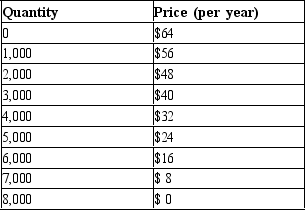 -Refer to Table 17-7. The socially efficient level of output supplied to this market is
 (Multiple Choice)
4.8/5 (68)
(68) Because oligopoly markets have only a few sellers, the actions of any one seller
(Multiple Choice)
4.9/5 (83)
(83) Table 17-25
There are just two producers of a certain product. Each is considering offering promotional discounts.
 -Refer to Table 17-25. The dominant strategy
 (Multiple Choice)
4.9/5 (95)
(95) Suppose three firms form a cartel and agree to charge a specific price for their output. Each individual firm has an incentive to maintain the agreement because the firm's individual profits will be the greatest under the cartel arrangement.
(True/False)
4.8/5 (88)
(88) Figure 17-3. Hector and Bart are roommates. On a particular day, their apartment needs to be cleaned. Each person has to decide whether to take part in cleaning. At the end of the day, either the apartment will be completely clean (if one or both roommates take part in cleaning), or it will remain dirty (if neither roommate cleans). With happiness measured on a scale of 1 (very unhappy) to 10 (very happy), the possible outcomes are as follows:
 -Refer to Figure 17-3. In pursuing his own self-interest, Hector will
 (Multiple Choice)
4.9/5 (87)
(87) George and Jerry are competitors in a local market. Each is trying to decide if it is better to advertise on TV, on radio, or not at all. If they both advertise on TV, each will earn a profit of $3,000. If they both advertise on radio, each will earn a profit of $5,000. If neither advertises at all, each will earn a profit of $10,000. If one advertises on TV and the other advertises on radio, then the one advertising on TV will earn $4,000 and the other will earn $2,000. If one advertises on TV and the other does not advertise, then the one advertising on TV will earn $8,000 and the other will earn $5,000. If one advertises on radio and the other does not advertise, then the one advertising on radio will earn $9,000 and the other will earn $6,000. If both follow their dominant strategy, then George will
(Multiple Choice)
4.7/5 (60)
(60) An oligopolist will increase production if the output effect is
(Multiple Choice)
4.8/5 (83)
(83) As the number of sellers in an oligopoly becomes very large,
(Multiple Choice)
4.9/5 (86)
(86) Table 17-14
This table shows a game played between two players, A and B. The payoffs in the table are shown as (Payoff to A, Payoff to B).
 -Refer to Table 17-14. If player A chooses his/her best strategy, player B should
 (Multiple Choice)
4.7/5 (67)
(67) Why would lack of cooperation between criminal suspects be desirable for society as a whole?
(Multiple Choice)
4.8/5 (73)
(73) In which of the following markets are strategic interactions among firms most likely to occur?
(Multiple Choice)
4.9/5 (100)
(100) Table 17-28
Suppose that two firms determine that each could lower its costs and increase its profits if both reduced their advertising budgets. But in order for the plan to work, each firm must agree to refrain from advertising. Each firm believes that advertising works by increasing the demand for the firm's product, but each firm also believes that if neither firm advertises, the cost savings will outweigh the lost sales. The table below lists each firm's individual profits:
Firm A
Breaks agreement Maintains agreement
and advertises and does not advertise
 -Refer to Table 17-28. Which of the following statements does not correctly characterize the outcome of this game?
 (Multiple Choice)
4.9/5 (69)
(69) Very often, the reason that players can solve the prisoners' dilemma and reach the most profitable outcome is that
(Multiple Choice)
4.8/5 (87)
(87) Figure 17-3. Hector and Bart are roommates. On a particular day, their apartment needs to be cleaned. Each person has to decide whether to take part in cleaning. At the end of the day, either the apartment will be completely clean (if one or both roommates take part in cleaning), or it will remain dirty (if neither roommate cleans). With happiness measured on a scale of 1 (very unhappy) to 10 (very happy), the possible outcomes are as follows:
-Refer to Figure 17-3. In pursuing his own self-interest, Bart will
-Refer to Figure 17-3. In pursuing his own self-interest, Bart will (Multiple Choice)
5.0/5 (75)
(75) 
Filters
- Essay(0)
- Multiple Choice(0)
- Short Answer(0)
- True False(0)
- Matching(0)