



 Chat with AI
Exam 17: Oligopoly

Exam 1: Ten Principles of Economics439 Questions
Exam 2: Thinking Like an Economist617 Questions
Exam 3: Interdependence and the Gains From Trade527 Questions
Exam 4: The Market Forces of Supply and Demand698 Questions
Exam 5: Elasticity and Its Application595 Questions
Exam 6: Supply, Demand, and Government Policies644 Questions
Exam 7: Consumers, Producers, and the Efficiency of Markets549 Questions
Exam 8: Application: The Costs of Taxation511 Questions
Exam 9: Application: International Trade493 Questions
Exam 10: Externalities524 Questions
Exam 11: Public Goods and Common Resources433 Questions
Exam 12: The Design of the Tax System551 Questions
Exam 13: The Costs of Production420 Questions
Exam 14: Firms in Competitive Markets543 Questions
Exam 15: Monopoly637 Questions
Exam 16: Monopolistic Competition587 Questions
Exam 17: Oligopoly496 Questions
Exam 18: The Markets for the Factors of Production564 Questions
Exam 19: Earnings and Discrimination490 Questions
Exam 20: Income Inequality and Poverty457 Questions
Exam 21: The Theory of Consumer Choice440 Questions
Exam 22: Frontiers of Microeconomics441 Questions
Select questions type


Table 17-6
Imagine a small town in which only two residents, Kunal and Naj, own wells that produce safe drinking water. Each week Kunal and Naj work together to decide how many gallons of water to pump, to bring the water to town, and to sell it at whatever price the market will bear. Assume Kunal and Naj can pump as much water as they want without cost so that the marginal cost of water equals zero.
The weekly town demand schedule and total revenue schedule for water are shown in the table below.
 -Refer to Table 17-6. Suppose the town enacts new antitrust laws that prohibit Kunal and Naj from operating as a monopolist. Once the Nash equilibrium is reached, how much profit will each producer earn?
 (Multiple Choice)
4.9/5  (86)
(86) Suppose two companies own adjacent oil fields. Under the two fields is a common pool of oil worth $60 million. For each well that is drilled, the company that drills the well incurs a cost of $4 million. Each company can drill up to two wells. What is the likely outcome of this game if each company pursues its own self-interest?
(Multiple Choice)
4.7/5 (83)
(83) Scenario 17-3.
Consider two countries, Kinglandia and Rovinastan, that are engaged in an arms race. Each country must decide whether to build new weapons or to disarm existing weapons. Each country prefers to have more arms than the other because a large arsenal gives it more influence in world affairs. But each country also prefers to live in a world safe from the other country's weapons. The following table shows the possible outcomes for each decision combination. The numbers in each cell represent the country's ranking of the outcome (10 = best outcome, 1 = worst outcome).
 -Refer to Scenario 17-3. If each country only makes a choice of whether to build or disarm one time and Rovinastan chooses to build new weapons, then Kinglandia will
 (Multiple Choice)
4.9/5 (90)
(90) Ford and General Motors are considering expanding into the Vietnamese automobile market. Devise a simple prisoners' dilemma game to demonstrate the strategic considerations that are relevant to this decision.
(Essay)
4.9/5 (81)
(81) Table 17-31
Imagine a small town in a remote area where only two residents, Maria and Miguel, own dairies that produce milk that is safe to drink. Each week Maria and Miguel work together to decide how many gallons of milk to produce. They bring milk to town and sell it at whatever price the market will bear. To keep things simple, suppose that Maria and Miguel can produce as much milk as they want without cost so that the marginal cost is zero. The weekly town demand schedule and total revenue schedule for milk is shown in the table below:
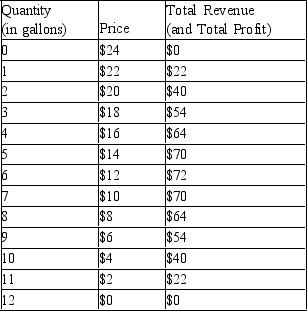 -Refer to Table 17-31. Briefly explain why each duopolist earns a lower profit at the Nash equilibrium than if they cooperated to produce the monopoly output.
 (Essay)
4.8/5 (70)
(70) Scenario 17-2.
Imagine that two oil companies, BQ and Exxoff, own adjacent oil fields. Under the fields is a common pool of oil worth $144 million. Drilling a well to recover oil costs $5 million per well. If each company drills one well, each will get half of the oil and earn a $67 million profit ($72 million in revenue - $5 million in costs). Assume that having X percent of the total wells means that a company will collect X percent of the total revenue.
-Refer to Scenario 17-2. If BQ were to drill a second well, what would its profit be if Exxoff did not drill a second well?
(Multiple Choice)
4.8/5 (78)
(78) Table 17-13
Two home-improvement stores (Lopes and HomeMax) in a growing urban area are interested in expanding their market share. Both are interested in expanding the size of their store and parking lot to accommodate potential growth in their customer base. The following game depicts the strategic outcomes that result from the game. Increases in annual profits of the two home-improvement stores are shown in the table below.
 14.
-Refer to Table 17-13. Pursuing its own best interest, HomeMax will
14.
-Refer to Table 17-13. Pursuing its own best interest, HomeMax will (Multiple Choice)
4.9/5 (83)
(83) Although the practice of predatory pricing is a common claim in antitrust suits, some economists are skeptical of this argument because they believe
(Multiple Choice)
4.9/5 (82)
(82) Figure 17-5. Two companies, ABC and QRS, are sellers in the same market. Each company decides whether to charge a high price or a low price. In the figure, the dollar amounts are payoffs and they represent annual profits for the two companies.  -Refer to Figure 17-5. The situation faced by ABC and QRS is
 (Multiple Choice)
4.8/5 (77)
(77) Table 17-16
This table shows a game played between two players, A and B. The payoffs are given in the table as (Payoff to A, Payoff to B).
 -Refer to Table 17-16. Which of the following outcomes represents a Nash equilibrium in the game?
 (Multiple Choice)
4.9/5 (82)
(82) Table 17-13
Two home-improvement stores (Lopes and HomeMax) in a growing urban area are interested in expanding their market share. Both are interested in expanding the size of their store and parking lot to accommodate potential growth in their customer base. The following game depicts the strategic outcomes that result from the game. Increases in annual profits of the two home-improvement stores are shown in the table below.
14.
-Refer to Table 17-13. If both stores follow a dominant strategy, HomeMax's annual profit will grow by
14.
-Refer to Table 17-13. If both stores follow a dominant strategy, HomeMax's annual profit will grow by (Multiple Choice)
4.9/5 (63)
(63) In which of the following games is it clearly the case that the cooperative outcome of the game is good for the two players and good for society?
(Multiple Choice)
4.7/5 (78)
(78) As the number of firms in an oligopoly industry increases, the market
moves closer to a market.
(Short Answer)
4.8/5 (91)
(91) Table 17-12
The table shows the town of Driveaway's demand schedule for gasoline. Assume the town's gasoline seller(s) incurs a cost of $2 for each gallon sold, with no fixed cost.
 -Refer to Table 17-12. If there are exactly five sellers of gasoline in Driveaway and if they collude, then which of the following outcomes is most likely?
 (Multiple Choice)
4.8/5 (76)
(76) 
Filters
- Essay(0)
- Multiple Choice(0)
- Short Answer(0)
- True False(0)
- Matching(0)