Multiple Choice
Scenario 17-3.
Consider two countries, Kinglandia and Rovinastan, that are engaged in an arms race. Each country must decide whether to build new weapons or to disarm existing weapons. Each country prefers to have more arms than the other because a large arsenal gives it more influence in world affairs. But each country also prefers to live in a world safe from the other country's weapons. The following table shows the possible outcomes for each decision combination. The numbers in each cell represent the country's ranking of the outcome (10 = best outcome, 1 = worst outcome) .
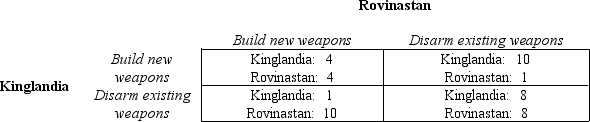
-Refer to Scenario 17-3. Suppose the two countries agreed to disarm existing weapons. In reality these two countries may have a hard time keeping this agreement due to which of the following reasons? (i) Even though Kinglandia has no incentive to cheat on the agreement, Rovinastan has an incentive to cheat on the agreement.
(ii) Much like the prisoners' dilemma, both countries are better off reneging on the
Agreement and building new weapons.
(iii) Both countries want to increase their world power by building new weapons.
A) (i) and (ii)
B) (ii) and (iii)
C) (i) and (iii)
D) (i) , (ii) , and (iii)
Correct Answer:

Verified
Correct Answer:
Verified
Q5: When all firms choose their best strategy
Q38: Like monopolists, oligopolists are aware that an
Q46: Table 17-9<br>The table shows the demand schedule
Q96: A dominant strategy is one that<br>A)makes every
Q113: For a firm, strategic interactions with other
Q123: The Sherman Antitrust Act states that if
Q147: In the U.S. government's 1998 suit against
Q319: Table 17-18<br>This table shows a game played
Q321: Scenario 17-4.<br>Consider two cigarette companies, PM Inc.
Q421: Much of the research on game theory