



 Chat with AI
Exam 2: Atoms and Molecules the Chemical Basis of Life

Exam 1: A View of Life66 Questions
Exam 2: Atoms and Molecules the Chemical Basis of Life69 Questions
Exam 3: The Chemistry of Life Organic Compounds68 Questions
Exam 4: Organization of the Cell71 Questions
Exam 5: Biological Membranes69 Questions
Exam 6: Cell Communication69 Questions
Exam 7: Energy and Metabolism73 Questions
Exam 8: How Cells Make Atp Energy-Releasing Pathways66 Questions
Exam 9: Photosynthesis Capturing Light Energy72 Questions
Exam 10: Chromosomes, Mitosis, and Meiosis66 Questions
Exam 11: The Basic Principles of Heredity78 Questions
Exam 12: Dna the Carrier of Genetic Information68 Questions
Exam 13: Gene Expression82 Questions
Exam 14: Gene Regulation77 Questions
Exam 15: Dna Technology and Genomics81 Questions
Exam 16: Human Genetics and the Human Genome75 Questions
Exam 17: Developmental Genetics83 Questions
Exam 18: Introduction to Darwinian Evolution66 Questions
Exam 19: Evolutionary Change in Populations72 Questions
Exam 20: Speciation and Macroevolution139 Questions
Exam 21: The Origin and Evolutionary History of Life67 Questions
Exam 22: The Evolution of Primates70 Questions
Exam 23: Understanding Diversity Systematics66 Questions
Exam 24: Viruses and Subviral Agents51 Questions
Exam 25: Bacteria and Archaea59 Questions
Exam 26: Protists69 Questions
Exam 27: Seedless Plants70 Questions
Exam 28: Seed Plants69 Questions
Exam 29: The Fungi69 Questions
Exam 30: An Introduction to Animal Diversity66 Questions
Exam 31: Sponges, Cnidarians, Ctenophores, and Protostomes99 Questions
Exam 32: The Deuterostomes75 Questions
Exam 33: Plant Structure Growth and Development73 Questions
Exam 34: Leaf Structure and Function76 Questions
Exam 35: Stem Structure and Transport75 Questions
Exam 36: Roots and Mineral Nutrition84 Questions
Exam 37: Reproduction in Flowering Plants81 Questions
Exam 38: Plant Developmental Responses to External and Internal Signals84 Questions
Exam 39: Animal Structure and Function an Introduction84 Questions
Exam 40: Protection Support and Movement68 Questions
Exam 41: Neural Signaling66 Questions
Exam 42: Neural Regulation67 Questions
Exam 43: Sensory Systems78 Questions
Exam 44: Internal Transport90 Questions
Exam 45: The Immune System Internal Defense79 Questions
Exam 46: Gas Exchange93 Questions
Exam 47: Processing Food and Nutrition90 Questions
Exam 48: Osmoregulation and Disposal of Metabolic Wastes111 Questions
Exam 49: Endocrine Regulation69 Questions
Exam 50: Reproduction95 Questions
Exam 51: Animal Development88 Questions
Exam 52: Animal Behavior83 Questions
Exam 53: Introduction to Ecology Population Ecology90 Questions
Exam 54: Community Ecology73 Questions
Exam 55: Ecosystems and the Biosphere91 Questions
Exam 56: Ecology and the Geography of Life81 Questions
Exam 57: Biological Diversity and Conservation Biology68 Questions
Select questions type


As a researcher, you are charged with determining the side effects of a new drug. From previous observations, you suspect that this drug reduces the rate of DNA production (replication) within skin cells of patients using the drug. With the following materials, design an experiment that would answer your questions about the effect of the drug on DNA production. You know that: DNA contains phosphate groups. You have: radioactive isotopes of phosphate (32P), skin cell cultures from various patients, the drug in question, and a device that measures radioactivity.
(Essay)
4.9/5  (91)
(91) The chemical behavior of an atom is determined most directly by the:
(Multiple Choice)
4.9/5 (80)
(80) Figure 2-1 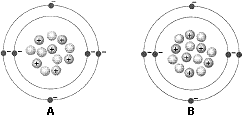 What is the atomic mass of the atom identified as A in the accompanying figure?
 (Multiple Choice)
4.8/5 (73)
(73) Which component is the oxidizing agent in the following chemical reaction? 4 Fe + 3 O2 → 2 Fe2O3
(Multiple Choice)
4.8/5 (82)
(82) In a water molecule, because oxygen is more electronegative than hydrogen, the shared electrons are more commonly found around the ____ nucleus than the ____ nucleus.
(Multiple Choice)
4.8/5 (87)
(87) An atom having a filled valence shell is stable and unreactive .
__________________
(True/False)
4.7/5 (81)
(81) What differentiates an organic compound from an inorganic compound?
(Multiple Choice)
4.9/5 (95)
(95) The tetrahedron shape of a methane molecule is the result of orbital hybridization .
__________________
(True/False)
4.8/5 (80)
(80) A chlorine atom has 17 protons and 18 neutrons. What is its atomic mass?
(Multiple Choice)
4.9/5 (83)
(83) Which substance correctly identifies a reactant in the following chemical equation? CO2 + H2O ↔ H2CO3
(Multiple Choice)
4.8/5 (88)
(88) Which description best illustrates the product of a chemical reaction?
(Multiple Choice)
5.0/5 (89)
(89) The valence shell of hydrogen or helium is unstable when it contains two electrons.
(True/False)
4.8/5 (62)
(62) Which of the following would most likely form electrolytes in water?
(Multiple Choice)
4.7/5 (77)
(77) Specific heat refers to the amount of energy required to change 1 gram of a substance from the liquid phase to the vapor phase.
__________________
(True/False)
4.8/5 (77)
(77) Oxidation occurs when an atom gains one or more electrons.
__________________
(True/False)
4.8/5 (86)
(86) A salt is a compound in which the hydrogen ion of ____ is replaced by some other cation.
(Multiple Choice)
4.8/5 (80)
(80) 
Filters
- Essay(0)
- Multiple Choice(0)
- Short Answer(0)
- True False(0)
- Matching(0)