



 Chat with AI
Exam 40: Protection Support and Movement

Exam 1: A View of Life66 Questions
Exam 2: Atoms and Molecules the Chemical Basis of Life69 Questions
Exam 3: The Chemistry of Life Organic Compounds68 Questions
Exam 4: Organization of the Cell71 Questions
Exam 5: Biological Membranes69 Questions
Exam 6: Cell Communication69 Questions
Exam 7: Energy and Metabolism73 Questions
Exam 8: How Cells Make Atp Energy-Releasing Pathways66 Questions
Exam 9: Photosynthesis Capturing Light Energy72 Questions
Exam 10: Chromosomes, Mitosis, and Meiosis66 Questions
Exam 11: The Basic Principles of Heredity78 Questions
Exam 12: Dna the Carrier of Genetic Information68 Questions
Exam 13: Gene Expression82 Questions
Exam 14: Gene Regulation77 Questions
Exam 15: Dna Technology and Genomics81 Questions
Exam 16: Human Genetics and the Human Genome75 Questions
Exam 17: Developmental Genetics83 Questions
Exam 18: Introduction to Darwinian Evolution66 Questions
Exam 19: Evolutionary Change in Populations72 Questions
Exam 20: Speciation and Macroevolution139 Questions
Exam 21: The Origin and Evolutionary History of Life67 Questions
Exam 22: The Evolution of Primates70 Questions
Exam 23: Understanding Diversity Systematics66 Questions
Exam 24: Viruses and Subviral Agents51 Questions
Exam 25: Bacteria and Archaea59 Questions
Exam 26: Protists69 Questions
Exam 27: Seedless Plants70 Questions
Exam 28: Seed Plants69 Questions
Exam 29: The Fungi69 Questions
Exam 30: An Introduction to Animal Diversity66 Questions
Exam 31: Sponges, Cnidarians, Ctenophores, and Protostomes99 Questions
Exam 32: The Deuterostomes75 Questions
Exam 33: Plant Structure Growth and Development73 Questions
Exam 34: Leaf Structure and Function76 Questions
Exam 35: Stem Structure and Transport75 Questions
Exam 36: Roots and Mineral Nutrition84 Questions
Exam 37: Reproduction in Flowering Plants81 Questions
Exam 38: Plant Developmental Responses to External and Internal Signals84 Questions
Exam 39: Animal Structure and Function an Introduction84 Questions
Exam 40: Protection Support and Movement68 Questions
Exam 41: Neural Signaling66 Questions
Exam 42: Neural Regulation67 Questions
Exam 43: Sensory Systems78 Questions
Exam 44: Internal Transport90 Questions
Exam 45: The Immune System Internal Defense79 Questions
Exam 46: Gas Exchange93 Questions
Exam 47: Processing Food and Nutrition90 Questions
Exam 48: Osmoregulation and Disposal of Metabolic Wastes111 Questions
Exam 49: Endocrine Regulation69 Questions
Exam 50: Reproduction95 Questions
Exam 51: Animal Development88 Questions
Exam 52: Animal Behavior83 Questions
Exam 53: Introduction to Ecology Population Ecology90 Questions
Exam 54: Community Ecology73 Questions
Exam 55: Ecosystems and the Biosphere91 Questions
Exam 56: Ecology and the Geography of Life81 Questions
Exam 57: Biological Diversity and Conservation Biology68 Questions
Select questions type


The plasma membrane of a muscle fiber is called the sarcolemma .
____________________

Free
(True/False)
4.9/5  (82)
(82) Correct Answer: Verified
True
The components of the pectoral girdle are:
Free
(Multiple Choice)
4.9/5 (77)
(77) Correct Answer:Verified
VerifiedB
Draw and label a long bone, giving the function of each part.
Free
(Essay)
4.8/5 (68)
(68) Correct Answer:Verified
VerifiedConcepts to Consider: Periosteum--outer connective tissue to which tendons and ligaments attach; capable of producing bone and increasing diameter. Diaphysis--shaft of long bone; houses marrow cavity filled with bone marrow. Epiphyses--ends of long bone. Metaphysis--disk of cartilage that separates diaphysis and epiphyses; growth center, allows for the lengthening of bone. Epiphyseal line occurs when growth stops.
Figure 40-3 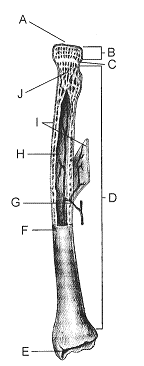 Refer to the accompanying figure. In which portion of the bone does red blood cell production occur?
 (Multiple Choice)
4.8/5 (82)
(82) Helena's doctor has advised her to take calcium supplements to help prevent:
(Multiple Choice)
4.8/5 (69)
(69) What is the correct order of events that occur during muscle contraction?
1) muscle shortens
2) calcium binds to troponin
3) filaments slide
4) T tubules are depolarized
5) acetylcholine is released
6) ATP molecule is split
(Multiple Choice)
4.8/5 (77)
(77) The Z line consists of parts of actin filaments on two adjacent sarcomeres.
____________________
(True/False)
4.9/5 (87)
(87) Figure 40-3 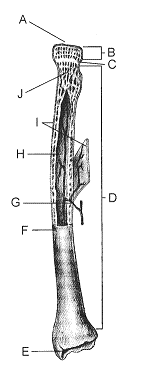 The portion of the bone labeled I in the accompanying figure is called the:
 (Multiple Choice)
4.9/5 (77)
(77) The collagen fibers in bone are secreted by osteoblasts .
____________________
(True/False)
4.9/5 (84)
(84) Figure 40-3 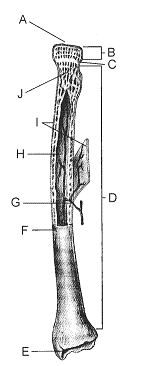 In the accompanying figure, the function of the structure labeled C, particularly in small children, is to:
 (Multiple Choice)
4.9/5 (80)
(80) Endoskeletons are shed in the process of ecdysis.
____________________
(True/False)
4.9/5 (77)
(77) Match each term with its description. Use each term only once.
Correct Answer:Verified
VerifiedPremises:
Responses:
(Matching)
5.0/5 (87)
(87) The axial skeleton of vertebrates consists of the bones of the limbs, the pectoral girdle, and most of the pelvic girdle.
____________________
(True/False)
4.9/5 (84)
(84) What is a major difference between the endoskeleton and the exoskeleton?
(Multiple Choice)
5.0/5 (80)
(80) People who undergo radiation therapy sometimes develop anemia resulting from a decreased production of red blood cells. This is because radiation affects:
(Multiple Choice)
4.8/5 (79)
(79) Which process is an example of a function carried out by the skeletal system?
(Multiple Choice)
4.8/5 (88)
(88) Compare and contrast the function of the external epithelium and its derivatives in invertebrates and vertebrates.
(Essay)
4.7/5 (88)
(88) 
Filters
- Essay(0)
- Multiple Choice(0)
- Short Answer(0)
- True False(0)
- Matching(0)