



 Chat with AI
Exam 24: Viruses and Subviral Agents

Exam 1: A View of Life66 Questions
Exam 2: Atoms and Molecules the Chemical Basis of Life69 Questions
Exam 3: The Chemistry of Life Organic Compounds68 Questions
Exam 4: Organization of the Cell71 Questions
Exam 5: Biological Membranes69 Questions
Exam 6: Cell Communication69 Questions
Exam 7: Energy and Metabolism73 Questions
Exam 8: How Cells Make Atp Energy-Releasing Pathways66 Questions
Exam 9: Photosynthesis Capturing Light Energy72 Questions
Exam 10: Chromosomes, Mitosis, and Meiosis66 Questions
Exam 11: The Basic Principles of Heredity78 Questions
Exam 12: Dna the Carrier of Genetic Information68 Questions
Exam 13: Gene Expression82 Questions
Exam 14: Gene Regulation77 Questions
Exam 15: Dna Technology and Genomics81 Questions
Exam 16: Human Genetics and the Human Genome75 Questions
Exam 17: Developmental Genetics83 Questions
Exam 18: Introduction to Darwinian Evolution66 Questions
Exam 19: Evolutionary Change in Populations72 Questions
Exam 20: Speciation and Macroevolution139 Questions
Exam 21: The Origin and Evolutionary History of Life67 Questions
Exam 22: The Evolution of Primates70 Questions
Exam 23: Understanding Diversity Systematics66 Questions
Exam 24: Viruses and Subviral Agents51 Questions
Exam 25: Bacteria and Archaea59 Questions
Exam 26: Protists69 Questions
Exam 27: Seedless Plants70 Questions
Exam 28: Seed Plants69 Questions
Exam 29: The Fungi69 Questions
Exam 30: An Introduction to Animal Diversity66 Questions
Exam 31: Sponges, Cnidarians, Ctenophores, and Protostomes99 Questions
Exam 32: The Deuterostomes75 Questions
Exam 33: Plant Structure Growth and Development73 Questions
Exam 34: Leaf Structure and Function76 Questions
Exam 35: Stem Structure and Transport75 Questions
Exam 36: Roots and Mineral Nutrition84 Questions
Exam 37: Reproduction in Flowering Plants81 Questions
Exam 38: Plant Developmental Responses to External and Internal Signals84 Questions
Exam 39: Animal Structure and Function an Introduction84 Questions
Exam 40: Protection Support and Movement68 Questions
Exam 41: Neural Signaling66 Questions
Exam 42: Neural Regulation67 Questions
Exam 43: Sensory Systems78 Questions
Exam 44: Internal Transport90 Questions
Exam 45: The Immune System Internal Defense79 Questions
Exam 46: Gas Exchange93 Questions
Exam 47: Processing Food and Nutrition90 Questions
Exam 48: Osmoregulation and Disposal of Metabolic Wastes111 Questions
Exam 49: Endocrine Regulation69 Questions
Exam 50: Reproduction95 Questions
Exam 51: Animal Development88 Questions
Exam 52: Animal Behavior83 Questions
Exam 53: Introduction to Ecology Population Ecology90 Questions
Exam 54: Community Ecology73 Questions
Exam 55: Ecosystems and the Biosphere91 Questions
Exam 56: Ecology and the Geography of Life81 Questions
Exam 57: Biological Diversity and Conservation Biology68 Questions
Select questions type


Prions induce normal Prp on the surface of brain cells to misfold into a(n) insoluble form and cause brain damage.
____________________

Free
(True/False)
4.7/5  (74)
(74) Correct Answer: Verified
False
The bacterium that causes botulism disease is harmless until it:
Free
(Multiple Choice)
4.8/5 (72)
(72) Correct Answer:Verified
VerifiedD
What is the difference between a viral lytic cycle and a viral lysogenic cycle?
Free
(Essay)
4.8/5 (80)
(80) Correct Answer:Verified
VerifiedIn a lytic infection the virus destroys the host cell. The virus takes over the host cell's metabolism and forces the host cell to replicate viral particles. Lytic infections result in cell lysis and death.
In lysogenic infections, temperate viruses integrate into the host DNA. The integrated virus is called a provirus. When the bacterial DNA replicates, the provirus DNA replicates with the host cell genome. Temperate viruses revert to lytic cycles under stress conditions.
Which hypothesis asserts that viruses are remnants of cellular organisms and evolved from small cells that were parasites in larger cells?
(Multiple Choice)
4.9/5 (65)
(65) Dr. Stanley Prusiner concluded that the infective agent of CJD was not a(n) virus because it was not sensitive to radiation which mutates nucleic acids.
____________________
(True/False)
4.9/5 (90)
(90) Why can measles virus and poxvirus infect many human tissues and influenza virus can infect only one type of tissue?
(Essay)
4.7/5 (60)
(60) The genome of most plant viruses consists of what kind of RNA?
(Multiple Choice)
4.8/5 (75)
(75) A virus consists of a DNA or RNA core surrounded by a(n) envelope .
____________________
(True/False)
4.7/5 (82)
(82) Bacteriophages attach to the cell walls of bacteria by envelope proteins. ____________________
(True/False)
5.0/5 (84)
(84) Which has an unusual characteristic in that their circular DNA does not have genes for making the proteins needed to replicate and produce new viruses?
(Multiple Choice)
4.9/5 (89)
(89) Figure 24-1d 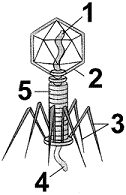 Refer to the accompanying figure. What is the function of the structure labeled as 3?
 (Multiple Choice)
4.7/5 (85)
(85) Compare and contrast the three hypotheses which explain the evolution of viruses
(Essay)
4.8/5 (79)
(79) The five stages of a lytic infection are attachment, penetration, __________, assembly, and release.
(Multiple Choice)
4.8/5 (75)
(75) At what stage of the lysogenic cycle would a prophage appear?
(Multiple Choice)
4.9/5 (81)
(81) At what stage of a lytic infection are phage components put together to make new viruses?
(Multiple Choice)
4.7/5 (83)
(83) 
Filters
- Essay(0)
- Multiple Choice(0)
- Short Answer(0)
- True False(0)
- Matching(0)