



 Chat with AI
Exam 16: Human Genetics and the Human Genome

Exam 1: A View of Life66 Questions
Exam 2: Atoms and Molecules the Chemical Basis of Life69 Questions
Exam 3: The Chemistry of Life Organic Compounds68 Questions
Exam 4: Organization of the Cell71 Questions
Exam 5: Biological Membranes69 Questions
Exam 6: Cell Communication69 Questions
Exam 7: Energy and Metabolism73 Questions
Exam 8: How Cells Make Atp Energy-Releasing Pathways66 Questions
Exam 9: Photosynthesis Capturing Light Energy72 Questions
Exam 10: Chromosomes, Mitosis, and Meiosis66 Questions
Exam 11: The Basic Principles of Heredity78 Questions
Exam 12: Dna the Carrier of Genetic Information68 Questions
Exam 13: Gene Expression82 Questions
Exam 14: Gene Regulation77 Questions
Exam 15: Dna Technology and Genomics81 Questions
Exam 16: Human Genetics and the Human Genome75 Questions
Exam 17: Developmental Genetics83 Questions
Exam 18: Introduction to Darwinian Evolution66 Questions
Exam 19: Evolutionary Change in Populations72 Questions
Exam 20: Speciation and Macroevolution139 Questions
Exam 21: The Origin and Evolutionary History of Life67 Questions
Exam 22: The Evolution of Primates70 Questions
Exam 23: Understanding Diversity Systematics66 Questions
Exam 24: Viruses and Subviral Agents51 Questions
Exam 25: Bacteria and Archaea59 Questions
Exam 26: Protists69 Questions
Exam 27: Seedless Plants70 Questions
Exam 28: Seed Plants69 Questions
Exam 29: The Fungi69 Questions
Exam 30: An Introduction to Animal Diversity66 Questions
Exam 31: Sponges, Cnidarians, Ctenophores, and Protostomes99 Questions
Exam 32: The Deuterostomes75 Questions
Exam 33: Plant Structure Growth and Development73 Questions
Exam 34: Leaf Structure and Function76 Questions
Exam 35: Stem Structure and Transport75 Questions
Exam 36: Roots and Mineral Nutrition84 Questions
Exam 37: Reproduction in Flowering Plants81 Questions
Exam 38: Plant Developmental Responses to External and Internal Signals84 Questions
Exam 39: Animal Structure and Function an Introduction84 Questions
Exam 40: Protection Support and Movement68 Questions
Exam 41: Neural Signaling66 Questions
Exam 42: Neural Regulation67 Questions
Exam 43: Sensory Systems78 Questions
Exam 44: Internal Transport90 Questions
Exam 45: The Immune System Internal Defense79 Questions
Exam 46: Gas Exchange93 Questions
Exam 47: Processing Food and Nutrition90 Questions
Exam 48: Osmoregulation and Disposal of Metabolic Wastes111 Questions
Exam 49: Endocrine Regulation69 Questions
Exam 50: Reproduction95 Questions
Exam 51: Animal Development88 Questions
Exam 52: Animal Behavior83 Questions
Exam 53: Introduction to Ecology Population Ecology90 Questions
Exam 54: Community Ecology73 Questions
Exam 55: Ecosystems and the Biosphere91 Questions
Exam 56: Ecology and the Geography of Life81 Questions
Exam 57: Biological Diversity and Conservation Biology68 Questions
Select questions type


Persons having an XO karyotype are sterile females. They have ____ syndrome.

Free
(Multiple Choice)
4.9/5  (79)
(79) Correct Answer: Verified
A
Compare and contrast the following three terms: polyploidy, aneuploidy, and nondisjunction. Identify and briefly discuss examples of each of these conditions.
Free
(Essay)
4.9/5 (85)
(85) Correct Answer:Verified
VerifiedPolyploidy is the condition in which an individual has multiple chromosome sets and is rare in animals, although common in plants (and linked with speciation events. Aneuploidy is a genetic abnormality involving the presence or absence of one chromosome. This is likely the result of nondisjunction and includes Trisomy 21 (Down syndrome and Turner syndrome (a monosomy. Nondisjunction is the condition in which homologous chromosomes fail to separate during anaphase I of meiosis and is linked to the conditions mentioned in the previous sentence.
Down syndrome is an example of a ____ condition.
Free
(Multiple Choice)
4.9/5 (83)
(83) Correct Answer:Verified
VerifiedC
Geneticists study pedigrees in order to predict how traits determined by phenotype are inherited from one generation to the next.
_________________
(True/False)
4.9/5 (69)
(69) Figure 16-2 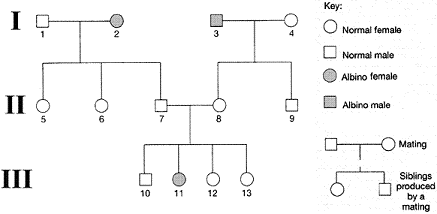 The genotypes of the normal females in the second generation in accompanying figure are:
 (Multiple Choice)
4.9/5 (90)
(90) What explains the viability of individuals with aneuploidies for the sex chromosomes?
(Multiple Choice)
4.9/5 (91)
(91) Which of the following must be true for a female to have hemophilia?
(Multiple Choice)
4.9/5 (89)
(89) Figure 16-2 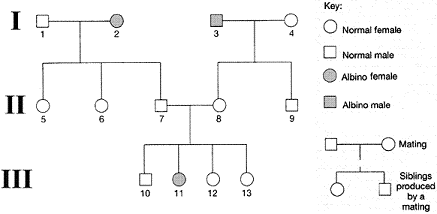 Refer to the accompanying figure. Based on the phenotypes of the third generation, the genotype of the father in the second generation must be:
 (Multiple Choice)
4.9/5 (71)
(71) FISH distinguishes chromosomes by using more than one fluorescent-tagged RNA strand, which will bind to complementary DNA sequences on a specific chromosome.
_________________
(True/False)
4.7/5 (79)
(79) In trisomy 21, while all genetic information is intact, a(n) abnormal copy of this chromosome creates a genetic imbalance which causes abnormal physical and mental development.
_________________
(True/False)
4.9/5 (79)
(79) Make a sketch showing how nondisjunction in meiosis can result in Down syndrome.
(Essay)
4.8/5 (72)
(72) What is the role of heterozygote advantage in maintaining high frequencies of mutant alleles in populations?
(Essay)
4.8/5 (96)
(96) Polyploidy may arise from the failure of chromosomes to separate during cell division or by the fertilization of an egg by more than one sperm.
_________________
(True/False)
4.9/5 (83)
(83) According to data from the ENCODE project, approximately 80% of the human genome is associated with biological function.
(True/False)
4.8/5 (83)
(83) An individual who inherits the specific chromosome ____ deletion from his/her ____ will most likely have Prader-Willi syndrome rather than Angelman syndrome.
(Multiple Choice)
4.8/5 (79)
(79) Sickle cell anemia and cystic fibrosis are examples of a(n) homozygote advantage.
_________________
(True/False)
4.9/5 (83)
(83) The normal human karyotype contains ____ total chromosomes, consisting of ____ autosomes and ____ sex chromosomes.
(Multiple Choice)
4.7/5 (99)
(99) Identify human genetic defects or diseases that are inherited as:
A. an autosomal recessive.
B. an autosomal dominant.
C. an X-linked recessive.
(Essay)
4.8/5 (80)
(80) 
Filters
- Essay(0)
- Multiple Choice(0)
- Short Answer(0)
- True False(0)
- Matching(0)