



 Chat with AI
Exam 56: Ecology and the Geography of Life

Exam 1: A View of Life66 Questions
Exam 2: Atoms and Molecules the Chemical Basis of Life69 Questions
Exam 3: The Chemistry of Life Organic Compounds68 Questions
Exam 4: Organization of the Cell71 Questions
Exam 5: Biological Membranes69 Questions
Exam 6: Cell Communication69 Questions
Exam 7: Energy and Metabolism73 Questions
Exam 8: How Cells Make Atp Energy-Releasing Pathways66 Questions
Exam 9: Photosynthesis Capturing Light Energy72 Questions
Exam 10: Chromosomes, Mitosis, and Meiosis66 Questions
Exam 11: The Basic Principles of Heredity78 Questions
Exam 12: Dna the Carrier of Genetic Information68 Questions
Exam 13: Gene Expression82 Questions
Exam 14: Gene Regulation77 Questions
Exam 15: Dna Technology and Genomics81 Questions
Exam 16: Human Genetics and the Human Genome75 Questions
Exam 17: Developmental Genetics83 Questions
Exam 18: Introduction to Darwinian Evolution66 Questions
Exam 19: Evolutionary Change in Populations72 Questions
Exam 20: Speciation and Macroevolution139 Questions
Exam 21: The Origin and Evolutionary History of Life67 Questions
Exam 22: The Evolution of Primates70 Questions
Exam 23: Understanding Diversity Systematics66 Questions
Exam 24: Viruses and Subviral Agents51 Questions
Exam 25: Bacteria and Archaea59 Questions
Exam 26: Protists69 Questions
Exam 27: Seedless Plants70 Questions
Exam 28: Seed Plants69 Questions
Exam 29: The Fungi69 Questions
Exam 30: An Introduction to Animal Diversity66 Questions
Exam 31: Sponges, Cnidarians, Ctenophores, and Protostomes99 Questions
Exam 32: The Deuterostomes75 Questions
Exam 33: Plant Structure Growth and Development73 Questions
Exam 34: Leaf Structure and Function76 Questions
Exam 35: Stem Structure and Transport75 Questions
Exam 36: Roots and Mineral Nutrition84 Questions
Exam 37: Reproduction in Flowering Plants81 Questions
Exam 38: Plant Developmental Responses to External and Internal Signals84 Questions
Exam 39: Animal Structure and Function an Introduction84 Questions
Exam 40: Protection Support and Movement68 Questions
Exam 41: Neural Signaling66 Questions
Exam 42: Neural Regulation67 Questions
Exam 43: Sensory Systems78 Questions
Exam 44: Internal Transport90 Questions
Exam 45: The Immune System Internal Defense79 Questions
Exam 46: Gas Exchange93 Questions
Exam 47: Processing Food and Nutrition90 Questions
Exam 48: Osmoregulation and Disposal of Metabolic Wastes111 Questions
Exam 49: Endocrine Regulation69 Questions
Exam 50: Reproduction95 Questions
Exam 51: Animal Development88 Questions
Exam 52: Animal Behavior83 Questions
Exam 53: Introduction to Ecology Population Ecology90 Questions
Exam 54: Community Ecology73 Questions
Exam 55: Ecosystems and the Biosphere91 Questions
Exam 56: Ecology and the Geography of Life81 Questions
Exam 57: Biological Diversity and Conservation Biology68 Questions
Select questions type


Describe and diagram the various zones and provinces in the ocean. What adaptations to these variable conditions are seen in the biota that inhabit these regions?

Free
(Essay)
4.8/5  (81)
(81) Correct Answer: Verified
Concepts to Consider: Neritic province overlies the continental shelves and is a highly productive zone; the photic region of the neritic province is particularly productive and rich in species; oceanic province is the open ocean area portion of the ocean and most is aphotic; neritic organisms depend on marine snow as a base for the food chain; the benthic environment includes sandy areas as well as the productive kelp forests and coral reefs; the intertidal zone is between the high and low tide levels; intertidal organisms are characterized by adaptations to variations in wave action and to possible desiccation.
The greatest proportion of which two biomes have been converted to agriculture?
Free
(Multiple Choice)
4.9/5 (78)
(78) Correct Answer:Verified
VerifiedC
Which biome is characterized by weasels, gray wolves, ptarmigan, musk oxen, and lemmings?
Free
(Multiple Choice)
5.0/5 (81)
(81) Correct Answer:Verified
VerifiedA
Figure 56-2 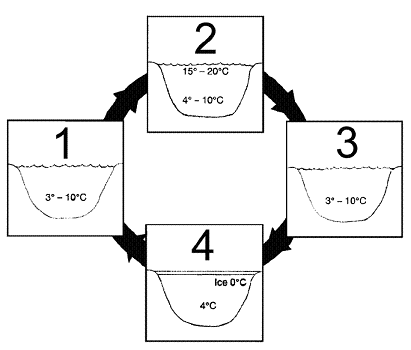 Which of the lakes in the accompanying figure may experience turnover?
 (Multiple Choice)
4.8/5 (82)
(82) A(n) ____ is the transition zone where two ecosystems meet and intergrade.
(Multiple Choice)
4.9/5 (82)
(82) The hadal zone is that part of the benthic environment deeper than 6000 m.
(True/False)
4.8/5 (80)
(80) Which of the following is most characteristic of desert animals?
(Multiple Choice)
5.0/5 (95)
(95) Which biome has the greatest number of distinct layers of vegetation?
(Multiple Choice)
4.9/5 (69)
(69) The ____ biome has the greatest species richness of the terrestrial biomes.
(Multiple Choice)
4.9/5 (85)
(85) In tropical and temperate regions, ____ becomes more significant than temperature.
(Multiple Choice)
4.8/5 (94)
(94) Describe the human impact on at least two aquatic ecosystems discussed. How have these alterations impacted these ecosystems?
(Essay)
4.8/5 (82)
(82) Adaptations found in inhabitants of the rocky intertidal zone include:
(Multiple Choice)
4.9/5 (85)
(85) Tundra soils are usually ____ and have ____ in the uppermost layer of soil.
(Multiple Choice)
4.7/5 (84)
(84) The ____ biome is found in states such as Iowa, Minnesota, Nebraska, and other Midwestern states, and is characterized by thick, rich soils, and a thick mat of sod.
(Multiple Choice)
4.9/5 (71)
(71) 
Filters
- Essay(0)
- Multiple Choice(0)
- Short Answer(0)
- True False(0)
- Matching(0)