



 Chat with AI
Exam 19: Evolutionary Change in Populations

Exam 1: A View of Life66 Questions
Exam 2: Atoms and Molecules the Chemical Basis of Life69 Questions
Exam 3: The Chemistry of Life Organic Compounds68 Questions
Exam 4: Organization of the Cell71 Questions
Exam 5: Biological Membranes69 Questions
Exam 6: Cell Communication69 Questions
Exam 7: Energy and Metabolism73 Questions
Exam 8: How Cells Make Atp Energy-Releasing Pathways66 Questions
Exam 9: Photosynthesis Capturing Light Energy72 Questions
Exam 10: Chromosomes, Mitosis, and Meiosis66 Questions
Exam 11: The Basic Principles of Heredity78 Questions
Exam 12: Dna the Carrier of Genetic Information68 Questions
Exam 13: Gene Expression82 Questions
Exam 14: Gene Regulation77 Questions
Exam 15: Dna Technology and Genomics81 Questions
Exam 16: Human Genetics and the Human Genome75 Questions
Exam 17: Developmental Genetics83 Questions
Exam 18: Introduction to Darwinian Evolution66 Questions
Exam 19: Evolutionary Change in Populations72 Questions
Exam 20: Speciation and Macroevolution139 Questions
Exam 21: The Origin and Evolutionary History of Life67 Questions
Exam 22: The Evolution of Primates70 Questions
Exam 23: Understanding Diversity Systematics66 Questions
Exam 24: Viruses and Subviral Agents51 Questions
Exam 25: Bacteria and Archaea59 Questions
Exam 26: Protists69 Questions
Exam 27: Seedless Plants70 Questions
Exam 28: Seed Plants69 Questions
Exam 29: The Fungi69 Questions
Exam 30: An Introduction to Animal Diversity66 Questions
Exam 31: Sponges, Cnidarians, Ctenophores, and Protostomes99 Questions
Exam 32: The Deuterostomes75 Questions
Exam 33: Plant Structure Growth and Development73 Questions
Exam 34: Leaf Structure and Function76 Questions
Exam 35: Stem Structure and Transport75 Questions
Exam 36: Roots and Mineral Nutrition84 Questions
Exam 37: Reproduction in Flowering Plants81 Questions
Exam 38: Plant Developmental Responses to External and Internal Signals84 Questions
Exam 39: Animal Structure and Function an Introduction84 Questions
Exam 40: Protection Support and Movement68 Questions
Exam 41: Neural Signaling66 Questions
Exam 42: Neural Regulation67 Questions
Exam 43: Sensory Systems78 Questions
Exam 44: Internal Transport90 Questions
Exam 45: The Immune System Internal Defense79 Questions
Exam 46: Gas Exchange93 Questions
Exam 47: Processing Food and Nutrition90 Questions
Exam 48: Osmoregulation and Disposal of Metabolic Wastes111 Questions
Exam 49: Endocrine Regulation69 Questions
Exam 50: Reproduction95 Questions
Exam 51: Animal Development88 Questions
Exam 52: Animal Behavior83 Questions
Exam 53: Introduction to Ecology Population Ecology90 Questions
Exam 54: Community Ecology73 Questions
Exam 55: Ecosystems and the Biosphere91 Questions
Exam 56: Ecology and the Geography of Life81 Questions
Exam 57: Biological Diversity and Conservation Biology68 Questions
Select questions type


When a population goes through a bottleneck, genetic drift occurs in the large population of survivors of a severe change in environment.
___________
(True/False)
5.0/5  (69)
(69) Frequency-dependent selection acts to decrease the frequency of which phenotype in a population?
(Multiple Choice)
4.9/5 (70)
(70) A population of people who have lived in the middle of the jungle for thousands of years without coming in contact with other individuals would show evidence of:
(Multiple Choice)
4.9/5 (83)
(83) The movement of 25-year-old fertile individuals between Mexico and Canada will eventually contribute to:
(Multiple Choice)
4.9/5 (85)
(85) The allele for sickle cell anemia is maintained in populations by frequency dependent selection .
_______________
(True/False)
4.9/5 (80)
(80) What best describes all of the alleles for all the loci present in a population?
(Multiple Choice)
4.9/5 (80)
(80) The Hardy-Weinberg principle is applicable provided that migration:
(Multiple Choice)
4.8/5 (73)
(73) If individuals in the same town continue to only mate with other individuals from the same town, one would expect to see an increase in ____ within the population.
(Multiple Choice)
4.8/5 (79)
(79) Variation that does not alter the ability of an individual to survive and reproduce is therefore considered:
(Multiple Choice)
4.8/5 (84)
(84) If a population of 1000 individuals has 120 aa genotypes, 460 Aa genotypes, and 420 AA genotypes, what is the allele frequency of the dominant allele (A)?
(Multiple Choice)
4.9/5 (81)
(81) If an animal population is diploid, then each individual possesses:
(Multiple Choice)
4.9/5 (80)
(80) Bacterial populations have been exposed to an antibiotic and have developed resistance to the antibiotic over time. Would this be an example of stabilizing selection, directional selection, or disruptive selection? Explain your reasoning.
(Essay)
4.8/5 (80)
(80) A ____ consists of all of the individuals of the same species that inhabit a particular place at the same time.
(Multiple Choice)
4.8/5 (83)
(83) What is heterozygote advantage? Provide one example of this and briefly explain.
(Essay)
4.9/5 (64)
(64) When phenotypes are favored at one extreme of a normal distribution, ____ selection occurs.
(Multiple Choice)
4.8/5 (91)
(91) Table 19-1 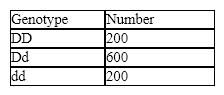 Refer to the accompanying table. What is the frequency of the Dd genotype?
 (Multiple Choice)
4.8/5 (77)
(77) Figure 19-1 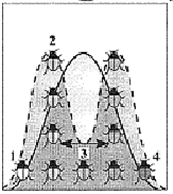 What type of selection is represented by the accompanying figure?
 (Multiple Choice)
4.7/5 (93)
(93) The observation by scientists that flies preferentially mate with those of similar phenotypes illustrates random mating.
(True/False)
4.8/5 (94)
(94) In nonrandom mating, each individual in a population has an equal chance of mating with any individual of the opposite sex.
_________
(True/False)
4.9/5 (76)
(76) Discuss how genetic variability is maintained through genetic polymorphism.
(Essay)
4.8/5 (78)
(78) 
Filters
- Essay(0)
- Multiple Choice(0)
- Short Answer(0)
- True False(0)
- Matching(0)