



 Chat with AI
Exam 13: The Costs of Production

Exam 1: Ten Principles of Economics455 Questions
Exam 2: Thinking Like an Economist643 Questions
Exam 3: Interdependence and the Gains From Trade547 Questions
Exam 4: The Market Forces of Supply and Demand693 Questions
Exam 5: Elasticity and Its Application626 Questions
Exam 6: Supply, Demand, and Government Policies668 Questions
Exam 7: Consumers, Producers, and the Efficiency of Markets547 Questions
Exam 8: Applications: the Costs of Taxation509 Questions
Exam 9: Application: International Trade521 Questions
Exam 10: Externalities543 Questions
Exam 11: Public Goods and Common Resources452 Questions
Exam 12: The Design of the Tax System664 Questions
Exam 13: The Costs of Production649 Questions
Exam 14: Firms in Competitive Markets604 Questions
Exam 15: Monopoly662 Questions
Exam 16: Monopolistic Competition649 Questions
Exam 17: Oligopoly522 Questions
Exam 18: The Markets for the Factors of Production592 Questions
Exam 19: Earnings and Discrimination511 Questions
Exam 20: Income Inequality and Poverty478 Questions
Exam 21: The Theory of Consumer Choice570 Questions
Exam 22: Frontiers in Microeconomics461 Questions
Exam 23: Measuring a Nation S Income547 Questions
Exam 24: Measuring the Cost of Living565 Questions
Exam 25: Production and Growth527 Questions
Exam 26: Saving, Investment, and the Financial System637 Questions
Exam 27: Tools of Finance534 Questions
Exam 28: Unemployment and Its Natural Rate701 Questions
Exam 29: The Monetary System540 Questions
Exam 30: Money Growth and Inflation504 Questions
Exam 31: Open-Economy Macroeconomics: Basic Concepts540 Questions
Exam 32: A Macroeconomic Theory of the Open Economy511 Questions
Exam 33: Aggregate Demand and Aggregate Supply572 Questions
Exam 34: The Influence of Monetary and Fiscal Policy on Aggregate Demand523 Questions
Exam 35: The Short-Run Tradeoff Between Inflation and Unemployment536 Questions
Exam 36: Six Debates Over Macroeconomic Policy354 Questions
Select questions type


At what level of output will average variable cost equal average total cost?
(Multiple Choice)
4.9/5  (91)
(91) When a firm is experiencing diseconomies of scale, long-run
(Multiple Choice)
4.8/5 (84)
(84) Economists assume that the typical person who starts her own business does so with the intention of
(Multiple Choice)
5.0/5 (86)
(86) Variable costs usually change as the firm alters the quantity of output produced.
(True/False)
4.7/5 (73)
(73) Table 13-14 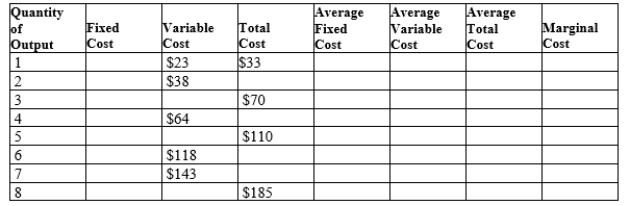 -Refer to Table 13-14. What is the marginal cost of the 2nd unit of output?
 (Multiple Choice)
4.9/5 (72)
(72) If marginal cost is below average total cost, then average total cost
(Multiple Choice)
4.9/5 (72)
(72) Cindy's Car Wash has average variable costs of $2 and average total costs of $3 when it produces 100 units of output (car washes). The firm's total variable cost is
(Multiple Choice)
4.8/5 (82)
(82) DIFFICULTY:
Figure 13-8 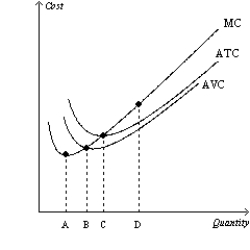 -Refer to Figure 13-8. The efficient scale of production occurs at which quantity?
 (Multiple Choice)
4.8/5 (79)
(79) Suppose that for a particular business there are no implicit costs. Then
(Multiple Choice)
4.9/5 (89)
(89) Suppose that a firm's long-run average total costs of producing televisions decreases as it produces between 10,000 and 20,000 televisions. For this range of output, the firm is experiencing
(Multiple Choice)
4.8/5 (73)
(73) Suppose that a worker can produce 100 units of output in 7 hours. In the 8th hour, he can produce 12 units of output. The worker can produce 112 units of output in 8 hours.
(True/False)
4.9/5 (71)
(71) When the marginal product of an input declines as the quantity of that input increases, the production function exhibits
(Multiple Choice)
5.0/5 (83)
(83) Figure 13-5  -Refer to Figure 13-5. Which curve is most likely to represent marginal cost?
 (Multiple Choice)
4.9/5 (76)
(76) According to the mathematical laws that govern the relationship between average total cost and marginal cost, where must these two curves intersect?
(Essay)
4.7/5 (89)
(89) Table 13-7
The Flying Elvis Copter Rides 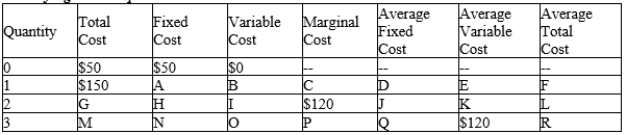 -Refer to Table 13-7. What is the value of H?
 (Multiple Choice)
4.8/5 (89)
(89) Table 13-14
-Refer to Table 13-14. What is the average total cost of producing 2 units of output?
-Refer to Table 13-14. What is the average total cost of producing 2 units of output? (Multiple Choice)
4.9/5 (91)
(91) Scenario 13-5
Suppose that Emily opens a restaurant. She receives a loan from a bank for $200,000. She withdraws $100,000 from her personal savings account. The interest rate on the loan is 6%, and the interest rate on her savings account is 2%.
-Refer to Scenario 13-5. Emily's total opportunity cost of capital is
(Multiple Choice)
4.8/5 (95)
(95) Figure 13-9
The figure below depicts average total cost functions for a firm that produces automobiles. 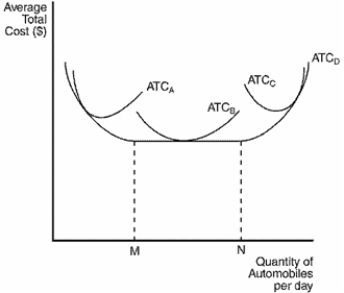 -Refer to Figure 13-9. At output levels greater than N, the firm experiences
 (Multiple Choice)
4.8/5 (83)
(83) Which of the following must always be true as the quantity of output increases?
(Multiple Choice)
4.8/5 (83)
(83) 
Filters
- Essay(0)
- Multiple Choice(0)
- Short Answer(0)
- True False(0)
- Matching(0)