



 Chat with AI
Exam 13: The Costs of Production

Exam 1: Ten Principles of Economics455 Questions
Exam 2: Thinking Like an Economist643 Questions
Exam 3: Interdependence and the Gains From Trade547 Questions
Exam 4: The Market Forces of Supply and Demand693 Questions
Exam 5: Elasticity and Its Application626 Questions
Exam 6: Supply, Demand, and Government Policies668 Questions
Exam 7: Consumers, Producers, and the Efficiency of Markets547 Questions
Exam 8: Applications: the Costs of Taxation509 Questions
Exam 9: Application: International Trade521 Questions
Exam 10: Externalities543 Questions
Exam 11: Public Goods and Common Resources452 Questions
Exam 12: The Design of the Tax System664 Questions
Exam 13: The Costs of Production649 Questions
Exam 14: Firms in Competitive Markets604 Questions
Exam 15: Monopoly662 Questions
Exam 16: Monopolistic Competition649 Questions
Exam 17: Oligopoly522 Questions
Exam 18: The Markets for the Factors of Production592 Questions
Exam 19: Earnings and Discrimination511 Questions
Exam 20: Income Inequality and Poverty478 Questions
Exam 21: The Theory of Consumer Choice570 Questions
Exam 22: Frontiers in Microeconomics461 Questions
Exam 23: Measuring a Nation S Income547 Questions
Exam 24: Measuring the Cost of Living565 Questions
Exam 25: Production and Growth527 Questions
Exam 26: Saving, Investment, and the Financial System637 Questions
Exam 27: Tools of Finance534 Questions
Exam 28: Unemployment and Its Natural Rate701 Questions
Exam 29: The Monetary System540 Questions
Exam 30: Money Growth and Inflation504 Questions
Exam 31: Open-Economy Macroeconomics: Basic Concepts540 Questions
Exam 32: A Macroeconomic Theory of the Open Economy511 Questions
Exam 33: Aggregate Demand and Aggregate Supply572 Questions
Exam 34: The Influence of Monetary and Fiscal Policy on Aggregate Demand523 Questions
Exam 35: The Short-Run Tradeoff Between Inflation and Unemployment536 Questions
Exam 36: Six Debates Over Macroeconomic Policy354 Questions
Select questions type


Consider a small family wheat farm. List some examples of explicit costs of farming.
(Essay)
4.8/5  (87)
(87) When average cost is greater than marginal cost, marginal cost must be
(Multiple Choice)
4.7/5 (86)
(86) Table 13-1 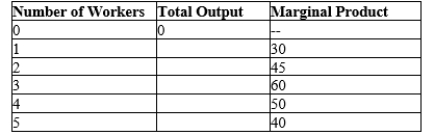 -Refer to Table 13-1. What is total output when 3 workers are hired?
 (Multiple Choice)
4.8/5 (82)
(82) Table 13-1
-Refer to Table 13-1. What is total output when 5 workers are hired?
-Refer to Table 13-1. What is total output when 5 workers are hired? (Multiple Choice)
4.7/5 (82)
(82) Figure 13-2 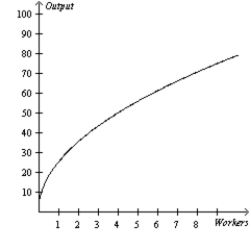 -Refer to Figure 13-2. If the figure represented production at a cookie factory, the factory would be experiencing
 (Multiple Choice)
4.8/5 (81)
(81) Because of the greater flexibility that firms have in the long run, all short-run cost curves lie on or above the long-run curve.
(True/False)
4.7/5 (76)
(76) Table 13-18 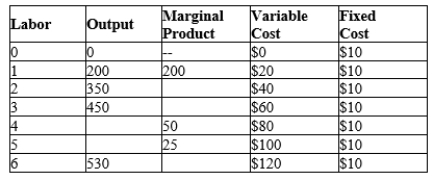 -Refer to Table 13-18. What is the shape of the average-fixed-cost curve?
 (Essay)
4.8/5 (88)
(88) In the long run a company that produces and sells popcorn incurs total costs of $1,050 when output is 90 canisters and $1,200 when output is 120 canisters. The popcorn company exhibits
(Multiple Choice)
4.7/5 (83)
(83) Assume Jack received all As in his classes last semester. If Jack gets all Bs in his classes this semester, his GPA may or may not fall.
(True/False)
4.8/5 (78)
(78) If the production function exhibits diminishing marginal product, the total cost function gets steeper as the quantity of output increases.
(True/False)
5.0/5 (80)
(80) Table 13-17
Consider the following table of long-run total cost for four different firms:  -Refer to Table 13-17. Which firm has economies of scale over the entire range of output?
 (Multiple Choice)
4.8/5 (82)
(82) Figure 13-9
The figure below depicts average total cost functions for a firm that produces automobiles. 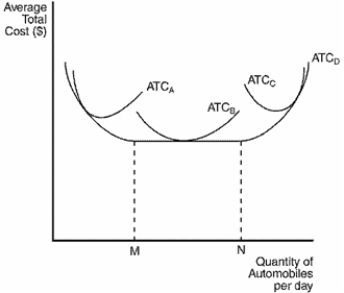 -Refer to Figure 13-9. The firm experiences constant returns to scale at which output levels?
 (Multiple Choice)
4.9/5 (74)
(74) Scenario 13-2
Chelsea wants to start her own Christmas ornament business. She can purchase a suitable factory that costs $100,000. Chelsea currently has $150,000 in the bank earning 3 percent interest per year.
-Refer to Scenario 13-2. Suppose Chelsea purchases the factory using her own money. What is Chelsea's annual implicit opportunity cost of purchasing the factory?
(Multiple Choice)
4.8/5 (74)
(74) The difference between accounting profit and economic profit is
(Multiple Choice)
5.0/5 (100)
(100) The cost of producing the typical unit of output is the firm's
(Multiple Choice)
4.9/5 (70)
(70) 
Filters
- Essay(0)
- Multiple Choice(0)
- Short Answer(0)
- True False(0)
- Matching(0)