



 Chat with AI
Exam 13: The Costs of Production

Exam 1: Ten Principles of Economics455 Questions
Exam 2: Thinking Like an Economist643 Questions
Exam 3: Interdependence and the Gains From Trade547 Questions
Exam 4: The Market Forces of Supply and Demand693 Questions
Exam 5: Elasticity and Its Application626 Questions
Exam 6: Supply, Demand, and Government Policies668 Questions
Exam 7: Consumers, Producers, and the Efficiency of Markets547 Questions
Exam 8: Applications: the Costs of Taxation509 Questions
Exam 9: Application: International Trade521 Questions
Exam 10: Externalities543 Questions
Exam 11: Public Goods and Common Resources452 Questions
Exam 12: The Design of the Tax System664 Questions
Exam 13: The Costs of Production649 Questions
Exam 14: Firms in Competitive Markets604 Questions
Exam 15: Monopoly662 Questions
Exam 16: Monopolistic Competition649 Questions
Exam 17: Oligopoly522 Questions
Exam 18: The Markets for the Factors of Production592 Questions
Exam 19: Earnings and Discrimination511 Questions
Exam 20: Income Inequality and Poverty478 Questions
Exam 21: The Theory of Consumer Choice570 Questions
Exam 22: Frontiers in Microeconomics461 Questions
Exam 23: Measuring a Nation S Income547 Questions
Exam 24: Measuring the Cost of Living565 Questions
Exam 25: Production and Growth527 Questions
Exam 26: Saving, Investment, and the Financial System637 Questions
Exam 27: Tools of Finance534 Questions
Exam 28: Unemployment and Its Natural Rate701 Questions
Exam 29: The Monetary System540 Questions
Exam 30: Money Growth and Inflation504 Questions
Exam 31: Open-Economy Macroeconomics: Basic Concepts540 Questions
Exam 32: A Macroeconomic Theory of the Open Economy511 Questions
Exam 33: Aggregate Demand and Aggregate Supply572 Questions
Exam 34: The Influence of Monetary and Fiscal Policy on Aggregate Demand523 Questions
Exam 35: The Short-Run Tradeoff Between Inflation and Unemployment536 Questions
Exam 36: Six Debates Over Macroeconomic Policy354 Questions
Select questions type


Table 13-18 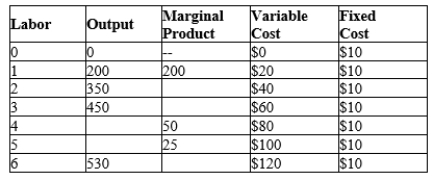 -Refer to Table 13-18. What is the total output of five workers?
 (Essay)
4.8/5  (70)
(70) Scenario 13-16
Barney builds custom wooden birdhouses. He can make 150 birdhouses per month and sell them for $50 each. His average total cost is $30 per birdhouse.
-Refer to Scenario 13-16. Barney is considering hiring his best friend Fred to work for him. Fred can build 125 birdhouses per month. If Barney hires Fred, what will be the monthly marginal product?
(Multiple Choice)
4.9/5 (81)
(81) Anna borrows $5,000 from a bank and withdraws $1,000 from her personal savings to start a coffee shop. The interest rate is 5 percent for both the bank loan and her personal savings. Her opportunity cost of capital is $250.
(True/False)
4.8/5 (73)
(73) What effect, if any, does diminishing marginal product have on the shape of the marginal cost curve?
(Essay)
4.8/5 (88)
(88) Figure 13-5  -Refer to Figure 13-5. Which of the curves is most likely to represent average fixed cost?
 (Multiple Choice)
4.8/5 (105)
(105) Table 13-19 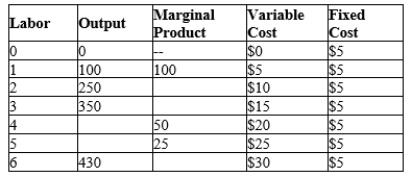 -Refer to Table 13-19. What is the shape of the average-fixed-cost curve?
 (Essay)
4.9/5 (73)
(73) A firm's total profit equals its marginal revenue minus its marginal cost.
(True/False)
4.9/5 (89)
(89) Describe how an accounting firm could experience economies of scale.
(Essay)
4.8/5 (89)
(89) An example of an explicit cost would be the wages that a business owner pays her employees.
(True/False)
4.8/5 (82)
(82) Let L represent the number of workers hired by a firm, and let Q represent that firm's quantity of output. Assume two points on the firm's production function are (L = 12, Q = 122) and (L = 13, Q = 130). Then the marginal product of the 13th worker is
(Multiple Choice)
4.8/5 (88)
(88) Table 13-2 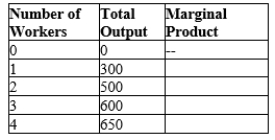 -Refer to Table 13-2. What is the marginal product of the second worker?
 (Multiple Choice)
4.9/5 (71)
(71) How would a production function that exhibits decreasing marginal product affect the shape of the total cost curve? Explain or draw a graph.
(Essay)
4.8/5 (86)
(86) The economic field of industrial organization examines how firms' decisions about prices and quantities depend on the market conditions they face.
(True/False)
4.9/5 (89)
(89) Scenario 13-9
Ellie has been working for an engineering firm and earning an annual salary of $80,000. She decides to open her own engineering business. Her annual expenses will include $15,000 for office rent, $3,000 for equipment rental, $1,000 for supplies, $1,200 for utilities, and a $35,000 salary for a secretary/bookkeeper. Ellie will cover her start-up expenses by cashing in a $20,000 certificate of deposit on which she was earning annual interest of $500.
-Refer to Scenario 13-9. According to Ellie's accountant, which of the following revenue totals will yield her business $50,000 in profits?
(Multiple Choice)
4.8/5 (62)
(62) Figure 13-10 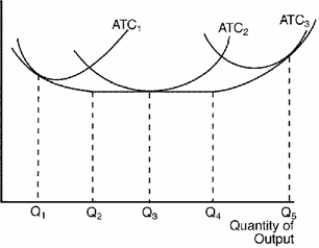 -Refer to Figure 13-10. The firm experiences economies of scale if it changes its level of output from
 (Multiple Choice)
4.8/5 (85)
(85) An entrepreneur's motivation to start a business arises from
(Multiple Choice)
4.9/5 (75)
(75) Pete owns a shoe-shine business. His accountant most likely includes which of the following costs on his financial statements?
(i)shoe polish
(ii)rent on the shoe stand
(iii)wages Pete could earn delivering newspapers
(iv)interest that Pete's money was earning before he spent his savings to set up the shoe-shine business
(Multiple Choice)
4.9/5 (74)
(74) Scenario 13-11
Walter builds birdhouses. He spends $5 on the materials for each birdhouse. He can build one in 30 minutes. He is semi-retired but earns $8 per hour at the local hardware store. He can sell a birdhouse for $20 each.
-Refer to Scenario 13-11. The explicit cost for one birdhouse is
(Multiple Choice)
4.9/5 (87)
(87) The amount of money that a wheat farmer could have earned if he had planted barley instead of wheat is
(Multiple Choice)
4.9/5 (79)
(79) 
Filters
- Essay(0)
- Multiple Choice(0)
- Short Answer(0)
- True False(0)
- Matching(0)