



 Chat with AI
Exam 13: The Costs of Production

Exam 1: Ten Principles of Economics455 Questions
Exam 2: Thinking Like an Economist643 Questions
Exam 3: Interdependence and the Gains From Trade547 Questions
Exam 4: The Market Forces of Supply and Demand693 Questions
Exam 5: Elasticity and Its Application626 Questions
Exam 6: Supply, Demand, and Government Policies668 Questions
Exam 7: Consumers, Producers, and the Efficiency of Markets547 Questions
Exam 8: Applications: the Costs of Taxation509 Questions
Exam 9: Application: International Trade521 Questions
Exam 10: Externalities543 Questions
Exam 11: Public Goods and Common Resources452 Questions
Exam 12: The Design of the Tax System664 Questions
Exam 13: The Costs of Production649 Questions
Exam 14: Firms in Competitive Markets604 Questions
Exam 15: Monopoly662 Questions
Exam 16: Monopolistic Competition649 Questions
Exam 17: Oligopoly522 Questions
Exam 18: The Markets for the Factors of Production592 Questions
Exam 19: Earnings and Discrimination511 Questions
Exam 20: Income Inequality and Poverty478 Questions
Exam 21: The Theory of Consumer Choice570 Questions
Exam 22: Frontiers in Microeconomics461 Questions
Exam 23: Measuring a Nation S Income547 Questions
Exam 24: Measuring the Cost of Living565 Questions
Exam 25: Production and Growth527 Questions
Exam 26: Saving, Investment, and the Financial System637 Questions
Exam 27: Tools of Finance534 Questions
Exam 28: Unemployment and Its Natural Rate701 Questions
Exam 29: The Monetary System540 Questions
Exam 30: Money Growth and Inflation504 Questions
Exam 31: Open-Economy Macroeconomics: Basic Concepts540 Questions
Exam 32: A Macroeconomic Theory of the Open Economy511 Questions
Exam 33: Aggregate Demand and Aggregate Supply572 Questions
Exam 34: The Influence of Monetary and Fiscal Policy on Aggregate Demand523 Questions
Exam 35: The Short-Run Tradeoff Between Inflation and Unemployment536 Questions
Exam 36: Six Debates Over Macroeconomic Policy354 Questions
Select questions type


When average total cost is above marginal cost, average total cost is rising.
(True/False)
4.8/5  (72)
(72) Scenario 13-11
Walter builds birdhouses. He spends $5 on the materials for each birdhouse. He can build one in 30 minutes. He is semi-retired but earns $8 per hour at the local hardware store. He can sell a birdhouse for $20 each.
-Refer to Scenario 13-11. An economist would calculate the total profit for one birdhouse to be
(Multiple Choice)
4.7/5 (80)
(80) A firm produces 400 units of output at a total cost of $1,200. If total variable costs are $1,000,
(Multiple Choice)
4.7/5 (66)
(66) 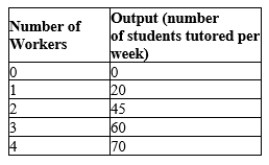 -Refer to Table 13-4. What is the marginal product of the third worker?
 (Multiple Choice)
4.8/5 (75)
(75) Table 13-7
The Flying Elvis Copter Rides 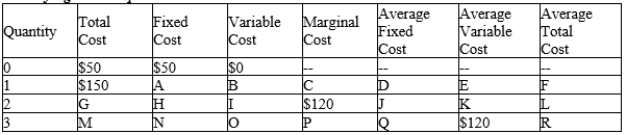 -Refer to Table 13-7. What is the value of J?
 (Multiple Choice)
4.9/5 (73)
(73) Table 13-20
Listed in the table are the long-run total costs for three different firms.  -Refer to Table 13-20. Firm A is experiencing economies of scale.
 (True/False)
4.9/5 (78)
(78) A key difference between accountants and economists is their different treatment of the cost of capital. Does this cause an accountant's estimate of total costs to be higher or lower than an economist's estimate? Explain.
(Essay)
4.9/5 (70)
(70) Table 13-17
Consider the following table of long-run total cost for four different firms:  -Refer to Table 13-17. Firm 4's efficient scale occurs at what quantity?
 (Multiple Choice)
4.8/5 (92)
(92) Scenario 13-9
Ellie has been working for an engineering firm and earning an annual salary of $80,000. She decides to open her own engineering business. Her annual expenses will include $15,000 for office rent, $3,000 for equipment rental, $1,000 for supplies, $1,200 for utilities, and a $35,000 salary for a secretary/bookkeeper. Ellie will cover her start-up expenses by cashing in a $20,000 certificate of deposit on which she was earning annual interest of $500.
-Refer to Scenario 13-9. Ellie's annual implicit costs will equal
(Multiple Choice)
4.9/5 (79)
(79) Scenario 13-14
If Farmer Brown plants no seeds on his farm, he gets no harvest. If he plants 1 bag of seeds, he gets 5 bushels of wheat. If he plants 2 bags, he gets 9 bushels. If he plants 3 bags, he gets 12 bushels. A bag of seeds costs $120, and seeds are his only cost.
-Refer to Scenario 13-14. Farmer Brown's total-cost curve is
(Multiple Choice)
4.9/5 (76)
(76) The average-total-cost curve reflects the shape of both the average-fixed-cost and average-variable-cost curves.
(True/False)
4.9/5 (79)
(79) Scenario 13-16
Barney builds custom wooden birdhouses. He can make 150 birdhouses per month and sell them for $50 each. His average total cost is $30 per birdhouse.
-Refer to Scenario 13-16. Barney's monthly total revenue is
(Multiple Choice)
4.9/5 (63)
(63) Table 13-5 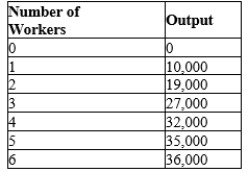 -Refer to Table 13-5. Assume that fixed costs are $500, and variable costs are $100 per worker. For this firm, what are the shapes of the production function and the total-cost curve?
 (Multiple Choice)
4.9/5 (75)
(75) Suppose Jan started up a small lemonade stand business last month. Variable costs for Jan's lemonade stand now include the cost of
(Multiple Choice)
4.8/5 (72)
(72) Figure 13-2 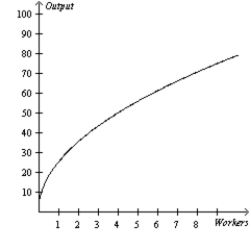 -Refer to Figure 13-2. As the number of workers increases,
 (Multiple Choice)
4.8/5 (85)
(85) 
Filters
- Essay(0)
- Multiple Choice(0)
- Short Answer(0)
- True False(0)
- Matching(0)