



 Chat with AI
Exam 13: The Costs of Production

Exam 1: Ten Principles of Economics455 Questions
Exam 2: Thinking Like an Economist643 Questions
Exam 3: Interdependence and the Gains From Trade547 Questions
Exam 4: The Market Forces of Supply and Demand693 Questions
Exam 5: Elasticity and Its Application626 Questions
Exam 6: Supply, Demand, and Government Policies668 Questions
Exam 7: Consumers, Producers, and the Efficiency of Markets547 Questions
Exam 8: Applications: the Costs of Taxation509 Questions
Exam 9: Application: International Trade521 Questions
Exam 10: Externalities543 Questions
Exam 11: Public Goods and Common Resources452 Questions
Exam 12: The Design of the Tax System664 Questions
Exam 13: The Costs of Production649 Questions
Exam 14: Firms in Competitive Markets604 Questions
Exam 15: Monopoly662 Questions
Exam 16: Monopolistic Competition649 Questions
Exam 17: Oligopoly522 Questions
Exam 18: The Markets for the Factors of Production592 Questions
Exam 19: Earnings and Discrimination511 Questions
Exam 20: Income Inequality and Poverty478 Questions
Exam 21: The Theory of Consumer Choice570 Questions
Exam 22: Frontiers in Microeconomics461 Questions
Exam 23: Measuring a Nation S Income547 Questions
Exam 24: Measuring the Cost of Living565 Questions
Exam 25: Production and Growth527 Questions
Exam 26: Saving, Investment, and the Financial System637 Questions
Exam 27: Tools of Finance534 Questions
Exam 28: Unemployment and Its Natural Rate701 Questions
Exam 29: The Monetary System540 Questions
Exam 30: Money Growth and Inflation504 Questions
Exam 31: Open-Economy Macroeconomics: Basic Concepts540 Questions
Exam 32: A Macroeconomic Theory of the Open Economy511 Questions
Exam 33: Aggregate Demand and Aggregate Supply572 Questions
Exam 34: The Influence of Monetary and Fiscal Policy on Aggregate Demand523 Questions
Exam 35: The Short-Run Tradeoff Between Inflation and Unemployment536 Questions
Exam 36: Six Debates Over Macroeconomic Policy354 Questions
Select questions type


Bubba is a shrimp fisherman who catches 4,000 pounds of shrimp per year. He can sell the shrimp for $5 per pound. His average total cost of catching shrimp is $3 per pound. Bubba's annual total revenue is
(Multiple Choice)
4.8/5  (79)
(79) Table 13-11 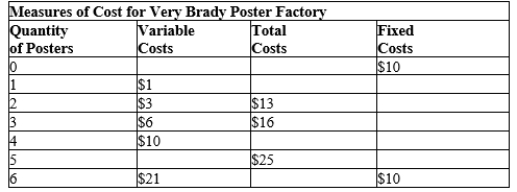 -Refer to Table 13-11. The average variable cost of producing 4 posters is
 (Multiple Choice)
4.9/5 (85)
(85) Cindy's Car Wash has average variable costs of $2 and average fixed costs of $3 when it produces 100 units of output (car washes). The firm's total cost is
(Multiple Choice)
4.9/5 (78)
(78) Table 13-9 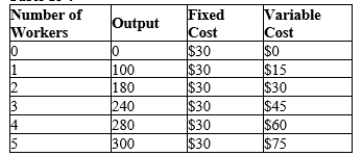 -Refer to Table 13-9. What is the marginal product of the third worker?
 (Multiple Choice)
4.8/5 (76)
(76) Scenario 13-11
Walter builds birdhouses. He spends $5 on the materials for each birdhouse. He can build one in 30 minutes. He is semi-retired but earns $8 per hour at the local hardware store. He can sell a birdhouse for $20 each.
-Refer to Scenario 13-11. An economist would calculate the total cost for one birdhouse to be
(Multiple Choice)
4.7/5 (81)
(81) Fixed costs are those costs that remain fixed no matter how long the time horizon is.
(True/False)
5.0/5 (78)
(78) Scenario 13-3
Kachina is a senior majoring in graphic design at Awesome University (AU). While she has been attending college, Kachina started a computer consulting business to help senior citizens learn how to use their iPads. Kachina charges $25 per hour for her consulting services. She also works 5 hours a week for the Economics Department to maintain that department's Web page. The Economics Department pays Kachina $20 per hour.
-Refer to Scenario 13-3. Which of the following statements is correct?
(Multiple Choice)
4.7/5 (82)
(82) For a firm, the production function represents the relationship between
(Multiple Choice)
4.9/5 (85)
(85) Scenario 13-8
Wanda owns a lemonade stand. She produces lemonade using five inputs: water, sugar, lemons, paper cups, and labor. Her costs per glass are as follows: $0.01 for water, $0.02 for sugar, $0.03 for lemons, $0.02 for cups, and $0.10 for the opportunity cost of her labor. She can sell 300 glasses for $0.50 each.
-Refer to Scenario 13-8. What are Wanda's explicit costs per glass?
(Multiple Choice)
4.8/5 (76)
(76) Scenario 13-10
Jessica makes photo frames. She spends $5 on the materials for each photo frame. She can create one photo frame in an hour. She earns $10 per hour at a part-time job at the local coffee shop. She can sell a photo frame for $30 each.
-Refer to Scenario 13-10. An accountant would calculate the total profit for one photo frame to be
(Multiple Choice)
4.9/5 (79)
(79) The efficient scale of the firm is the quantity of output that
(Multiple Choice)
4.9/5 (77)
(77) Suppose that a firm has only one variable input, labor, and firm output is zero when labor is zero. When the firm hires 6 workers it produces 90 units of output. Fixed cost of production are $6 and the variable cost per unit of labor is $10. The marginal product of the seventh unit of labor is 4. Given this information, what is the total cost of production when the firm hires 7 workers?
(Multiple Choice)
4.9/5 (89)
(89) Table 13-12
Eileen's Elegant Earrings produces pairs of earrings for its mail order catalogue business. Each pair is shipped in a separate box. She rents a small room for $150 a week in the downtown business district that serves as her factory. She can hire workers for $275 a week. There are no implicit costs. 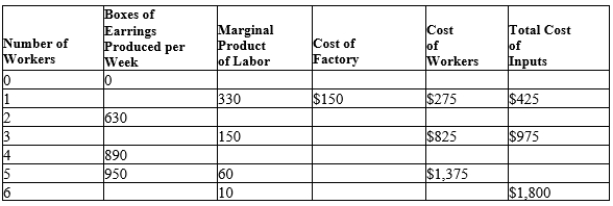 -Refer to Table 13-12. What is the total cost associated with making 890 boxes of earrings per week?
 (Multiple Choice)
4.9/5 (73)
(73) Scenario 13-21
Suppose that a small family farm sold its output for $100,000 in a given year. The family spent $25,000 on fuel, $40,000 on seed, fertilizer, and pesticides, and $25,000 on equipment, including maintenance. The family members could have earned $20,000 working at other occupations.
-Refer to Scenario 13-21. What is the economic profit for the family farm?
(Essay)
4.8/5 (91)
(91) Chloe's Café sells gourmet cinnamon rolls. In the long run, the café incurs a total cost of $500 to produce 1,000 cinnamon rolls. If Chloe's Café exhibits economies of scale between 1,000 and 2,000 cinnamon rolls, the long-run average total cost for 1,500 cinnamon rolls is
(Multiple Choice)
4.8/5 (71)
(71) Table 13-19 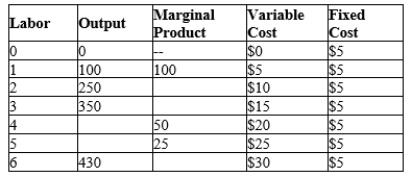 -Refer to Table 13-19. What is the marginal product of the second worker?
 (Short Answer)
4.8/5 (80)
(80) 
Filters
- Essay(0)
- Multiple Choice(0)
- Short Answer(0)
- True False(0)
- Matching(0)