



 Chat with AI
Exam 13: The Costs of Production

Exam 1: Ten Principles of Economics455 Questions
Exam 2: Thinking Like an Economist643 Questions
Exam 3: Interdependence and the Gains From Trade547 Questions
Exam 4: The Market Forces of Supply and Demand693 Questions
Exam 5: Elasticity and Its Application626 Questions
Exam 6: Supply, Demand, and Government Policies668 Questions
Exam 7: Consumers, Producers, and the Efficiency of Markets547 Questions
Exam 8: Applications: the Costs of Taxation509 Questions
Exam 9: Application: International Trade521 Questions
Exam 10: Externalities543 Questions
Exam 11: Public Goods and Common Resources452 Questions
Exam 12: The Design of the Tax System664 Questions
Exam 13: The Costs of Production649 Questions
Exam 14: Firms in Competitive Markets604 Questions
Exam 15: Monopoly662 Questions
Exam 16: Monopolistic Competition649 Questions
Exam 17: Oligopoly522 Questions
Exam 18: The Markets for the Factors of Production592 Questions
Exam 19: Earnings and Discrimination511 Questions
Exam 20: Income Inequality and Poverty478 Questions
Exam 21: The Theory of Consumer Choice570 Questions
Exam 22: Frontiers in Microeconomics461 Questions
Exam 23: Measuring a Nation S Income547 Questions
Exam 24: Measuring the Cost of Living565 Questions
Exam 25: Production and Growth527 Questions
Exam 26: Saving, Investment, and the Financial System637 Questions
Exam 27: Tools of Finance534 Questions
Exam 28: Unemployment and Its Natural Rate701 Questions
Exam 29: The Monetary System540 Questions
Exam 30: Money Growth and Inflation504 Questions
Exam 31: Open-Economy Macroeconomics: Basic Concepts540 Questions
Exam 32: A Macroeconomic Theory of the Open Economy511 Questions
Exam 33: Aggregate Demand and Aggregate Supply572 Questions
Exam 34: The Influence of Monetary and Fiscal Policy on Aggregate Demand523 Questions
Exam 35: The Short-Run Tradeoff Between Inflation and Unemployment536 Questions
Exam 36: Six Debates Over Macroeconomic Policy354 Questions
Select questions type


Diseconomies of scale often arise because higher production levels allow specialization among workers.
(True/False)
4.9/5  (66)
(66) Which of the following can be added to profit to obtain total revenue?
(Multiple Choice)
4.9/5 (67)
(67) Riva crafts and sells hard cider as a part-time job. She can bottle and sell four cases in a week. She is considering hiring her friend Atul to help her. Together, Riva and Atul can bottle and sell seven cases per week. What is Atul's marginal product?
(Multiple Choice)
4.9/5 (92)
(92) Figure 13-3  -Refer to Figure 13-3. Which of the following statements best captures the nature of the underlying production function (not pictured)?
 (Multiple Choice)
4.9/5 (86)
(86) Table 13-16 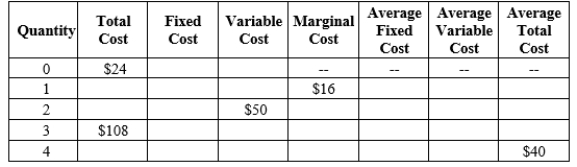 -Refer to Table 13-16. What is the marginal cost of the 4th unit of output?
 (Multiple Choice)
4.8/5 (74)
(74) 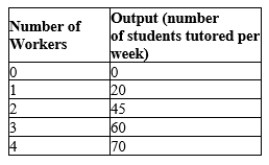 -Refer to Table 13-4. Charles's math tutoring company experiences diminishing marginal productivity with the addition of the
 (Multiple Choice)
4.8/5 (87)
(87) The shape of the total-cost curve is inversely related to the shape of the production function.
(True/False)
4.8/5 (83)
(83) When a firm's only variable input is labor, then the slope of the production function measures the
(Multiple Choice)
4.8/5 (64)
(64) The amount of money that a firm receives from the sale of its output is called
(Multiple Choice)
4.8/5 (83)
(83) Marcus sells 300 candy bars at $0.50 each. His total costs are $125. His profits are
(Multiple Choice)
4.7/5 (78)
(78) Suppose that Christine owns her own CPA firm. She uses only two inputs in her business: her hours worked (labor) and a computer (capital). In the short run, Christine most likely considers
(Multiple Choice)
4.7/5 (72)
(72) Scenario 13-5
Suppose that Emily opens a restaurant. She receives a loan from a bank for $200,000. She withdraws $100,000 from her personal savings account. The interest rate on the loan is 6%, and the interest rate on her savings account is 2%.
-Refer to Scenario 13-5. Emily's annual explicit cost of capital is
(Multiple Choice)
4.8/5 (75)
(75) Scenario 13-7
Julia prepares tax returns and does bookkeeping. Last year her revenues from the tax and bookkeeping business were $150,000, and her expenses for the business were $15,000. When she started her tax and bookkeeping business, Julia gave up her supplemental job doing in-home pet sitting. She used to earn $10,000 per year from pet sitting. Assume that she incurred no costs for her pet sitting business.
-Refer to Scenario 13-7. Julia's implicit costs are
(Multiple Choice)
4.9/5 (79)
(79) If a production function shows declining marginal product of an input as the quantity of the input increases, then the production function exhibits
(Multiple Choice)
4.9/5 (78)
(78) Table 13-19 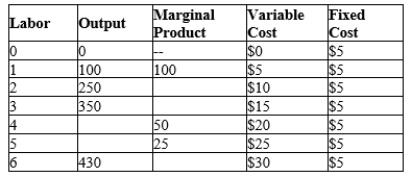 -Refer to Table 13-19. What is the average fixed cost of producing 430 units of output?
 (Short Answer)
5.0/5 (82)
(82) Scenario 13-9
Ellie has been working for an engineering firm and earning an annual salary of $80,000. She decides to open her own engineering business. Her annual expenses will include $15,000 for office rent, $3,000 for equipment rental, $1,000 for supplies, $1,200 for utilities, and a $35,000 salary for a secretary/bookkeeper. Ellie will cover her start-up expenses by cashing in a $20,000 certificate of deposit on which she was earning annual interest of $500.
-Refer to Scenario 13-9. Ellie's annual economic costs will equal
(Multiple Choice)
4.8/5 (76)
(76) If the marginal cost of producing the tenth unit of output is $2.50, and if the average total cost of producing the tenth unit of output is $3, then at ten units of output, average total cost is rising.
(True/False)
4.7/5 (84)
(84) Scenario 13-10
Jessica makes photo frames. She spends $5 on the materials for each photo frame. She can create one photo frame in an hour. She earns $10 per hour at a part-time job at the local coffee shop. She can sell a photo frame for $30 each.
-Refer to Scenario 13-10. An economist would calculate the total profit for one photo frame to be
(Multiple Choice)
4.9/5 (79)
(79) Scenario 13-8
Wanda owns a lemonade stand. She produces lemonade using five inputs: water, sugar, lemons, paper cups, and labor. Her costs per glass are as follows: $0.01 for water, $0.02 for sugar, $0.03 for lemons, $0.02 for cups, and $0.10 for the opportunity cost of her labor. She can sell 300 glasses for $0.50 each.
-Refer to Scenario 13-8. What are Wanda's total accounting profits?
(Multiple Choice)
4.9/5 (79)
(79) 
Filters
- Essay(0)
- Multiple Choice(0)
- Short Answer(0)
- True False(0)
- Matching(0)