



 Chat with AI
Exam 13: The Costs of Production

Exam 1: Ten Principles of Economics455 Questions
Exam 2: Thinking Like an Economist643 Questions
Exam 3: Interdependence and the Gains From Trade547 Questions
Exam 4: The Market Forces of Supply and Demand693 Questions
Exam 5: Elasticity and Its Application626 Questions
Exam 6: Supply, Demand, and Government Policies668 Questions
Exam 7: Consumers, Producers, and the Efficiency of Markets547 Questions
Exam 8: Applications: the Costs of Taxation509 Questions
Exam 9: Application: International Trade521 Questions
Exam 10: Externalities543 Questions
Exam 11: Public Goods and Common Resources452 Questions
Exam 12: The Design of the Tax System664 Questions
Exam 13: The Costs of Production649 Questions
Exam 14: Firms in Competitive Markets604 Questions
Exam 15: Monopoly662 Questions
Exam 16: Monopolistic Competition649 Questions
Exam 17: Oligopoly522 Questions
Exam 18: The Markets for the Factors of Production592 Questions
Exam 19: Earnings and Discrimination511 Questions
Exam 20: Income Inequality and Poverty478 Questions
Exam 21: The Theory of Consumer Choice570 Questions
Exam 22: Frontiers in Microeconomics461 Questions
Exam 23: Measuring a Nation S Income547 Questions
Exam 24: Measuring the Cost of Living565 Questions
Exam 25: Production and Growth527 Questions
Exam 26: Saving, Investment, and the Financial System637 Questions
Exam 27: Tools of Finance534 Questions
Exam 28: Unemployment and Its Natural Rate701 Questions
Exam 29: The Monetary System540 Questions
Exam 30: Money Growth and Inflation504 Questions
Exam 31: Open-Economy Macroeconomics: Basic Concepts540 Questions
Exam 32: A Macroeconomic Theory of the Open Economy511 Questions
Exam 33: Aggregate Demand and Aggregate Supply572 Questions
Exam 34: The Influence of Monetary and Fiscal Policy on Aggregate Demand523 Questions
Exam 35: The Short-Run Tradeoff Between Inflation and Unemployment536 Questions
Exam 36: Six Debates Over Macroeconomic Policy354 Questions
Select questions type


Table 13-20
Listed in the table are the long-run total costs for three different firms.  -Refer to Table 13-20. Firm B is experiencing diseconomies of scale.
 (True/False)
4.9/5  (69)
(69) Economists normally assume that the goal of a firm is to
(i)sell as much of its product as possible.
(ii)set the price of the product as high as possible.
(iii)maximize profit.
(Multiple Choice)
5.0/5 (79)
(79) Scenario 13-6
Ziva is an organic lettuce farmer, but she also spends part of her day as a professional organizing consultant. As a consultant, Ziva helps people organize their houses. Due to the popularity of her home-organization services, Farmer Ziva has more clients requesting her services than she has time to help if she maintains her farming business. Farmer Ziva charges $25 an hour for her home-organization services. One spring day, Ziva spends 10 hours in her fields planting $130 worth of seeds on her farm. She expects that the seeds she planted will yield $300 worth of lettuce.
-Refer to Scenario 13-6. What is the total opportunity cost of the day that Farmer Ziva spent in the field planting lettuce?
(Multiple Choice)
5.0/5 (78)
(78) The fact that many inputs are fixed in the short run but variable in the long run has little impact on the firm's cost curves.
(True/False)
4.8/5 (79)
(79) Scenario 13-19
Doreen's Dairy produces and sells Swiss cheese. Last year, it produced 7,000 pounds and sold each pound for $6. In producing the 7,000 pounds, the dairy incurred variable costs of $28,000 and a total cost of $40,000.
-Refer to Scenario 13-19. In producing the 7,000 pounds of cheese, the firm's average total cost was
(Multiple Choice)
4.9/5 (86)
(86) Marginal cost increases as the quantity of output increases. This reflects the property of
(Multiple Choice)
4.7/5 (84)
(84) DIFFICULTY:
Figure 13-8 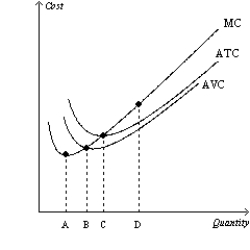 -Refer to Figure 13-8. Quantity C represents the output level where the firm
 (Multiple Choice)
4.8/5 (82)
(82) A local playground equipment company plans to operate out of its current factory, which is estimated to last 30 years. All cost decisions it makes during the 30-year period
(Multiple Choice)
4.8/5 (94)
(94) Table 13-20
Listed in the table are the long-run total costs for three different firms.
-Refer to Table 13-20. Firm C is experiencing diseconomies of scale.
-Refer to Table 13-20. Firm C is experiencing diseconomies of scale. (True/False)
4.8/5 (72)
(72) Table 13-7
The Flying Elvis Copter Rides 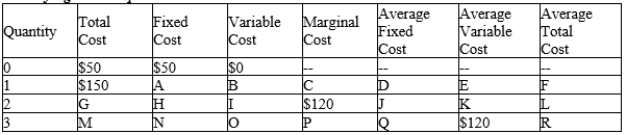 -Refer to Table 13-7. What is the value of D?
 (Multiple Choice)
4.9/5 (75)
(75) DIFFICULTY:
Figure 13-8
-Refer to Figure 13-8. Which of the following statements is correct?
-Refer to Figure 13-8. Which of the following statements is correct? (Multiple Choice)
4.9/5 (90)
(90) Table 13-13
Teacher's Helper is a small company that has a subcontract to produce instructional materials for disabled children in public school districts. The owner rents several small rooms in an office building in the suburbs for $600 a month and has leased computer equipment that costs $480 a month. 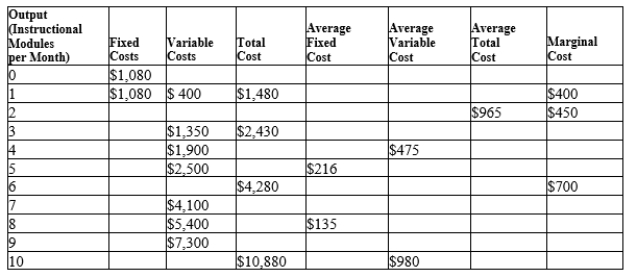 -Refer to Table 13-13. What is the average variable cost for the month if 6 instructional modules are produced?
 (Multiple Choice)
4.8/5 (67)
(67) Chloe's Café sells gourmet cinnamon rolls. In the long run, the café incurs a total cost of $500 to produce 1,000 cinnamon rolls. If Chloe's Café exhibits constant returns to scale between 1,000 and 1,500 cinnamon rolls, the long-run average total cost for 1,250 cinnamon rolls is
(Multiple Choice)
4.8/5 (75)
(75) Table 13-6
Wooden Chair Factory 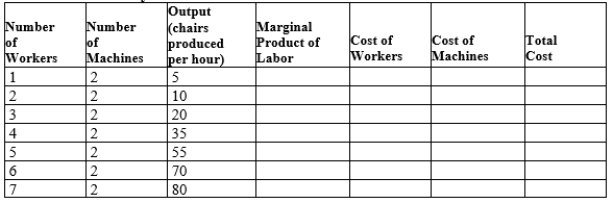 -Refer to Table 13-6. Each worker at the Wooden Chair Factory costs $12 per hour. The cost of each machine is $20 per day regardless of the number of chairs produced. Assume the number of machines does not change. If the factory produces at a rate of 78 chairs per hour, what is the total machine cost per day?
 (Multiple Choice)
4.9/5 (82)
(82) Scenario 13-6
Ziva is an organic lettuce farmer, but she also spends part of her day as a professional organizing consultant. As a consultant, Ziva helps people organize their houses. Due to the popularity of her home-organization services, Farmer Ziva has more clients requesting her services than she has time to help if she maintains her farming business. Farmer Ziva charges $25 an hour for her home-organization services. One spring day, Ziva spends 10 hours in her fields planting $130 worth of seeds on her farm. She expects that the seeds she planted will yield $300 worth of lettuce.
-Refer to Scenario 13-6. An economist would calculate Ziva's total cost for the day of farming to equal
(Multiple Choice)
4.9/5 (75)
(75) When a firm is making a profit-maximizing production decision, which of the following principles of economics is likely to be most important to the firm's decision?
(Multiple Choice)
4.8/5 (86)
(86) Figure 13-5  -Refer to Figure 13-5. Which curve is most likely to represent average total cost?
 (Multiple Choice)
4.7/5 (76)
(76) DIFFICULTY:
Figure 13-8
-Refer to Figure 13-8. Quantity B represents the output level where the firm
-Refer to Figure 13-8. Quantity B represents the output level where the firm (Multiple Choice)
4.7/5 (76)
(76) 
Filters
- Essay(0)
- Multiple Choice(0)
- Short Answer(0)
- True False(0)
- Matching(0)