



 Chat with AI
Exam 13: The Costs of Production

Exam 1: Ten Principles of Economics455 Questions
Exam 2: Thinking Like an Economist643 Questions
Exam 3: Interdependence and the Gains From Trade547 Questions
Exam 4: The Market Forces of Supply and Demand693 Questions
Exam 5: Elasticity and Its Application626 Questions
Exam 6: Supply, Demand, and Government Policies668 Questions
Exam 7: Consumers, Producers, and the Efficiency of Markets547 Questions
Exam 8: Applications: the Costs of Taxation509 Questions
Exam 9: Application: International Trade521 Questions
Exam 10: Externalities543 Questions
Exam 11: Public Goods and Common Resources452 Questions
Exam 12: The Design of the Tax System664 Questions
Exam 13: The Costs of Production649 Questions
Exam 14: Firms in Competitive Markets604 Questions
Exam 15: Monopoly662 Questions
Exam 16: Monopolistic Competition649 Questions
Exam 17: Oligopoly522 Questions
Exam 18: The Markets for the Factors of Production592 Questions
Exam 19: Earnings and Discrimination511 Questions
Exam 20: Income Inequality and Poverty478 Questions
Exam 21: The Theory of Consumer Choice570 Questions
Exam 22: Frontiers in Microeconomics461 Questions
Exam 23: Measuring a Nation S Income547 Questions
Exam 24: Measuring the Cost of Living565 Questions
Exam 25: Production and Growth527 Questions
Exam 26: Saving, Investment, and the Financial System637 Questions
Exam 27: Tools of Finance534 Questions
Exam 28: Unemployment and Its Natural Rate701 Questions
Exam 29: The Monetary System540 Questions
Exam 30: Money Growth and Inflation504 Questions
Exam 31: Open-Economy Macroeconomics: Basic Concepts540 Questions
Exam 32: A Macroeconomic Theory of the Open Economy511 Questions
Exam 33: Aggregate Demand and Aggregate Supply572 Questions
Exam 34: The Influence of Monetary and Fiscal Policy on Aggregate Demand523 Questions
Exam 35: The Short-Run Tradeoff Between Inflation and Unemployment536 Questions
Exam 36: Six Debates Over Macroeconomic Policy354 Questions
Select questions type


A firm produces 60 units of output with 5 workers, 65 units with 6 workers, and 68 units with 7 workers. The firm's production function exhibits diminishing marginal productivity between 5 and 7 workers.
(True/False)
4.9/5  (99)
(99) Scenario 13-21
Suppose that a small family farm sold its output for $100,000 in a given year. The family spent $25,000 on fuel, $40,000 on seed, fertilizer, and pesticides, and $25,000 on equipment, including maintenance. The family members could have earned $20,000 working at other occupations.
-Refer to Scenario 13-21. What is the accounting profit for the family farm?
(Essay)
4.7/5 (70)
(70) Diminishing marginal productivity implies decreasing total product.
(True/False)
4.7/5 (74)
(74) Figure 13-5  -Refer to Figure 13-5. Curve C represents which type of cost curve?
 (Multiple Choice)
4.7/5 (87)
(87) How long does it take a firm to go from the short run to the long run?
(Multiple Choice)
4.8/5 (74)
(74) The production function depicts a relationship between which two variables? Also, draw a production function that exhibits diminishing marginal product.
(Essay)
4.9/5 (79)
(79) Table 13-6
Wooden Chair Factory 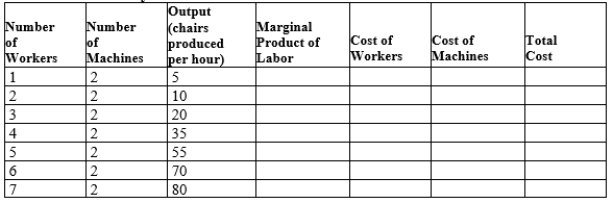 -Refer to Table 13-6. Each worker at the Wooden Chair Factory costs $12 per hour. The cost of each machine is $20 per day regardless of the number of chairs produced. If the factory produces at a rate of 70 chairs per hour and operates 8 hours per day, what is the factory's total labor cost per day?
 (Multiple Choice)
4.8/5 (78)
(78) The total cost to the firm of producing zero units of output is
(Multiple Choice)
4.7/5 (86)
(86) Table 13-14 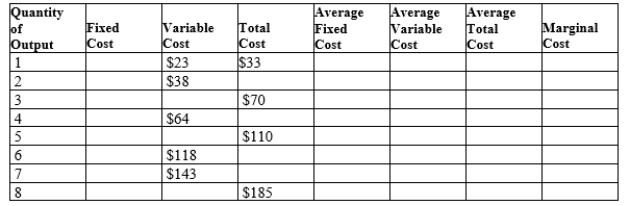 -Refer to Table 13-14. What is the total cost of producing 2 units of output?
 (Multiple Choice)
4.9/5 (89)
(89) The average-fixed-cost curve is always declining. How does this affect the relationship between the AVC and ATC curves?
(Essay)
4.8/5 (79)
(79) In the long run a company that produces and sells covers for cell phones incurs total costs of $2,500 when output is 1,250 covers and $4,000 when output is 1,500 covers. For this range of output, the cell phone cover company exhibits
(Multiple Choice)
4.9/5 (90)
(90) Tony's Taco Truck has an average variable cost of $1.50 and a marginal cost of $2 when it produces 50 units of output (tacos). We can conclude that the average variable cost of producing 51 tacos is
(Multiple Choice)
4.8/5 (68)
(68) Table 13-18 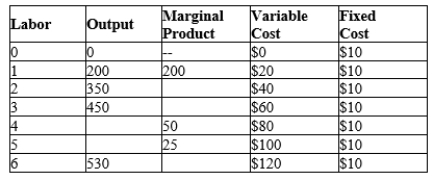 -Refer to Table 13-18. What is the shape of the average-variable-cost curve?
 (Essay)
4.8/5 (80)
(80) Table 13-14
-Refer to Table 13-14. What is the variable cost of producing 8 units of output?
-Refer to Table 13-14. What is the variable cost of producing 8 units of output? (Multiple Choice)
4.8/5 (96)
(96) Table 13-16 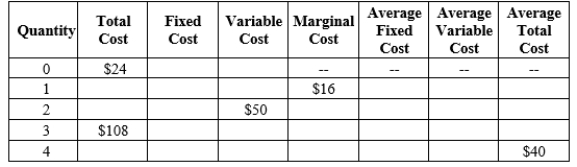 -Refer to Table 13-16. What is the fixed cost of producing 0 units of output?
 (Multiple Choice)
4.8/5 (94)
(94) Marginal cost equals
(i)change in total cost divided by change in quantity produced.
(ii)change in variable cost divided by change in quantity produced.
(iii)the average fixed cost of the current unit.
(Multiple Choice)
4.9/5 (71)
(71) 
Filters
- Essay(0)
- Multiple Choice(0)
- Short Answer(0)
- True False(0)
- Matching(0)