



 Chat with AI
Exam 13: The Costs of Production

Exam 1: Ten Principles of Economics455 Questions
Exam 2: Thinking Like an Economist643 Questions
Exam 3: Interdependence and the Gains From Trade547 Questions
Exam 4: The Market Forces of Supply and Demand693 Questions
Exam 5: Elasticity and Its Application626 Questions
Exam 6: Supply, Demand, and Government Policies668 Questions
Exam 7: Consumers, Producers, and the Efficiency of Markets547 Questions
Exam 8: Applications: the Costs of Taxation509 Questions
Exam 9: Application: International Trade521 Questions
Exam 10: Externalities543 Questions
Exam 11: Public Goods and Common Resources452 Questions
Exam 12: The Design of the Tax System664 Questions
Exam 13: The Costs of Production649 Questions
Exam 14: Firms in Competitive Markets604 Questions
Exam 15: Monopoly662 Questions
Exam 16: Monopolistic Competition649 Questions
Exam 17: Oligopoly522 Questions
Exam 18: The Markets for the Factors of Production592 Questions
Exam 19: Earnings and Discrimination511 Questions
Exam 20: Income Inequality and Poverty478 Questions
Exam 21: The Theory of Consumer Choice570 Questions
Exam 22: Frontiers in Microeconomics461 Questions
Exam 23: Measuring a Nation S Income547 Questions
Exam 24: Measuring the Cost of Living565 Questions
Exam 25: Production and Growth527 Questions
Exam 26: Saving, Investment, and the Financial System637 Questions
Exam 27: Tools of Finance534 Questions
Exam 28: Unemployment and Its Natural Rate701 Questions
Exam 29: The Monetary System540 Questions
Exam 30: Money Growth and Inflation504 Questions
Exam 31: Open-Economy Macroeconomics: Basic Concepts540 Questions
Exam 32: A Macroeconomic Theory of the Open Economy511 Questions
Exam 33: Aggregate Demand and Aggregate Supply572 Questions
Exam 34: The Influence of Monetary and Fiscal Policy on Aggregate Demand523 Questions
Exam 35: The Short-Run Tradeoff Between Inflation and Unemployment536 Questions
Exam 36: Six Debates Over Macroeconomic Policy354 Questions
Select questions type


Table 13-11 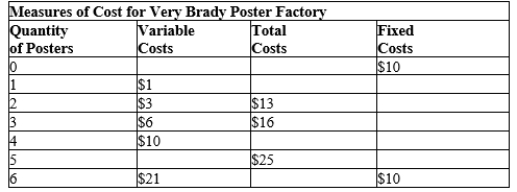 -Refer to Table 13-11. What is the variable cost of producing 0 posters?
 (Multiple Choice)
4.8/5  (81)
(81) The shape of the marginal cost curve tells a producer something about the marginal product of her workers.
(True/False)
4.9/5 (77)
(77) Table 13-18 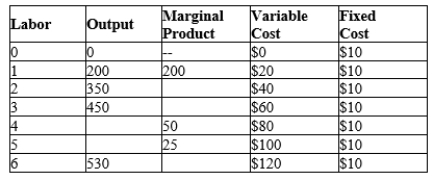 -Refer to Table 13-18. What is the shape of the firm's total-cost curve?
 (Essay)
4.8/5 (71)
(71) Patrice owns a travel agency. Her accountant most likely includes which of the following costs on her financial statements?
(Multiple Choice)
4.9/5 (78)
(78) The fundamental reason that marginal cost eventually rises as output increases is because of
(Multiple Choice)
4.8/5 (90)
(90) Trevor's Tire Company produced and sold 500 tires. The average cost of production per tire was $50. Each tire sold for a price of $65. Trevor's Tire Company's total profits are
(Multiple Choice)
4.8/5 (80)
(80) Figure 13-6 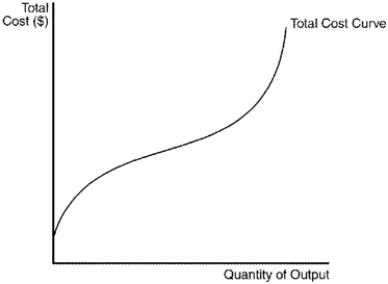 -Refer to Figure 13-6. Which of the following can be inferred from the figure above?
(i)Marginal cost is increasing at all levels of output.
(ii)Marginal product is increasing at low levels of output.
(iii)Marginal product is decreasing at high levels of output.
-Refer to Figure 13-6. Which of the following can be inferred from the figure above?
(i)Marginal cost is increasing at all levels of output.
(ii)Marginal product is increasing at low levels of output.
(iii)Marginal product is decreasing at high levels of output. (Multiple Choice)
4.8/5 (77)
(77) Economies of scale often arise because higher production levels allow specialization among workers.
(True/False)
4.7/5 (86)
(86) Table 13-14 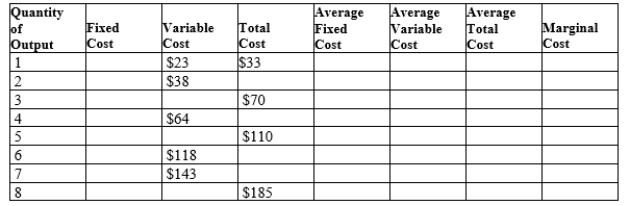 -Refer to Table 13-14. What is the average variable cost of producing 6 units of output?
 (Multiple Choice)
4.8/5 (74)
(74) The Wacky Widget company has total fixed costs of $100,000 per year. The firm's average variable cost is $5 for 10,000 widgets. At that level of output, the firm's average total costs equal
(Multiple Choice)
4.9/5 (87)
(87) Scenario 13-19
Doreen's Dairy produces and sells Swiss cheese. Last year, it produced 7,000 pounds and sold each pound for $6. In producing the 7,000 pounds, the dairy incurred variable costs of $28,000 and a total cost of $40,000.
-Refer to Scenario 13-19. Suppose the owner of the business had an offer to work for another firm for $25,000. The firm's economic profit for the year was
(Multiple Choice)
4.9/5 (80)
(80) The difference between accounting profit and economic profit relates to
(Multiple Choice)
4.7/5 (81)
(81) Scenario 13-6
Ziva is an organic lettuce farmer, but she also spends part of her day as a professional organizing consultant. As a consultant, Ziva helps people organize their houses. Due to the popularity of her home-organization services, Farmer Ziva has more clients requesting her services than she has time to help if she maintains her farming business. Farmer Ziva charges $25 an hour for her home-organization services. One spring day, Ziva spends 10 hours in her fields planting $130 worth of seeds on her farm. She expects that the seeds she planted will yield $300 worth of lettuce.
-Refer to Scenario 13-6. Ziva's economic profit from farming equals
(Multiple Choice)
4.9/5 (79)
(79) At all levels of production higher than the point where the marginal cost curve crosses the average variable cost curve, average variable cost
(Multiple Choice)
4.9/5 (69)
(69) Table 13-3 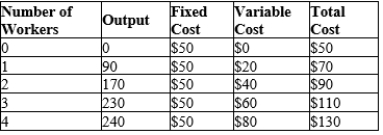 -Refer to Table 13-3. The marginal product of the third worker is
 (Multiple Choice)
4.7/5 (76)
(76) Larry's Lunchcart is a small street vendor business. If Larry makes 15 pretzels in his first hour of business and incurs a total cost of $16.50, his average total cost per pretzel is
(Multiple Choice)
4.8/5 (80)
(80) When marginal cost is greater than average cost, average cost is
(Multiple Choice)
4.8/5 (80)
(80) Table 13-2 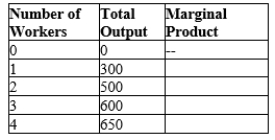 -Refer to Table 13-2. At which number of workers does diminishing marginal product begin?
 (Multiple Choice)
5.0/5 (81)
(81) 
Filters
- Essay(0)
- Multiple Choice(0)
- Short Answer(0)
- True False(0)
- Matching(0)