



 Chat with AI
Exam 13: The Costs of Production

Exam 1: Ten Principles of Economics455 Questions
Exam 2: Thinking Like an Economist643 Questions
Exam 3: Interdependence and the Gains From Trade547 Questions
Exam 4: The Market Forces of Supply and Demand693 Questions
Exam 5: Elasticity and Its Application626 Questions
Exam 6: Supply, Demand, and Government Policies668 Questions
Exam 7: Consumers, Producers, and the Efficiency of Markets547 Questions
Exam 8: Applications: the Costs of Taxation509 Questions
Exam 9: Application: International Trade521 Questions
Exam 10: Externalities543 Questions
Exam 11: Public Goods and Common Resources452 Questions
Exam 12: The Design of the Tax System664 Questions
Exam 13: The Costs of Production649 Questions
Exam 14: Firms in Competitive Markets604 Questions
Exam 15: Monopoly662 Questions
Exam 16: Monopolistic Competition649 Questions
Exam 17: Oligopoly522 Questions
Exam 18: The Markets for the Factors of Production592 Questions
Exam 19: Earnings and Discrimination511 Questions
Exam 20: Income Inequality and Poverty478 Questions
Exam 21: The Theory of Consumer Choice570 Questions
Exam 22: Frontiers in Microeconomics461 Questions
Exam 23: Measuring a Nation S Income547 Questions
Exam 24: Measuring the Cost of Living565 Questions
Exam 25: Production and Growth527 Questions
Exam 26: Saving, Investment, and the Financial System637 Questions
Exam 27: Tools of Finance534 Questions
Exam 28: Unemployment and Its Natural Rate701 Questions
Exam 29: The Monetary System540 Questions
Exam 30: Money Growth and Inflation504 Questions
Exam 31: Open-Economy Macroeconomics: Basic Concepts540 Questions
Exam 32: A Macroeconomic Theory of the Open Economy511 Questions
Exam 33: Aggregate Demand and Aggregate Supply572 Questions
Exam 34: The Influence of Monetary and Fiscal Policy on Aggregate Demand523 Questions
Exam 35: The Short-Run Tradeoff Between Inflation and Unemployment536 Questions
Exam 36: Six Debates Over Macroeconomic Policy354 Questions
Select questions type


When adding another unit of labor leads to an increase in output that is smaller than the increases in output that resulted from adding previous units of labor, the firm is experiencing
(Multiple Choice)
4.9/5  (88)
(88) Suppose that Danita owns a cupcake bakery. In the short run, at least one of her inputs is fixed. Provide one or two examples of the types of inputs that could be fixed in the short run.
(Essay)
4.7/5 (72)
(72) The cost of producing an additional unit of output is the firm's
(Multiple Choice)
4.8/5 (84)
(84) Table 13-10 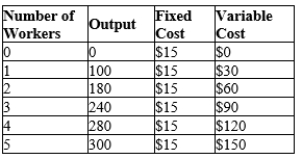 -Refer to Table 13-10. The average total cost of producing 240 units is
 (Multiple Choice)
4.8/5 (70)
(70) Table 13-20
Listed in the table are the long-run total costs for three different firms.  -Refer to Table 13-20. Firm B is experiencing constant returns to scale.
 (True/False)
4.9/5 (86)
(86) The nature of a firm's cost (fixed or variable) depends on the
(Multiple Choice)
4.9/5 (86)
(86) If the total cost curve gets steeper as output increases, the firm is experiencing
(Multiple Choice)
4.8/5 (77)
(77) Figure 13-2 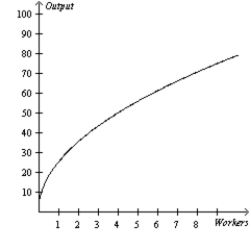 -Refer to Figure 13-2. As the number of workers increases,
 (Multiple Choice)
4.9/5 (68)
(68) A student might describe information about the costs of production as
(Multiple Choice)
4.9/5 (93)
(93) In the long run, a firm that produces and sells textbooks gets to choose
(Multiple Choice)
4.8/5 (85)
(85) David's firm experiences diminishing marginal product for all ranges of inputs. The total cost curve associated with David's firm
(Multiple Choice)
4.8/5 (90)
(90) Katherine gives piano lessons for $15 per hour. She also grows flowers, which she arranges and sells at the local farmer's market. One day she spends 5 hours planting $50 worth of seeds in her garden. Once the seeds have grown into flowers, she can sell them for $150 at the farmer's market. Katherine's accounting profits are
(Multiple Choice)
4.8/5 (86)
(86) Table 13-5 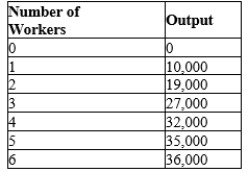 -Refer to Table 13-5. The marginal product of the fourth worker is
 (Multiple Choice)
4.8/5 (89)
(89) Describe how an accounting firm could experience diseconomies of scale.
(Essay)
4.9/5 (69)
(69) Table 13-7
The Flying Elvis Copter Rides 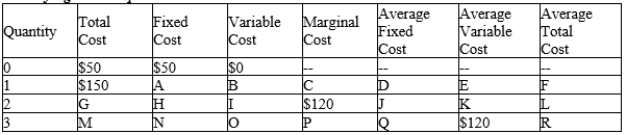 -Refer to Table 13-7. What is the value of N?
 (Multiple Choice)
4.9/5 (78)
(78) Scenario 13-14
If Farmer Brown plants no seeds on his farm, he gets no harvest. If he plants 1 bag of seeds, he gets 5 bushels of wheat. If he plants 2 bags, he gets 9 bushels. If he plants 3 bags, he gets 12 bushels. A bag of seeds costs $120, and seeds are his only cost.
-Refer to Scenario 13-14. Farmer Brown's production function exhibits
(Multiple Choice)
4.9/5 (58)
(58) Table 13-11 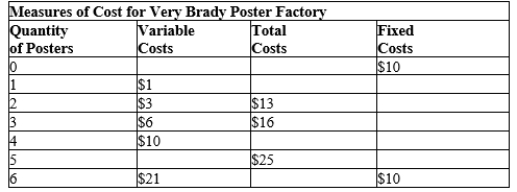 -Refer to Table 13-11. What is the variable cost of producing 5 posters?
 (Multiple Choice)
4.7/5 (77)
(77) Table 13-9 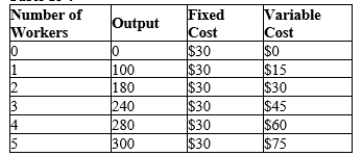 -Refer to Table 13-9. The marginal products of hiring additional workers are
 (Multiple Choice)
4.9/5 (78)
(78) 
Filters
- Essay(0)
- Multiple Choice(0)
- Short Answer(0)
- True False(0)
- Matching(0)