



 Chat with AI
Exam 13: The Costs of Production

Exam 1: Ten Principles of Economics455 Questions
Exam 2: Thinking Like an Economist643 Questions
Exam 3: Interdependence and the Gains From Trade547 Questions
Exam 4: The Market Forces of Supply and Demand693 Questions
Exam 5: Elasticity and Its Application626 Questions
Exam 6: Supply, Demand, and Government Policies668 Questions
Exam 7: Consumers, Producers, and the Efficiency of Markets547 Questions
Exam 8: Applications: the Costs of Taxation509 Questions
Exam 9: Application: International Trade521 Questions
Exam 10: Externalities543 Questions
Exam 11: Public Goods and Common Resources452 Questions
Exam 12: The Design of the Tax System664 Questions
Exam 13: The Costs of Production649 Questions
Exam 14: Firms in Competitive Markets604 Questions
Exam 15: Monopoly662 Questions
Exam 16: Monopolistic Competition649 Questions
Exam 17: Oligopoly522 Questions
Exam 18: The Markets for the Factors of Production592 Questions
Exam 19: Earnings and Discrimination511 Questions
Exam 20: Income Inequality and Poverty478 Questions
Exam 21: The Theory of Consumer Choice570 Questions
Exam 22: Frontiers in Microeconomics461 Questions
Exam 23: Measuring a Nation S Income547 Questions
Exam 24: Measuring the Cost of Living565 Questions
Exam 25: Production and Growth527 Questions
Exam 26: Saving, Investment, and the Financial System637 Questions
Exam 27: Tools of Finance534 Questions
Exam 28: Unemployment and Its Natural Rate701 Questions
Exam 29: The Monetary System540 Questions
Exam 30: Money Growth and Inflation504 Questions
Exam 31: Open-Economy Macroeconomics: Basic Concepts540 Questions
Exam 32: A Macroeconomic Theory of the Open Economy511 Questions
Exam 33: Aggregate Demand and Aggregate Supply572 Questions
Exam 34: The Influence of Monetary and Fiscal Policy on Aggregate Demand523 Questions
Exam 35: The Short-Run Tradeoff Between Inflation and Unemployment536 Questions
Exam 36: Six Debates Over Macroeconomic Policy354 Questions
Select questions type


Sebastian decides to open a tree farm. When deciding to open his own business, he turned down two separate job offers of $25,000 and $30,000 and withdrew $20,000 from his savings. Sebastian's savings account paid 3 percent interest. He also borrowed $20,000 from his brother, whom he pays 2 percent interest per year. He spent $15,000 to purchase supplies and earned $50,000 in revenue during his first year. What are Sebastian's implicit costs from running his own business?
(Multiple Choice)
4.9/5  (76)
(76) Table 13-12
Eileen's Elegant Earrings produces pairs of earrings for its mail order catalogue business. Each pair is shipped in a separate box. She rents a small room for $150 a week in the downtown business district that serves as her factory. She can hire workers for $275 a week. There are no implicit costs. 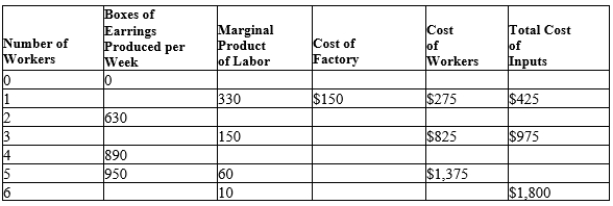 -Refer to Table 13-12. Eileen has received an order for 3,000 boxes of earrings for next week. If she expects that the trend in the marginal product of labor will continue in the same direction, it is most likely that her best decision will be to
 (Multiple Choice)
4.8/5 (83)
(83) Figure 13-7 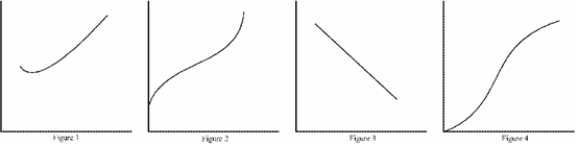 -Refer to Figure 13-7. Which of the figures represents the production function for a typical firm?
 (Multiple Choice)
4.8/5 (80)
(80) The minimum points of the average variable cost and average total cost curves occur where the
(Multiple Choice)
4.7/5 (94)
(94) Consider the following information about baseball production at Bobby's Baseball Factory: 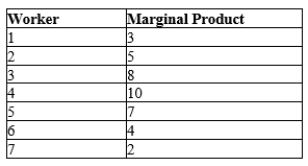 Bobby pays all his workers the same wage, and labor is his only variable cost. From this information we can conclude that Bobby's average variable cost decreases
 (Multiple Choice)
4.8/5 (97)
(97) Which field of economics studies how the number of firms affects the prices in a market and the efficiency of market outcomes?
(Multiple Choice)
4.8/5 (79)
(79) If Kevin's children run a lemonade stand for a day and sell 200 glasses of lemonade at $0.50 each, their total revenues are
(Multiple Choice)
4.8/5 (69)
(69) Average total cost reveals how much total cost will change as the firm alters its level of production.
(True/False)
4.7/5 (67)
(67) Table 13-19 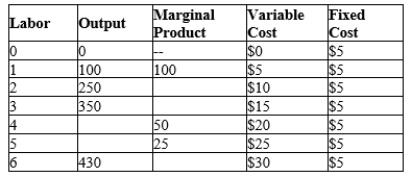 -Refer to Table 13-19. What is the shape of the marginal-cost curve?
 (Essay)
4.8/5 (82)
(82) Figure 13-5  -Refer to Figure 13-5. Curve D is increasing because
 (Multiple Choice)
4.9/5 (76)
(76) When a firm's long-run average total costs do not vary as output increases, the firm exhibits
(Multiple Choice)
4.8/5 (75)
(75) The field of industrial organization addresses how the number of firms affects prices in a market and the efficiency of the market outcome.
(True/False)
4.8/5 (86)
(86) Table 13-7
The Flying Elvis Copter Rides 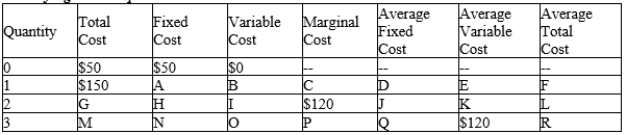 -Refer to Table 13-7. What is the value of C?
 (Multiple Choice)
4.9/5 (84)
(84) Table 13-11 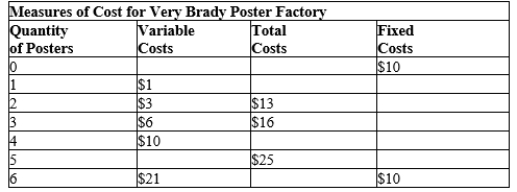 -Refer to Table 13-11. What is the marginal cost of producing the 1st poster?
 (Multiple Choice)
4.7/5 (68)
(68) Scenario 13-18
Farmer Jack is a watermelon farmer. If Jack plants no seeds on his farm, he gets no harvest. If he plants 1 bag of seeds, he gets 30 watermelons. If he plants 2 bags of seeds, he gets 50 watermelons. If he plants 3 bags of seeds he gets 60 watermelons. A bag of seeds costs $100, and the costs of seeds are his only costs.
-Refer to Scenario 13-18. Which of the following statements is (are) true?
(i)Farmer Jack experiences decreasing marginal product.
(ii)Farmer Jack's production function is nonlinear.
(iii)Farmer Jack's total cost curve is linear.
(Multiple Choice)
4.9/5 (76)
(76) Figure 13-6 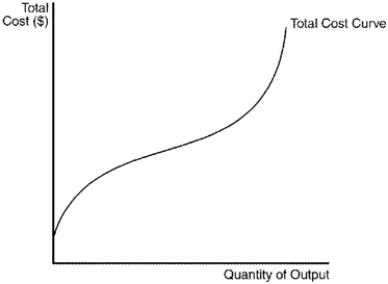 -Refer to Figure 13-6. Why doesn't the total cost curve begin at the origin (the point 0,0)?
 (Multiple Choice)
4.9/5 (65)
(65) If a firm experiences constant returns to scale at all output levels, then its long-run average total cost curve would
(Multiple Choice)
4.8/5 (76)
(76) 
Filters
- Essay(0)
- Multiple Choice(0)
- Short Answer(0)
- True False(0)
- Matching(0)