



 Chat with AI
Exam 13: The Costs of Production

Exam 1: Ten Principles of Economics455 Questions
Exam 2: Thinking Like an Economist643 Questions
Exam 3: Interdependence and the Gains From Trade547 Questions
Exam 4: The Market Forces of Supply and Demand693 Questions
Exam 5: Elasticity and Its Application626 Questions
Exam 6: Supply, Demand, and Government Policies668 Questions
Exam 7: Consumers, Producers, and the Efficiency of Markets547 Questions
Exam 8: Applications: the Costs of Taxation509 Questions
Exam 9: Application: International Trade521 Questions
Exam 10: Externalities543 Questions
Exam 11: Public Goods and Common Resources452 Questions
Exam 12: The Design of the Tax System664 Questions
Exam 13: The Costs of Production649 Questions
Exam 14: Firms in Competitive Markets604 Questions
Exam 15: Monopoly662 Questions
Exam 16: Monopolistic Competition649 Questions
Exam 17: Oligopoly522 Questions
Exam 18: The Markets for the Factors of Production592 Questions
Exam 19: Earnings and Discrimination511 Questions
Exam 20: Income Inequality and Poverty478 Questions
Exam 21: The Theory of Consumer Choice570 Questions
Exam 22: Frontiers in Microeconomics461 Questions
Exam 23: Measuring a Nation S Income547 Questions
Exam 24: Measuring the Cost of Living565 Questions
Exam 25: Production and Growth527 Questions
Exam 26: Saving, Investment, and the Financial System637 Questions
Exam 27: Tools of Finance534 Questions
Exam 28: Unemployment and Its Natural Rate701 Questions
Exam 29: The Monetary System540 Questions
Exam 30: Money Growth and Inflation504 Questions
Exam 31: Open-Economy Macroeconomics: Basic Concepts540 Questions
Exam 32: A Macroeconomic Theory of the Open Economy511 Questions
Exam 33: Aggregate Demand and Aggregate Supply572 Questions
Exam 34: The Influence of Monetary and Fiscal Policy on Aggregate Demand523 Questions
Exam 35: The Short-Run Tradeoff Between Inflation and Unemployment536 Questions
Exam 36: Six Debates Over Macroeconomic Policy354 Questions
Select questions type


Implicit costs are costs that do not require an outlay of money by the firm.
(True/False)
4.8/5  (71)
(71) Table 13-14 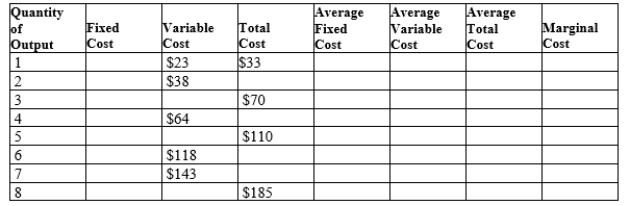 -Refer to Table 13-14. What is the average total cost of producing 6 units of output?
 (Multiple Choice)
4.7/5 (91)
(91) Several related measures of cost can be derived from a firm's total cost.
(True/False)
4.8/5 (70)
(70) Table 13-13
Teacher's Helper is a small company that has a subcontract to produce instructional materials for disabled children in public school districts. The owner rents several small rooms in an office building in the suburbs for $600 a month and has leased computer equipment that costs $480 a month. 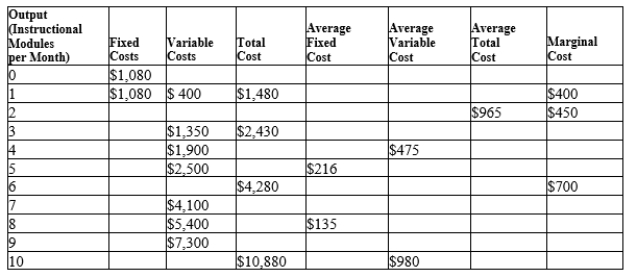 -Refer to Table 13-13. What is the marginal cost of creating the tenth instructional module in a given month?
 (Multiple Choice)
4.8/5 (63)
(63) Shelley's Salsa produces and sells organic salsa. Last year it sold 3 million tubs of salsa at a price of $3 per tub. For last year, the firm's
(Multiple Choice)
4.8/5 (66)
(66) Table 13-7
The Flying Elvis Copter Rides 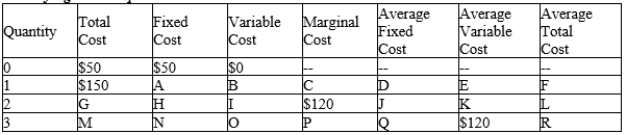 -Refer to Table 13-7. What is the value of K?
 (Multiple Choice)
4.9/5 (69)
(69) Which of the following is an example of an implicit cost?
(i)the owner of a firm forgoing an opportunity to earn a large salary working for a Wall Street brokerage firm
(ii)interest paid on the firm's debt
(iii)rent paid by the firm to lease office space
(Multiple Choice)
4.8/5 (87)
(87) On a 100-acre farm, a farmer is able to produce 3,000 bushels of wheat when he hires 2 workers. He is able to produce 4,400 bushels of wheat when he hires 3 workers. Which of the following possibilities is consistent with the property of diminishing marginal product?
(Multiple Choice)
4.7/5 (69)
(69) Table 13-18 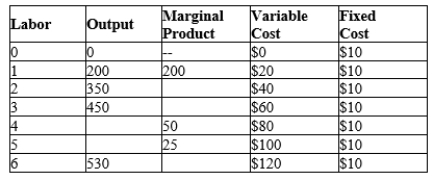 -Refer to Table 13-18. What is the shape of the average-total-cost curve?
 (Essay)
4.7/5 (77)
(77) Brady Industries has average variable costs of $1 and average total costs of $3 when it produces 500 units of output. The firm's total fixed costs equal
(Multiple Choice)
4.9/5 (78)
(78) If the average-total-cost of producing five units is $10, and the marginal-cost of producing the fifth unit is $10, then the average-total-cost curve is at its minimum at five units.
(True/False)
4.8/5 (78)
(78) Figure 13-10 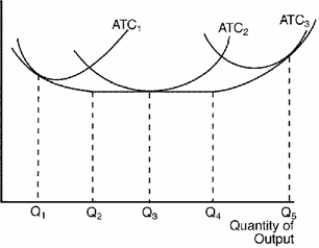 -Refer to Figure 13-10. The firm experiences constant returns to scale if it changes its level of output from
 (Multiple Choice)
5.0/5 (77)
(77) Scenario 13-12
Ariana withdrew $400,000 out of her personal savings account and used it to start her new Internet cafe. The savings account pays 3 percent interest per year. During the first year of her business, Ariana sold 2,000 cups of coffee for $2.50 per cup and 4,000 hours of Internet time, also at $2.50 per hour. During the first year, the business made monetary outlays of $9,000. You may assume that there is no opportunity cost to Ariana's time.
-Refer to Scenario 13-12. Ariana's economic profit for the year was
(Multiple Choice)
4.8/5 (80)
(80) Table 13-1 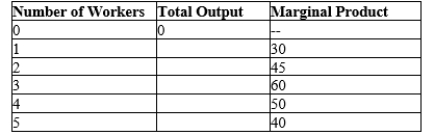 -Refer to Table 13-1. What is total output when 2 workers are hired?
 (Multiple Choice)
4.8/5 (68)
(68) Scenario 13-13
Christine is an artist who creates custom cookie jars. Her annual revenue from selling the cookie jars is $90,000. The annual explicit costs of the materials used to make the cookie jars are $54,000.
-Refer to Scenario 13-13. Christine used $5,000 from her personal savings account to buy pottery tools for her business. The savings account paid 1% annual interest. Christine could earn $6,000 per year as a tax preparer. What is the annual economic profit of her cookie jar business?
(Multiple Choice)
4.9/5 (69)
(69) As a firm moves along its long-run average cost curve, it is adjusting the size of its factory to the quantity of production.
(True/False)
4.8/5 (82)
(82) 
Filters
- Essay(0)
- Multiple Choice(0)
- Short Answer(0)
- True False(0)
- Matching(0)