



 Chat with AI
Exam 13: The Costs of Production

Exam 1: Ten Principles of Economics455 Questions
Exam 2: Thinking Like an Economist643 Questions
Exam 3: Interdependence and the Gains From Trade547 Questions
Exam 4: The Market Forces of Supply and Demand693 Questions
Exam 5: Elasticity and Its Application626 Questions
Exam 6: Supply, Demand, and Government Policies668 Questions
Exam 7: Consumers, Producers, and the Efficiency of Markets547 Questions
Exam 8: Applications: the Costs of Taxation509 Questions
Exam 9: Application: International Trade521 Questions
Exam 10: Externalities543 Questions
Exam 11: Public Goods and Common Resources452 Questions
Exam 12: The Design of the Tax System664 Questions
Exam 13: The Costs of Production649 Questions
Exam 14: Firms in Competitive Markets604 Questions
Exam 15: Monopoly662 Questions
Exam 16: Monopolistic Competition649 Questions
Exam 17: Oligopoly522 Questions
Exam 18: The Markets for the Factors of Production592 Questions
Exam 19: Earnings and Discrimination511 Questions
Exam 20: Income Inequality and Poverty478 Questions
Exam 21: The Theory of Consumer Choice570 Questions
Exam 22: Frontiers in Microeconomics461 Questions
Exam 23: Measuring a Nation S Income547 Questions
Exam 24: Measuring the Cost of Living565 Questions
Exam 25: Production and Growth527 Questions
Exam 26: Saving, Investment, and the Financial System637 Questions
Exam 27: Tools of Finance534 Questions
Exam 28: Unemployment and Its Natural Rate701 Questions
Exam 29: The Monetary System540 Questions
Exam 30: Money Growth and Inflation504 Questions
Exam 31: Open-Economy Macroeconomics: Basic Concepts540 Questions
Exam 32: A Macroeconomic Theory of the Open Economy511 Questions
Exam 33: Aggregate Demand and Aggregate Supply572 Questions
Exam 34: The Influence of Monetary and Fiscal Policy on Aggregate Demand523 Questions
Exam 35: The Short-Run Tradeoff Between Inflation and Unemployment536 Questions
Exam 36: Six Debates Over Macroeconomic Policy354 Questions
Select questions type


Figure 13-5  -Refer to Figure 13-5. Curve A represents which type of cost curve?
 (Multiple Choice)
4.8/5  (68)
(68) Figure 13-3  -Refer to Figure 13-3. Assuming that the firm depicted produces cookies, which of the statements below is most consistent with the shape of the total cost curve?
 (Multiple Choice)
4.8/5 (78)
(78) Table 13-1 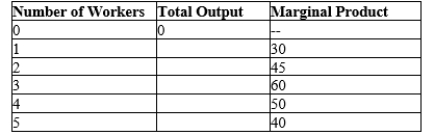 -Refer to Table 13-1. What is total output when 4 workers are hired?
 (Multiple Choice)
4.7/5 (67)
(67) Figure 13-10 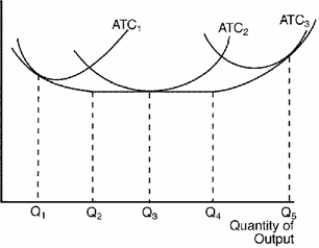 -Refer to Figure 13-10. The firm experiences diseconomies of scale if it changes its level of output from
 (Multiple Choice)
4.8/5 (75)
(75) Table 13-7
The Flying Elvis Copter Rides 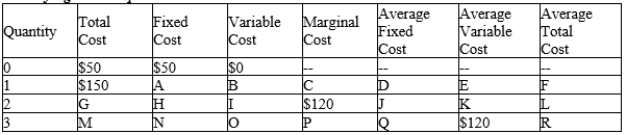 -Refer to Table 13-7. What is the value of G?
 (Multiple Choice)
4.9/5 (76)
(76) Diminishing marginal product exists when the total cost curve becomes horizontal as outputs increases.
(True/False)
4.9/5 (72)
(72) Table 13-12
Eileen's Elegant Earrings produces pairs of earrings for its mail order catalogue business. Each pair is shipped in a separate box. She rents a small room for $150 a week in the downtown business district that serves as her factory. She can hire workers for $275 a week. There are no implicit costs. 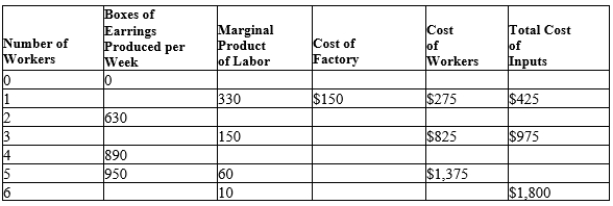 -Refer to Table 13-12. What is the marginal product of the second worker?
 (Multiple Choice)
4.9/5 (69)
(69) Table 13-20
Listed in the table are the long-run total costs for three different firms.  -Refer to Table 13-20. Firm A is experiencing constant returns to scale.
 (True/False)
5.0/5 (77)
(77) In the long run a company that produces and sells candy bars incurs total costs of $1,200 when output is 2,400 candy bars and $1,400 when output is 2,900 candy bars. The candy bar company exhibits
(Multiple Choice)
4.9/5 (69)
(69) Bubba is a shrimp fisherman who catches 4,000 pounds of shrimp per year. He can sell the shrimp for $5 per pound. His average total cost of catching shrimp is $3 per pound. Bubba's annual total profit is
(Multiple Choice)
4.8/5 (84)
(84) Suppose that for a particular firm the only variable input into the production process is labor and that output equals zero when no workers are hired. In addition, suppose that when four units of output are produced, the total cost is $175, and the average variable cost is $33.75. What would the average fixed cost be if ten units were produced?
(Multiple Choice)
4.7/5 (69)
(69) In the long run a company that produces and sells kayaks incurs total costs of $15,000 when output is 30 kayaks and $20,000 when output is 40 kayaks. The kayak company exhibits
(Multiple Choice)
4.8/5 (75)
(75) When a firm is able to put idle equipment to use by hiring another worker,
(Multiple Choice)
4.8/5 (86)
(86) Bev is opening her own court-reporting business. She financed the business by withdrawing money from her personal savings account. When she closed the account, the bank representative mentioned that she would have earned $300 in interest next year. If Bev hadn't opened her own business, she would have earned a salary of $25,000. In her first year, Bev's revenues were $30,000, and she spent $1,000 on materials and supplies. Which of the following statements is correct?
(Multiple Choice)
4.9/5 (80)
(80) Table 13-7
The Flying Elvis Copter Rides
-Refer to Table 13-7. What is the value of L?
-Refer to Table 13-7. What is the value of L? (Multiple Choice)
4.8/5 (88)
(88) Figure 13-9
The figure below depicts average total cost functions for a firm that produces automobiles. 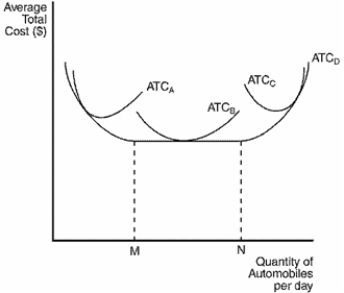 -Refer to Figure 13-9. Which of the curves is most likely to characterize the short-run average total cost curve of the smallest factory?
 (Multiple Choice)
4.7/5 (87)
(87) 
Filters
- Essay(0)
- Multiple Choice(0)
- Short Answer(0)
- True False(0)
- Matching(0)