



 Chat with AI
Exam 13: The Costs of Production

Exam 1: Ten Principles of Economics455 Questions
Exam 2: Thinking Like an Economist643 Questions
Exam 3: Interdependence and the Gains From Trade547 Questions
Exam 4: The Market Forces of Supply and Demand693 Questions
Exam 5: Elasticity and Its Application626 Questions
Exam 6: Supply, Demand, and Government Policies668 Questions
Exam 7: Consumers, Producers, and the Efficiency of Markets547 Questions
Exam 8: Applications: the Costs of Taxation509 Questions
Exam 9: Application: International Trade521 Questions
Exam 10: Externalities543 Questions
Exam 11: Public Goods and Common Resources452 Questions
Exam 12: The Design of the Tax System664 Questions
Exam 13: The Costs of Production649 Questions
Exam 14: Firms in Competitive Markets604 Questions
Exam 15: Monopoly662 Questions
Exam 16: Monopolistic Competition649 Questions
Exam 17: Oligopoly522 Questions
Exam 18: The Markets for the Factors of Production592 Questions
Exam 19: Earnings and Discrimination511 Questions
Exam 20: Income Inequality and Poverty478 Questions
Exam 21: The Theory of Consumer Choice570 Questions
Exam 22: Frontiers in Microeconomics461 Questions
Exam 23: Measuring a Nation S Income547 Questions
Exam 24: Measuring the Cost of Living565 Questions
Exam 25: Production and Growth527 Questions
Exam 26: Saving, Investment, and the Financial System637 Questions
Exam 27: Tools of Finance534 Questions
Exam 28: Unemployment and Its Natural Rate701 Questions
Exam 29: The Monetary System540 Questions
Exam 30: Money Growth and Inflation504 Questions
Exam 31: Open-Economy Macroeconomics: Basic Concepts540 Questions
Exam 32: A Macroeconomic Theory of the Open Economy511 Questions
Exam 33: Aggregate Demand and Aggregate Supply572 Questions
Exam 34: The Influence of Monetary and Fiscal Policy on Aggregate Demand523 Questions
Exam 35: The Short-Run Tradeoff Between Inflation and Unemployment536 Questions
Exam 36: Six Debates Over Macroeconomic Policy354 Questions
Select questions type


How can the average-fixed-cost curve be declining when fixed cost is constant?
(Essay)
4.8/5  (86)
(86) Walter used to work as a high school teacher for $40,000 per year but quit in order to start his own painting business. To invest in his painting business, he withdrew $20,000 from his savings, which paid 3 percent interest, and borrowed $30,000 from his uncle, whom he pays 3 percent interest per year. Last year Walter paid $25,000 for supplies and had revenue of $60,000. Walter asked Tyler the accountant and Greg the economist to calculate his painting business's costs.
(Multiple Choice)
4.7/5 (78)
(78) Figure 13-3  -Refer to Figure 13-3. The changing slope of the total cost curve reflects
 (Multiple Choice)
4.9/5 (84)
(84) In the long run a company that produces and sells dog beds incurs total costs of $1,200 when output is 30 beds and $1,600 when output is 40 beds. Firm A exhibits
(Multiple Choice)
4.9/5 (83)
(83) Jane was a partner at a law firm earning $223,000 per year. She left the firm to open her own law practice. In the first year of business she generated revenues of $347,000 and incurred explicit costs of $163,000. Jane's economic profit from her first year in her own practice is
(Multiple Choice)
4.9/5 (84)
(84) Scenario 13-18
Farmer Jack is a watermelon farmer. If Jack plants no seeds on his farm, he gets no harvest. If he plants 1 bag of seeds, he gets 30 watermelons. If he plants 2 bags of seeds, he gets 50 watermelons. If he plants 3 bags of seeds he gets 60 watermelons. A bag of seeds costs $100, and the costs of seeds are his only costs.
-Refer to Scenario 13-18. Farmer Jack's production function will
(Multiple Choice)
4.9/5 (104)
(104) Suppose that a firm has only one variable input, labor, and firm output is zero when labor is zero. When the firm hires 6 workers the firm produces 90 units of output. Fixed costs of production are $6 and the variable cost per unit of labor is $10. The marginal product of the seventh unit of labor is 4. Given this information, what is the average total cost of production when the firm hires 7 workers?
(Multiple Choice)
4.9/5 (80)
(80) Table 13-7
The Flying Elvis Copter Rides 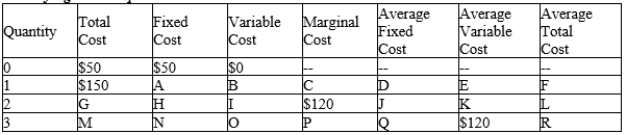 -Refer to Table 13-7. What is the value of M?
 (Multiple Choice)
4.9/5 (85)
(85) Scenario 13-13
Christine is an artist who creates custom cookie jars. Her annual revenue from selling the cookie jars is $90,000. The annual explicit costs of the materials used to make the cookie jars are $54,000.
-Refer to Scenario 13-13. Christine used $5,000 from her personal savings account to buy pottery tools for her business. The savings account paid 1% annual interest. What is Christine's annual opportunity cost of the financial capital that she invested in her business?
(Multiple Choice)
4.8/5 (98)
(98) Bob Edwards owns a bagel shop. Bob hires an economist who assesses the shape of the bagel shop's average total cost (ATC) curve as a function of the number of bagels produced. The results indicate a U-shaped average total cost curve. Bob's economist explains that ATC is U-shaped for two reasons. The first is the existence of diminishing marginal product, which causes it to rise. What would be the second reason? Assume that the marginal cost curve is linear. (Hint: The second reason relates to average fixed cost)
(Essay)
4.8/5 (91)
(91) If the marginal cost of producing the fifth unit of output is higher than the marginal cost of producing the fourth unit of output, then at five units of output, average total cost must be rising.
(True/False)
4.9/5 (73)
(73) If a firm uses labor to produce output, the firm's production function depicts the relationship between
(Multiple Choice)
5.0/5 (82)
(82) Scenario 13-8
Wanda owns a lemonade stand. She produces lemonade using five inputs: water, sugar, lemons, paper cups, and labor. Her costs per glass are as follows: $0.01 for water, $0.02 for sugar, $0.03 for lemons, $0.02 for cups, and $0.10 for the opportunity cost of her labor. She can sell 300 glasses for $0.50 each.
-Refer to Scenario 13-8. What are Wanda's implicit costs per glass?
(Multiple Choice)
4.8/5 (85)
(85) As Bubba's Bubble Gum Company adds workers while using the same amount of machinery, some workers may be underutilized because they have little work to do while waiting in line to use the machinery. When this occurs, Bubba's Bubble Gum Company encounters
(Multiple Choice)
4.9/5 (81)
(81) Tsintah weaves traditional Navaho rugs. She weaves and sells 50 rugs. Her average cost of production per rug is $50. She sells each rug for a price of $65. Tsintah's total revenues are
(Multiple Choice)
4.9/5 (86)
(86) Table 13-19 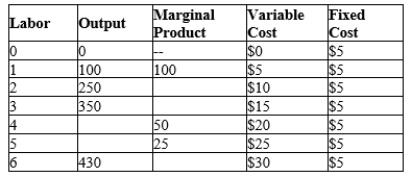 -Refer to Table 13-19. What is the average total cost of producing 425 units of output?
 (Short Answer)
4.8/5 (82)
(82) Table 13-14 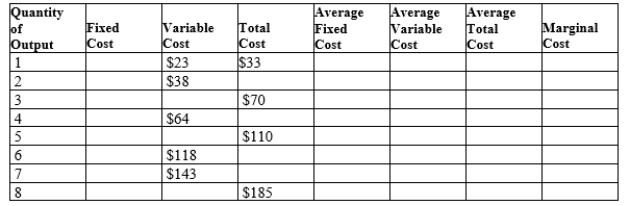 -Refer to Table 13-14. What is the variable cost of producing 5 units of output?
 (Multiple Choice)
4.9/5 (70)
(70) 
Filters
- Essay(0)
- Multiple Choice(0)
- Short Answer(0)
- True False(0)
- Matching(0)