



 Chat with AI
Exam 13: The Costs of Production

Exam 1: Ten Principles of Economics455 Questions
Exam 2: Thinking Like an Economist643 Questions
Exam 3: Interdependence and the Gains From Trade547 Questions
Exam 4: The Market Forces of Supply and Demand693 Questions
Exam 5: Elasticity and Its Application626 Questions
Exam 6: Supply, Demand, and Government Policies668 Questions
Exam 7: Consumers, Producers, and the Efficiency of Markets547 Questions
Exam 8: Applications: the Costs of Taxation509 Questions
Exam 9: Application: International Trade521 Questions
Exam 10: Externalities543 Questions
Exam 11: Public Goods and Common Resources452 Questions
Exam 12: The Design of the Tax System664 Questions
Exam 13: The Costs of Production649 Questions
Exam 14: Firms in Competitive Markets604 Questions
Exam 15: Monopoly662 Questions
Exam 16: Monopolistic Competition649 Questions
Exam 17: Oligopoly522 Questions
Exam 18: The Markets for the Factors of Production592 Questions
Exam 19: Earnings and Discrimination511 Questions
Exam 20: Income Inequality and Poverty478 Questions
Exam 21: The Theory of Consumer Choice570 Questions
Exam 22: Frontiers in Microeconomics461 Questions
Exam 23: Measuring a Nation S Income547 Questions
Exam 24: Measuring the Cost of Living565 Questions
Exam 25: Production and Growth527 Questions
Exam 26: Saving, Investment, and the Financial System637 Questions
Exam 27: Tools of Finance534 Questions
Exam 28: Unemployment and Its Natural Rate701 Questions
Exam 29: The Monetary System540 Questions
Exam 30: Money Growth and Inflation504 Questions
Exam 31: Open-Economy Macroeconomics: Basic Concepts540 Questions
Exam 32: A Macroeconomic Theory of the Open Economy511 Questions
Exam 33: Aggregate Demand and Aggregate Supply572 Questions
Exam 34: The Influence of Monetary and Fiscal Policy on Aggregate Demand523 Questions
Exam 35: The Short-Run Tradeoff Between Inflation and Unemployment536 Questions
Exam 36: Six Debates Over Macroeconomic Policy354 Questions
Select questions type


Scenario 13-22
Suppose that a small hair styling salon had revenues of $150,000 in a given year. The owner spent $10,000 on utilities, $60,000 on supplies (shampoo, conditioner, hair coloring and other chemicals, etc.), and $50,000 on equipment (mirrors, chairs, scissors, curling irons, etc.), including maintenance. The owner could have earned $50,000 working at another salon.
-Refer to Scenario 13-22. What is the accounting profit for the hair styling salon?
(Essay)
4.9/5  (88)
(88) Which of the following costs of publishing a book is a fixed cost?
(Multiple Choice)
4.7/5 (85)
(85) Economists in the field of industrial organization study how
(Multiple Choice)
4.9/5 (65)
(65) Table 13-5 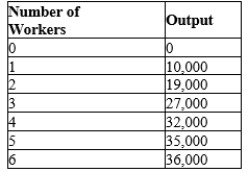 -Refer to Table 13-5. The marginal product of the third worker is
 (Multiple Choice)
4.7/5 (78)
(78) Scenario 13-18
Farmer Jack is a watermelon farmer. If Jack plants no seeds on his farm, he gets no harvest. If he plants 1 bag of seeds, he gets 30 watermelons. If he plants 2 bags of seeds, he gets 50 watermelons. If he plants 3 bags of seeds he gets 60 watermelons. A bag of seeds costs $100, and the costs of seeds are his only costs.
-Refer to Scenario 13-18. What is the shape of Farmer Jack's marginal cost curve?
(Multiple Choice)
4.7/5 (78)
(78) Table 13-15 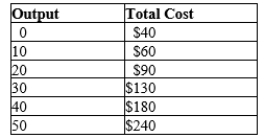 -Refer to Table 13-15. What is average fixed cost when output is 40 units?
 (Multiple Choice)
4.7/5 (81)
(81) 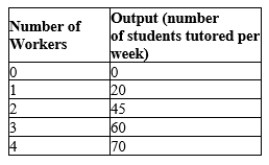 -Refer to Table 13-4. What is the marginal product of the second worker?
 (Multiple Choice)
4.9/5 (104)
(104) Which of the following costs do not vary with the amount of output a firm produces?
(Multiple Choice)
4.8/5 (85)
(85) DIFFICULTY:
Figure 13-8 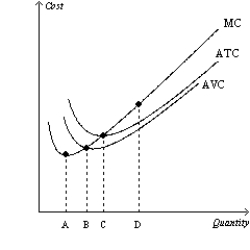 -Refer to Figure 13-8. Which of the following statements is correct?
 (Multiple Choice)
4.9/5 (79)
(79) Some costs do not vary with the quantity of output produced. Those costs are called
(Multiple Choice)
4.7/5 (74)
(74) Scenario 13-18
Farmer Jack is a watermelon farmer. If Jack plants no seeds on his farm, he gets no harvest. If he plants 1 bag of seeds, he gets 30 watermelons. If he plants 2 bags of seeds, he gets 50 watermelons. If he plants 3 bags of seeds he gets 60 watermelons. A bag of seeds costs $100, and the costs of seeds are his only costs.
-Refer to Scenario 13-18. Farmer Jack's marginal cost
(i)curve is U-shaped.
(ii)decreases with increased watermelon output.
(iii)reflects diminishing marginal product.
(Multiple Choice)
4.8/5 (85)
(85) Table 13-7  -Refer to Table 13-7. What is the marginal product of the third worker?
 (Multiple Choice)
4.9/5 (81)
(81) When economists speak of a firm's costs, they are usually excluding the opportunity costs.
(True/False)
4.9/5 (80)
(80) Thirsty Thelma owns and operates a small lemonade stand. When Thelma is producing a low quantity of lemonade she has few workers and her equipment is not being fully utilized. Because she can easily put her idle resources to use,
(Multiple Choice)
4.9/5 (72)
(72) Table 13-19 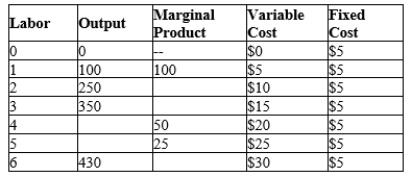 -Refer to Table 13-19. What is the average variable cost of producing 400 units of output?
 (Short Answer)
4.7/5 (62)
(62) 
Filters
- Essay(0)
- Multiple Choice(0)
- Short Answer(0)
- True False(0)
- Matching(0)