



 Chat with AI
Exam 17: Oligopoly

Exam 1: Ten Principles of Economics455 Questions
Exam 2: Thinking Like an Economist645 Questions
Exam 3: Interdependence and the Gains From Trade550 Questions
Exam 4: The Market Forces of Supply and Demand693 Questions
Exam 5: Elasticity and Its Application625 Questions
Exam 6: Supply, Demand, and Government Policies671 Questions
Exam 7: Consumers, Producers, and the Efficiency of Markets547 Questions
Exam 8: Application: The Costs of Taxation507 Questions
Exam 9: Application: International Trade521 Questions
Exam 10: Externalities543 Questions
Exam 11: Public Goods and Common Resources453 Questions
Exam 12: The Design of the Tax System563 Questions
Exam 13: The Costs of Production649 Questions
Exam 14: Firms in Competitive Markets608 Questions
Exam 15: Monopoly662 Questions
Exam 16: Monopolistic Competition649 Questions
Exam 17: Oligopoly522 Questions
Exam 18: The Markets for the Factors of Production592 Questions
Exam 19: Earnings and Discrimination511 Questions
Exam 20: Income Inequality and Poverty478 Questions
Exam 21: The Theory of Consumer Choice568 Questions
Exam 22: Frontiers in Microeconomics461 Questions
Select questions type


Scenario 17-4.
Consider two cigarette companies, PM Inc. and Brown Inc. If neither company advertises, the two companies split the market and earn $50 million each. If they both advertise, they again split the market, but profits are lower by $10 million since each company must bear the cost of advertising. Yet if one company advertises while the other does not, the one that advertises attracts customers from the other. In this case, the company that advertises earns $60 million while the company that does not advertise earns only $30 million.
-Refer to Scenario 17-4. In 1971, Congress passed a law that banned cigarette advertising on television. If cigarette companies are profit maximizers, it is likely that
(Multiple Choice)
4.9/5  (81)
(81) Table 17-14
This table shows a game played between two players, A and B. The payoffs in the table are shown as (Payoff to A, Payoff to B).  -Refer to Table 17-14. If player A chooses his/her best strategy, player B should
 (Multiple Choice)
4.8/5 (93)
(93) Table 17-27
Each year the United States considers renewal of Most Favored Nation (MFN) trading status with Farland (a mythical nation). Historically, legislators have made threats of not renewing MFN status because of human rights abuses in Farland. The non-renewal of MFN trading status is likely to involve some retaliatory measures by Farland. The payoff table below shows the potential economic gains associated with a game in which Farland may impose trade sanctions against U.S. firms and the United States may not renew MFN status with Farland. The table contains the dollar value of all trade-flow benefits to the United States and Farland. 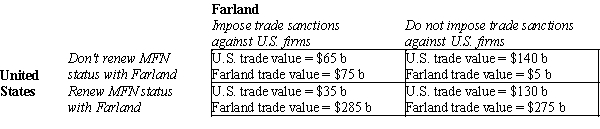 -Refer to Table 17-27. If trade negotiators are able to communicate effectively about the consequences of various trade policies (i.e., enter into an agreement about the policy they should adopt), then we would expect the countries to agree to which outcome?
 (Multiple Choice)
4.8/5 (82)
(82) Scenario 17-4.
Consider two cigarette companies, PM Inc. and Brown Inc. If neither company advertises, the two companies split the market and earn $50 million each. If they both advertise, they again split the market, but profits are lower by $10 million since each company must bear the cost of advertising. Yet if one company advertises while the other does not, the one that advertises attracts customers from the other. In this case, the company that advertises earns $60 million while the company that does not advertise earns only $30 million.
-Refer to Scenario 17-4. What will these two companies do if they behave as individual profit maximizers?
(Multiple Choice)
4.8/5 (85)
(85) In the U.S. government's 1998 suit against the Microsoft Corporation, a central issue was whether Microsoft should be allowed to integrate its Internet browser into its Windows operating system. Microsoft responded that
(Multiple Choice)
4.8/5 (78)
(78) Even when allowed to collude, firms in an oligopoly may choose to cheat on their agreements with the rest of the cartel. Why?
(Essay)
4.8/5 (94)
(94) When the prisoners' dilemma game is generalized to describe situations other than those that literally involve two prisoners, we see that cooperation between the players of the game
(Multiple Choice)
4.9/5 (84)
(84) As the number of firms in an oligopoly increases, the magnitude of the
(Multiple Choice)
4.9/5 (87)
(87) Table 17-6
Imagine a small town in which only two residents, Kunal and Naj, own wells that produce safe drinking water. Each week Kunal and Naj work together to decide how many gallons of water to pump, to bring the water to town, and to sell it at whatever price the market will bear. Assume Kunal and Naj can pump as much water as they want without cost so that the marginal cost of water equals zero.
The weekly town demand schedule and total revenue schedule for water are shown in the table below. 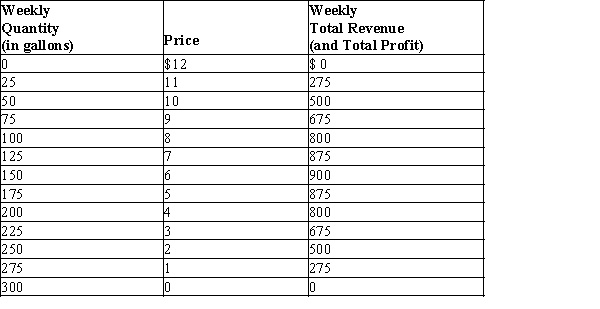 -Refer to Table 17-6. As long as Kunal and Naj operate as a profit-maximizing monopoly, what will their combined weekly revenue amount to?
 (Multiple Choice)
4.9/5 (79)
(79) Table 17-8
For a certain small town, the table shows the demand schedule for water. Assume the marginal cost of supplying water is constant at $4 per bottle and there are no other costs. 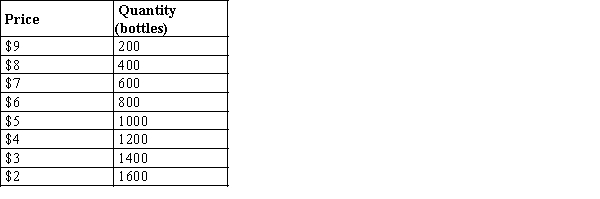 -Refer to Table 17-8. If there were only one supplier of water, what would be the price and quantity?
 (Multiple Choice)
4.9/5 (80)
(80) A cooperative agreement among oligopolists is less likely to be maintained,
(Multiple Choice)
4.9/5 (83)
(83) Which government entity is charged with investigating and enforcing antitrust laws?
(Multiple Choice)
4.8/5 (60)
(60) Table 17-11
Only two firms, ABC and XYZ, sell a particular product. The table below shows the demand curve for their product. Each firm has the same constant marginal cost of $8 and zero fixed cost. 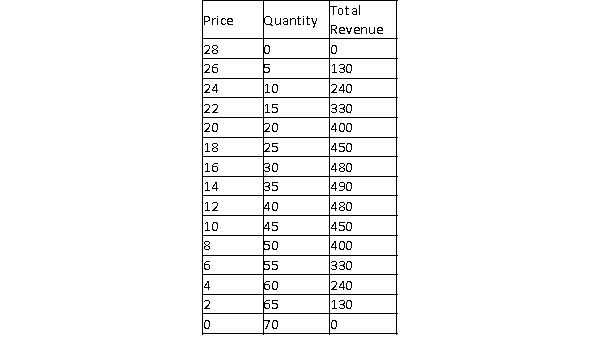 -Refer to Table 17-11. If ABC and XYZ operate to jointly maximize profits, then what quantity is sold?
 (Multiple Choice)
4.9/5 (77)
(77) Explain how the output effect and the price effect influence the production decision of the individual oligopolist.
(Essay)
4.8/5 (85)
(85) The Sherman Antitrust Act prohibits executives of competing companies from
(Multiple Choice)
4.8/5 (74)
(74) Other things the same, in which case is the quantity produced the highest?
(Multiple Choice)
4.9/5 (89)
(89) Suppose the market for home-grown peppers in the town of Smallville is comprised of two farmers. Suppose the two farmers try to collude. Explain why their collusion might not be successful.
(Essay)
5.0/5 (77)
(77) 
Filters
- Essay(0)
- Multiple Choice(0)
- Short Answer(0)
- True False(0)
- Matching(0)