



 Chat with AI
Exam 17: Oligopoly

Exam 1: Ten Principles of Economics455 Questions
Exam 2: Thinking Like an Economist645 Questions
Exam 3: Interdependence and the Gains From Trade550 Questions
Exam 4: The Market Forces of Supply and Demand693 Questions
Exam 5: Elasticity and Its Application625 Questions
Exam 6: Supply, Demand, and Government Policies671 Questions
Exam 7: Consumers, Producers, and the Efficiency of Markets547 Questions
Exam 8: Application: The Costs of Taxation507 Questions
Exam 9: Application: International Trade521 Questions
Exam 10: Externalities543 Questions
Exam 11: Public Goods and Common Resources453 Questions
Exam 12: The Design of the Tax System563 Questions
Exam 13: The Costs of Production649 Questions
Exam 14: Firms in Competitive Markets608 Questions
Exam 15: Monopoly662 Questions
Exam 16: Monopolistic Competition649 Questions
Exam 17: Oligopoly522 Questions
Exam 18: The Markets for the Factors of Production592 Questions
Exam 19: Earnings and Discrimination511 Questions
Exam 20: Income Inequality and Poverty478 Questions
Exam 21: The Theory of Consumer Choice568 Questions
Exam 22: Frontiers in Microeconomics461 Questions
Select questions type


Table 17-1
Imagine a small town in which only two residents, Rochelle and Alec, own wells that produce safe drinking water. Each week Rochelle and Alec work together to decide how many gallons of water to pump. They bring the water to town and sell it at whatever price the market will bear. To keep things simple, suppose that Rochelle and Alec can pump as much water as they want without cost so that the marginal cost of water equals zero. The town's weekly demand schedule and total revenue schedule for water is shown in the table below: 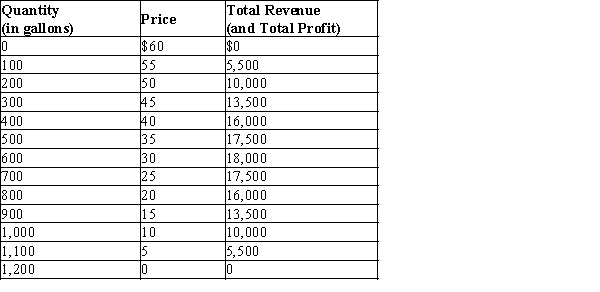 -Refer to Table 17-1. Suppose the town enacts new antitrust laws that prohibit Rochelle and Alec from operating as a monopoly. How many gallons of water will be produced and sold once Rochelle and Alec reach a Nash equilibrium?
 (Multiple Choice)
4.8/5  (87)
(87) If nations such as Germany, Japan, and the United States prohibited international trade in automobiles, a likely effect would be that
(Multiple Choice)
4.9/5 (84)
(84) Assuming that oligopolists do not have the opportunity to collude, once they have reached the Nash equilibrium, it
(Multiple Choice)
4.7/5 (78)
(78) The problems faced by oligopolies with three or more members are entirely different from the problems faced by duopolies.
(True/False)
5.0/5 (77)
(77) The manufacturer of South Face sells jackets to retail stores for $120 each, and it requires the retail stores to charge customers $150 per jacket. Any retailer that charges less than $150 would violate its contract with South Face. What do economists call this business practice?
(Multiple Choice)
4.8/5 (77)
(77) In the prisoners' dilemma game, confessing is a dominant strategy for each of the two prisoners.
(True/False)
4.8/5 (79)
(79) Table 17-1
Imagine a small town in which only two residents, Rochelle and Alec, own wells that produce safe drinking water. Each week Rochelle and Alec work together to decide how many gallons of water to pump. They bring the water to town and sell it at whatever price the market will bear. To keep things simple, suppose that Rochelle and Alec can pump as much water as they want without cost so that the marginal cost of water equals zero. The town's weekly demand schedule and total revenue schedule for water is shown in the table below:
-Refer to Table 17-1. Suppose the town enacts new antitrust laws that prohibit Rochelle and Alec from operating as a monopoly. What will be the price of water once Rochelle and Alec reach a Nash equilibrium?
-Refer to Table 17-1. Suppose the town enacts new antitrust laws that prohibit Rochelle and Alec from operating as a monopoly. What will be the price of water once Rochelle and Alec reach a Nash equilibrium? (Multiple Choice)
4.9/5 (82)
(82) What are the three examples of controversial business practices that antitrust laws often prohibit?
(Essay)
4.7/5 (75)
(75) Suppose two companies own adjacent oil fields. Under the two fields is a common pool of oil worth $60 million. For each well that is drilled, the company that drills the well incurs a cost of $4 million. Each company can drill up to two wells. What is the likely outcome of this game if each company pursues its own self-interest?
(Multiple Choice)
4.7/5 (94)
(94) Reaching and enforcing an agreement between members of a cartel becomes more difficult as the size of the group __________.
(Short Answer)
4.7/5 (74)
(74) Table 17-17
This table shows a game played between two firms, Firm A and Firm B. In this game each firm must decide how much output (Q) to produce: 2 units or 3 units. The profit for each firm is given in the table as (Profit for Firm A, Profit for Firm B).  -Refer to Table 17-17. In this game,
 (Multiple Choice)
4.9/5 (80)
(80) A distinguishing feature of an oligopolistic industry is the tension between
(Multiple Choice)
4.9/5 (85)
(85) For cartels, as the number of firms (members of the cartel) increases,
(Multiple Choice)
4.9/5 (78)
(78) It is always the case that players in a prisoner's dilemma situation will choose the Nash Equilibrium.
(True/False)
4.9/5 (71)
(71) Who wrote, "People of the same trade seldom meet together, but the conversation ends in a conspiracy against the public, or in some diversion to raise prices."?
(Multiple Choice)
5.0/5 (76)
(76) Table 17-34
Suppose that two oil companies - BP and Exxon - own adjacent natural gas fields. The profits that each firm earns depends on both the number of wells it drills and the number of wells drilled by the other firm. The table below lists each firm's individual profits:
Exxon
Drill one well Drill two wells  -Refer to Table 17-34. Does Exxon have a dominant strategy? If so, describe it.
 (Essay)
4.8/5 (84)
(84) In which of the following markets are strategic interactions among firms most likely to occur?
(Multiple Choice)
4.9/5 (76)
(76) 
Filters
- Essay(0)
- Multiple Choice(0)
- Short Answer(0)
- True False(0)
- Matching(0)