



 Chat with AI
Exam 17: Oligopoly

Exam 1: Ten Principles of Economics455 Questions
Exam 2: Thinking Like an Economist645 Questions
Exam 3: Interdependence and the Gains From Trade550 Questions
Exam 4: The Market Forces of Supply and Demand693 Questions
Exam 5: Elasticity and Its Application625 Questions
Exam 6: Supply, Demand, and Government Policies671 Questions
Exam 7: Consumers, Producers, and the Efficiency of Markets547 Questions
Exam 8: Application: The Costs of Taxation507 Questions
Exam 9: Application: International Trade521 Questions
Exam 10: Externalities543 Questions
Exam 11: Public Goods and Common Resources453 Questions
Exam 12: The Design of the Tax System563 Questions
Exam 13: The Costs of Production649 Questions
Exam 14: Firms in Competitive Markets608 Questions
Exam 15: Monopoly662 Questions
Exam 16: Monopolistic Competition649 Questions
Exam 17: Oligopoly522 Questions
Exam 18: The Markets for the Factors of Production592 Questions
Exam 19: Earnings and Discrimination511 Questions
Exam 20: Income Inequality and Poverty478 Questions
Exam 21: The Theory of Consumer Choice568 Questions
Exam 22: Frontiers in Microeconomics461 Questions
Select questions type


When individuals are damaged by an illegal arrangement to restrain trade, which law allows them to pursue civil action and recover up to three times the damages sustained?
(Multiple Choice)
4.9/5  (84)
(84) Table 17-7
The information in the table below shows the total demand for internet radio subscriptions in a small urban market. Assume that each company that provides these subscriptions incurs an annual fixed cost of $20,000 (per year) and that the marginal cost of providing an additional subscription is always $16. 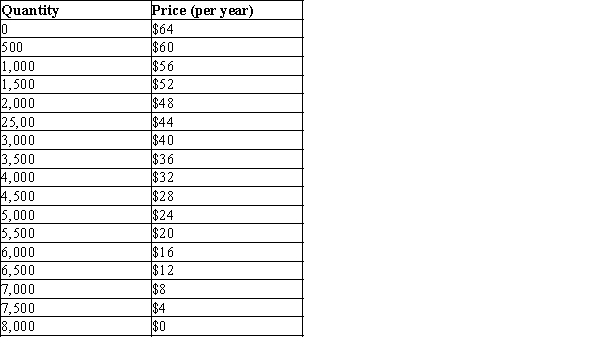 -Refer to Table 17-7. Assume there are two profit-maximizing internet radio providers operating in this market. Further assume that they are not able to collude on the price and quantity of subscriptions to sell. What price will they charge for a subscription when this market reaches a Nash equilibrium?
 (Multiple Choice)
4.8/5 (82)
(82) In which case do firms have some control over their price?
(Multiple Choice)
4.9/5 (84)
(84) Briefly describe the two arguments that economists make to defend the practice of resale price maintenance.
(Essay)
4.9/5 (81)
(81) Why are the actions of firms interdependent in an oligopoly market but not in a monopolistically competitive market?
(Essay)
4.8/5 (69)
(69) Why do economists use game theory to study the actions of firms in oligopoly markets but not in other markets?
(Essay)
5.0/5 (86)
(86) Scenario 17-4.
Consider two cigarette companies, PM Inc. and Brown Inc. If neither company advertises, the two companies split the market and earn $50 million each. If they both advertise, they again split the market, but profits are lower by $10 million since each company must bear the cost of advertising. Yet if one company advertises while the other does not, the one that advertises attracts customers from the other. In this case, the company that advertises earns $60 million while the company that does not advertise earns only $30 million.
-Refer to Scenario 17-4. The likely outcome of this game is that PM Inc. earns
(Multiple Choice)
4.7/5 (87)
(87) As a group, oligopolists earn the highest profit when they
(Multiple Choice)
4.9/5 (81)
(81) Oligopolies produce more when they collude then when they do not.
(True/False)
4.9/5 (77)
(77) Figure 17-3. Hector and Bart are roommates. On a particular day, their apartment needs to be cleaned. Each person has to decide whether to take part in cleaning. At the end of the day, either the apartment will be completely clean (if one or both roommates take part in cleaning), or it will remain dirty (if neither roommate cleans). With happiness measured on a scale of 1 (very unhappy) to 10 (very happy), the possible outcomes are as follows: 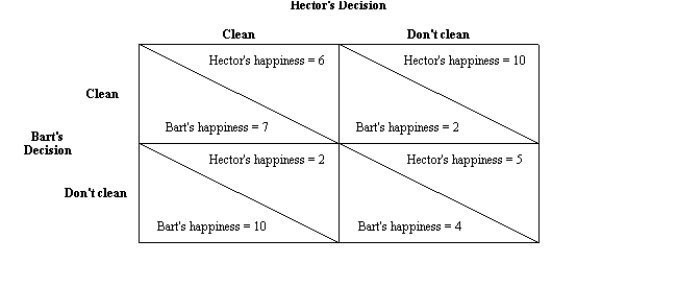 -Refer to Figure 17-3. The dominant strategy for Hector is to
 (Multiple Choice)
4.8/5 (75)
(75) Table 17-28
Suppose that two firms determine that each could lower its costs and increase its profits if both reduced their advertising budgets. But in order for the plan to work, each firm must agree to refrain from advertising. Each firm believes that advertising works by increasing the demand for the firm's product, but each firm also believes that if neither firm advertises, the cost savings will outweigh the lost sales. The table below lists each firm's individual profits:
Firm A
Breaks agreement Maintains agreement
and advertises and does not advertise  -Refer to Table 17-28. Which of the following statements does not correctly characterize the outcome of this game?
 (Multiple Choice)
4.9/5 (70)
(70) Table 17-14
This table shows a game played between two players, A and B. The payoffs in the table are shown as (Payoff to A, Payoff to B).  -Refer to Table 17-14. Which outcome is the Nash equilibrium in this game?
 (Multiple Choice)
4.7/5 (71)
(71) Table 17-20
Nadia and Maddie are two college roommates who both prefer a clean common space in their dorm room, but neither enjoys cleaning. The roommates must each make a decision to either clean or not clean the dorm room's common space. The payoff table for this situation is provided below, where the higher a player's payoff number, the better off that player is. The payoffs in each cell are shown as (payoff for Nadia, payoff for Maddie).  -Refer to Table 17-20. If Nadia chooses to not clean, then Maddie will
 (Multiple Choice)
4.9/5 (71)
(71) Scenario 17-5
Assume that a local restaurant sells two items, salads and steaks. The restaurant's only two customers on a particular day are Mr. Carnivore and Ms. Leafygreens. Mr. Carnivore is willing to pay $20 for a steak and $7 for a salad. Ms. Leafygreens is willing to pay only $8 for a steak, but is willing to pay $12 for a salad. Assume that the restaurant can provide each of these items at zero marginal cost.
-Refer to Scenario 17-5. How much additional profit can the restaurant earn by switching to the use of a tying strategy to price salads and steaks rather than pricing these goods separately?
(Multiple Choice)
4.9/5 (68)
(68) A central issue in the Microsoft antitrust lawsuit involved Microsoft's integration of its Internet browser into its Windows operating system, to be sold as one unit. This practice is known as
(Multiple Choice)
4.9/5 (74)
(74) George and Jerry are competitors in a local market. Each is trying to decide if it is better to advertise on TV, on radio, or not at all. If they both advertise on TV, each will earn a profit of $3,000. If they both advertise on radio, each will earn a profit of $5,000. If neither advertises at all, each will earn a profit of $10,000. If one advertises on TV and the other advertises on radio, then the one advertising on TV will earn $4,000 and the other will earn $2,000. If one advertises on TV and the other does not advertise, then the one advertising on TV will earn $8,000 and the other will earn $5,000. If one advertises on radio and the other does not advertise, then the one advertising on radio will earn $9,000 and the other will earn $6,000. If both follow their dominant strategy, then George will
(Multiple Choice)
4.9/5 (87)
(87) Individual profit earned by Dave, the oligopolist, depends on which of the following? (i)
The quantity of output that Dave produces
(ii)
The quantities of output that the other firms in the market produce
(iii)
The extent of collusion between Dave and the other firms in the market
(Multiple Choice)
4.9/5 (92)
(92) How did the Clayton Act of 1914 differ from the Sherman Antitrust Act of 1890?
(Essay)
4.9/5 (72)
(72) 
Filters
- Essay(0)
- Multiple Choice(0)
- Short Answer(0)
- True False(0)
- Matching(0)