



 Chat with AI
Exam 17: Oligopoly

Exam 1: Ten Principles of Economics455 Questions
Exam 2: Thinking Like an Economist645 Questions
Exam 3: Interdependence and the Gains From Trade550 Questions
Exam 4: The Market Forces of Supply and Demand693 Questions
Exam 5: Elasticity and Its Application625 Questions
Exam 6: Supply, Demand, and Government Policies671 Questions
Exam 7: Consumers, Producers, and the Efficiency of Markets547 Questions
Exam 8: Application: The Costs of Taxation507 Questions
Exam 9: Application: International Trade521 Questions
Exam 10: Externalities543 Questions
Exam 11: Public Goods and Common Resources453 Questions
Exam 12: The Design of the Tax System563 Questions
Exam 13: The Costs of Production649 Questions
Exam 14: Firms in Competitive Markets608 Questions
Exam 15: Monopoly662 Questions
Exam 16: Monopolistic Competition649 Questions
Exam 17: Oligopoly522 Questions
Exam 18: The Markets for the Factors of Production592 Questions
Exam 19: Earnings and Discrimination511 Questions
Exam 20: Income Inequality and Poverty478 Questions
Exam 21: The Theory of Consumer Choice568 Questions
Exam 22: Frontiers in Microeconomics461 Questions
Select questions type


Which of the following would be most likely to contribute to the breakdown of a cartel in a natural resource (e.g., bauxite) market?
(Multiple Choice)
4.9/5  (74)
(74) Table 17-11
Only two firms, ABC and XYZ, sell a particular product. The table below shows the demand curve for their product. Each firm has the same constant marginal cost of $8 and zero fixed cost. 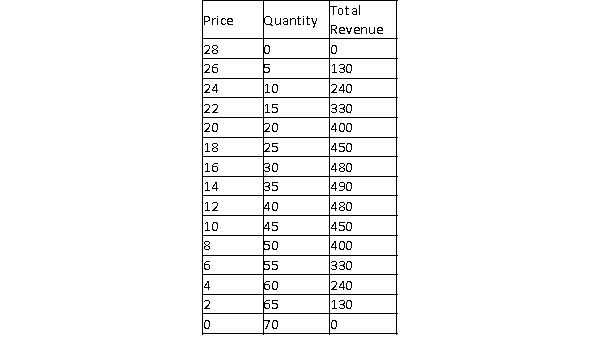 -Refer to Table 17-11. If ABC and XYZ operate to jointly maximize profits and agree to share the profit equally, then how much profit will each of them earn?
 (Multiple Choice)
4.7/5 (88)
(88) Scenario 17-6
Assume that a local telecommunications company sells high speed internet access and cable television. The company's only two customers are Taylor and Tim. Taylor is willing to pay $50 per month for high speed internet access and $50 per month for cable television. Tim is willing to pay only $20 per month for high speed internet access, but is willing to pay $70 per month for cable television. Assume that the telecommunications company can provide each of these products at zero marginal cost.
-Refer to Scenario 17-6. How much additional profit can the telecommunications company earn by switching to the use of a tying strategy to price high speed internet access and cable television rather than pricing these goods separately?
(Short Answer)
4.9/5 (90)
(90) Table 17-18
This table shows a game played between two firms, Firm A and Firm B. In this game each firm must decide how much output (Q) to produce: 10 units or 12 units. The profit for each firm is given in the table as (Profit for Firm A, Profit for Firm B).  -Refer to Table 17-18. If these two firms agree to cooperate to maximize their joint profit, the outcome of the game will be
 (Multiple Choice)
4.8/5 (68)
(68) Table 17-35
Suppose that two coal mining companies - Allied and Barclay - own adjacent land suitable for excavating coal mines. The profits that each firm earns depends on both the number of mines it excavates and the number of mines excavated by the other firm. The table below lists each firm's individual profits:
Allied
Excavate one mine Excavate two mines  -Refer to Table 17-35. Does Allied have a dominant strategy? If so, describe it.
 (Essay)
4.8/5 (72)
(72) There are two types of markets in which firms face some competition yet are still able to have some control over the prices of their products. Those two types of market are
(Multiple Choice)
4.8/5 (61)
(61) Table 17-6
Imagine a small town in which only two residents, Kunal and Naj, own wells that produce safe drinking water. Each week Kunal and Naj work together to decide how many gallons of water to pump, to bring the water to town, and to sell it at whatever price the market will bear. Assume Kunal and Naj can pump as much water as they want without cost so that the marginal cost of water equals zero.
The weekly town demand schedule and total revenue schedule for water are shown in the table below. 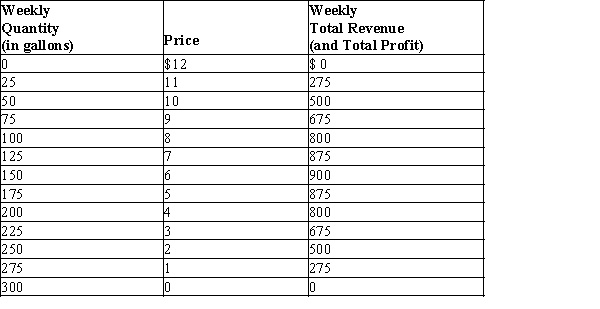 -Refer to Table 17-6. Suppose the town enacts new antitrust laws that prohibit Kunal and Naj from operating as a monopolist. What will the new price of water be once the Nash equilibrium is reached?
 (Multiple Choice)
4.8/5 (81)
(81) The Sherman Antitrust Act states that if a person can prove that he was damaged by an illegal arrangement to restrain trade, he could sue and recover three times the damages he sustained.
(True/False)
4.9/5 (75)
(75) When firms are faced with making strategic choices to maximize profit, economists typically use
(Multiple Choice)
4.8/5 (78)
(78) All examples of the prisoner's dilemma game are characterized by one and only one Nash equilibrium.
(True/False)
4.9/5 (92)
(92) Two suspected drug dealers are stopped by the highway patrol for speeding. The officer searches the car and finds a small bag of marijuana and arrests the two. During the interrogation, each is separately offered the following: "If you confess to dealing drugs and testify against your partner, you will be given immunity and released while your partner will get 10 years in prison. If you both confess, you will each get 5 years." If neither confesses, there is no evidence of drug dealing, and the most they could get is one year each for possession of marijuana. If each suspected drug dealer follows a dominant strategy, what should he/she do?
(Multiple Choice)
4.8/5 (85)
(85) When all firms choose their best strategy given the strategies that all the other firms have chosen, the result is a Nash equilibrium.
(True/False)
4.9/5 (77)
(77) An equilibrium in which each firm in an oligopoly maximizes profit, given the actions of its rivals, is called
(Multiple Choice)
4.8/5 (83)
(83) Table 17-35
Suppose that two coal mining companies - Allied and Barclay - own adjacent land suitable for excavating coal mines. The profits that each firm earns depends on both the number of mines it excavates and the number of mines excavated by the other firm. The table below lists each firm's individual profits:
Allied
Excavate one mine Excavate two mines
-Refer to Table 17-35. Does Barclay have a dominant strategy? If so, describe it.
-Refer to Table 17-35. Does Barclay have a dominant strategy? If so, describe it. (Essay)
4.9/5 (76)
(76) Table 17-12
The table shows the town of Driveaway's demand schedule for gasoline. Assume the town's gasoline seller(s) incurs a cost of $2 for each gallon sold, with no fixed cost. 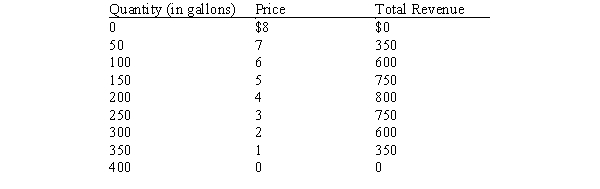 -Refer to Table 17-12. If the market for gasoline in Driveaway is a monopoly, then the profit-maximizing monopolist will charge a price of
 (Multiple Choice)
4.8/5 (75)
(75) Table 17-37
Two restaurants with a focus on Mexican dining operate in Texama. Both Mitch's Mexican and Tim's Tacos need to decide whether to add Zesty Queso or Fresh Guacamole to their menus. The circumstances are that each firm wants to add only one of the two choices on their menu. Below you will find the profits for the stores, shown as: (1) the payoff to Mitch; (2) the payoff to Tim. 
-Refer to Table 17-37. Based upon the information from the table, what is the Nash Equilibrium?
-Refer to Table 17-37. Based upon the information from the table, what is the Nash Equilibrium? (Multiple Choice)
4.8/5 (87)
(87) Table 17-35
Suppose that two coal mining companies - Allied and Barclay - own adjacent land suitable for excavating coal mines. The profits that each firm earns depends on both the number of mines it excavates and the number of mines excavated by the other firm. The table below lists each firm's individual profits:
Allied
Excavate one mine Excavate two mines
-Refer to Table 17-35. Is there a Nash equilibrium? If so, describe it.
-Refer to Table 17-35. Is there a Nash equilibrium? If so, describe it. (Essay)
4.8/5 (78)
(78) Whether an oligopoly consists of 3 firms or 10 firms, the level of output likely will be the same.
(True/False)
4.9/5 (72)
(72) 
Filters
- Essay(0)
- Multiple Choice(0)
- Short Answer(0)
- True False(0)
- Matching(0)