



 Chat with AI
Exam 17: Oligopoly

Exam 1: Ten Principles of Economics455 Questions
Exam 2: Thinking Like an Economist645 Questions
Exam 3: Interdependence and the Gains From Trade550 Questions
Exam 4: The Market Forces of Supply and Demand693 Questions
Exam 5: Elasticity and Its Application625 Questions
Exam 6: Supply, Demand, and Government Policies671 Questions
Exam 7: Consumers, Producers, and the Efficiency of Markets547 Questions
Exam 8: Application: The Costs of Taxation507 Questions
Exam 9: Application: International Trade521 Questions
Exam 10: Externalities543 Questions
Exam 11: Public Goods and Common Resources453 Questions
Exam 12: The Design of the Tax System563 Questions
Exam 13: The Costs of Production649 Questions
Exam 14: Firms in Competitive Markets608 Questions
Exam 15: Monopoly662 Questions
Exam 16: Monopolistic Competition649 Questions
Exam 17: Oligopoly522 Questions
Exam 18: The Markets for the Factors of Production592 Questions
Exam 19: Earnings and Discrimination511 Questions
Exam 20: Income Inequality and Poverty478 Questions
Exam 21: The Theory of Consumer Choice568 Questions
Exam 22: Frontiers in Microeconomics461 Questions
Select questions type


Firms do not need to be concerned about striking a balance between the price effect and the output effect when making production decisions in which of the following types of markets?
(Multiple Choice)
4.7/5  (81)
(81) Figure 17-4. Aaron and Ed are roommates. After a big snowstorm, their driveway needs to be shoveled. Each person has to decide whether to take part in shoveling the driveway. At the end of the day, either the driveway will be shoveled (if one or both roommates take part in shoveling), or it will remain unshoveled (if neither roommate shovels). With happiness measured on a scale of 1 (very unhappy) to 10 (very happy), the possible outcomes are as follows: 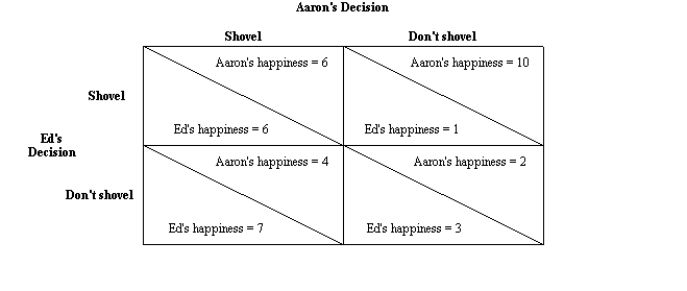 -Refer to Figure 17-4. In pursuing his own self-interest, Aaron will
 (Multiple Choice)
4.8/5 (86)
(86) After initial success, the OPEC cartel saw the price of oil and the revenues of its members decline due, in part, to
(Multiple Choice)
4.7/5 (78)
(78) If a person can prove that she was damaged by an illegal arrangement to restrain trade, that person can sue and recover
(Multiple Choice)
4.9/5 (86)
(86) Scenario 17-1.
Assume that the countries of Irun and Urun are the only two producers of crude oil. Further assume that both countries have entered into an agreement to maintain certain production levels in order to maximize profits. In the world market for oil, the demand curve is downward sloping.
-Refer to Scenario 17-1. The fact that both countries have colluded to earn higher profit shows their desire to keep their combined level of output
(Multiple Choice)
4.8/5 (88)
(88) Figure 17-1 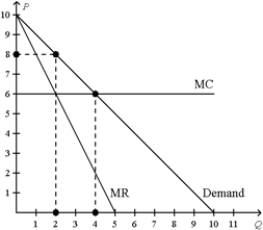 -Refer to Figure 17-1. Suppose this market is served by two firms who each face the marginal cost curve shown in the diagram and have zero fixed cost. The marginal revenue curve that a monopolist would face in this market is also shown. If the firms are able to collude successfully, each firm should earn a profit equal to
 (Multiple Choice)
4.7/5 (79)
(79) Table 17-34
Suppose that two oil companies - BP and Exxon - own adjacent natural gas fields. The profits that each firm earns depends on both the number of wells it drills and the number of wells drilled by the other firm. The table below lists each firm's individual profits:
Exxon
Drill one well Drill two wells  -Refer to Table 17-34. Does BP have a dominant strategy? If so, describe it.
 (Essay)
4.9/5 (78)
(78) Juan Pablo and Zak are competitors in a local market. Each is trying to decide if it is better to advertise on TV, on radio, or not at all. If they both advertise on TV, each will earn a profit of $8,000. If they both advertise on radio, each will earn a profit of $14,000. If neither advertises at all, each will earn a profit of $20,000. If one advertises on TV and other advertises on radio, then the one advertising on TV will earn $12,000 and the other will earn $10,000. If one advertises on TV and the other does not advertise, then the one advertising on TV will earn $22,000 and the other will earn $4,000. If one advertises on radio and the other does not advertise, then the one advertising on radio will earn $24,000 and the other will earn $8,000. If both follow their dominant strategy, then Juan Pablo will
(Multiple Choice)
4.9/5 (80)
(80) Table 17-25
There are just two producers of a certain product. Each is considering offering promotional discounts.  -Refer to Table 17-25. At the Nash equilibrium, how much profit will Firm A earn?
 (Multiple Choice)
4.9/5 (72)
(72) Although the practice of predatory pricing is a common claim in antitrust suits, some economists are skeptical of this argument because they believe
(Multiple Choice)
5.0/5 (66)
(66) Which of the following is necessarily a problem with antitrust laws?
(Multiple Choice)
4.8/5 (75)
(75) To function as a monopoly, OPEC and other cartels rely on __________ among members.
(Short Answer)
5.0/5 (90)
(90) Table 17-20
Nadia and Maddie are two college roommates who both prefer a clean common space in their dorm room, but neither enjoys cleaning. The roommates must each make a decision to either clean or not clean the dorm room's common space. The payoff table for this situation is provided below, where the higher a player's payoff number, the better off that player is. The payoffs in each cell are shown as (payoff for Nadia, payoff for Maddie).  -Refer to Table 17-20. What is Maddie's dominant strategy?
 (Multiple Choice)
4.9/5 (88)
(88) Table 17-26
Two prescription drug manufacturers (Firm A and Firm B) are faced with lawsuits from states to recover the healthcare related expenses associated with side-effects from its drugs. Each drug manufacturer has evidence that indicates that taking its prescription drug causes liver failure. State prosecutors do not have access to the same data used by drug manufacturers and thus will have difficulty recovering full costs without the help of at least one of the drug manufacturer's studies. Each firm has been presented with an opportunity to lower its liability in the suit if it cooperates with attorneys representing the states. 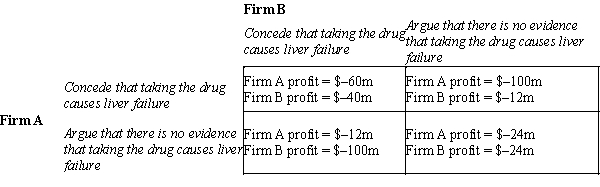 -Refer to Table 17-26. Which of the following statements is correct?
 (Multiple Choice)
4.7/5 (83)
(83) Table 17-16
This table shows a game played between two players, A and B. The payoffs are given in the table as (Payoff to A, Payoff to B).  -Refer to Table 17-16. Which of the following outcomes represents a Nash equilibrium in the game?
 (Multiple Choice)
4.9/5 (76)
(76) Table 17-20
Nadia and Maddie are two college roommates who both prefer a clean common space in their dorm room, but neither enjoys cleaning. The roommates must each make a decision to either clean or not clean the dorm room's common space. The payoff table for this situation is provided below, where the higher a player's payoff number, the better off that player is. The payoffs in each cell are shown as (payoff for Nadia, payoff for Maddie).
-Refer to Table 17-20. If Maddie chooses to clean, then Nadia will
-Refer to Table 17-20. If Maddie chooses to clean, then Nadia will (Multiple Choice)
4.9/5 (84)
(84) 
Filters
- Essay(0)
- Multiple Choice(0)
- Short Answer(0)
- True False(0)
- Matching(0)