



 Chat with AI
Exam 17: Oligopoly

Exam 1: Ten Principles of Economics455 Questions
Exam 2: Thinking Like an Economist645 Questions
Exam 3: Interdependence and the Gains From Trade550 Questions
Exam 4: The Market Forces of Supply and Demand693 Questions
Exam 5: Elasticity and Its Application625 Questions
Exam 6: Supply, Demand, and Government Policies671 Questions
Exam 7: Consumers, Producers, and the Efficiency of Markets547 Questions
Exam 8: Application: The Costs of Taxation507 Questions
Exam 9: Application: International Trade521 Questions
Exam 10: Externalities543 Questions
Exam 11: Public Goods and Common Resources453 Questions
Exam 12: The Design of the Tax System563 Questions
Exam 13: The Costs of Production649 Questions
Exam 14: Firms in Competitive Markets608 Questions
Exam 15: Monopoly662 Questions
Exam 16: Monopolistic Competition649 Questions
Exam 17: Oligopoly522 Questions
Exam 18: The Markets for the Factors of Production592 Questions
Exam 19: Earnings and Discrimination511 Questions
Exam 20: Income Inequality and Poverty478 Questions
Exam 21: The Theory of Consumer Choice568 Questions
Exam 22: Frontiers in Microeconomics461 Questions
Select questions type


If one firm left a duopoly market where the firms did not cooperate then
(Multiple Choice)
4.8/5  (69)
(69) An oligopoly would tend to restrict output and drive up price if
(Multiple Choice)
4.8/5 (86)
(86) Assume oligopoly firms are profit maximizers, they do not form a cartel, and they take other firms' production levels as given. Then in equilibrium the output effect
(Multiple Choice)
4.9/5 (73)
(73) The theory of oligopoly provides another reason that free trade can benefit all countries because
(Multiple Choice)
4.9/5 (68)
(68) A group of firms that act in unison to maximize collective profits is called a
(Multiple Choice)
4.8/5 (79)
(79) Table 17-26
Two prescription drug manufacturers (Firm A and Firm B) are faced with lawsuits from states to recover the healthcare related expenses associated with side-effects from its drugs. Each drug manufacturer has evidence that indicates that taking its prescription drug causes liver failure. State prosecutors do not have access to the same data used by drug manufacturers and thus will have difficulty recovering full costs without the help of at least one of the drug manufacturer's studies. Each firm has been presented with an opportunity to lower its liability in the suit if it cooperates with attorneys representing the states. 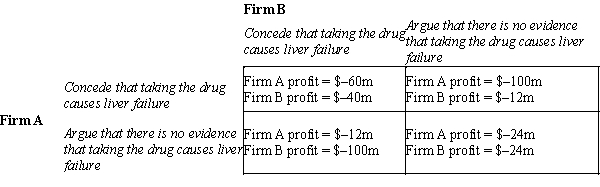 -Refer to Table 17-26. Pursuing its own best interests, Firm B will concede that taking its drug causes liver failure
 (Multiple Choice)
4.7/5 (60)
(60) Figure 17-2. Two companies, Acme and Pinnacle, each decide whether to produce a good quality product or a poor quality product. In the figure, the dollar amounts are payoffs and they represent annual profits for the two companies. 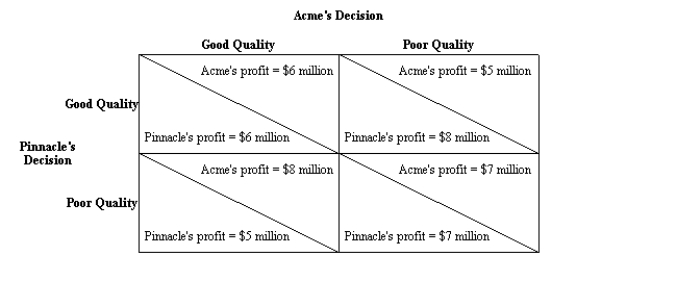 -Refer to Figure 17-2. The more frequently this game is played, the more likely it is that
 (Multiple Choice)
4.9/5 (80)
(80) Table 17-32
Suppose that Angelina and Brad own the only two professional photography stores in town. Each must choose between a low price and a high price for senior photo packages. The annual economic profit from each strategy is indicated in the table below:
Angelina
Low price High price  -Refer to Table 17-32. Does Angelina have a dominant strategy? If so, describe it.
 (Essay)
4.9/5 (78)
(78) Table 17-5
The information in the table below shows the total demand for premium-channel digital cable TV subscriptions in a small urban market. Assume that each digital cable TV operator pays a fixed cost of $200,000 (per year) to provide premium digital channels in the market area and that the marginal cost of providing the premium channel service to a household is zero. 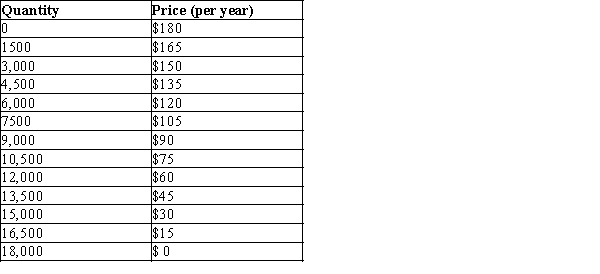 -Refer to Table 17-5. Assume there are two profit-maximizing digital cable TV companies operating in this market. Further assume that they are not able to collude on the price and quantity of premium digital channel subscriptions to sell. What price will premium digital channel cable TV subscriptions be sold at when this market reaches a Nash equilibrium?
 (Multiple Choice)
4.8/5 (100)
(100) Table 17-13
Two home-improvement stores (Lopes and HomeMax) in a growing urban area are interested in expanding their market share. Both are interested in expanding the size of their store and parking lot to accommodate potential growth in their customer base. The following game depicts the strategic outcomes that result from the game. Increases in annual profits of the two home-improvement stores are shown in the table below. 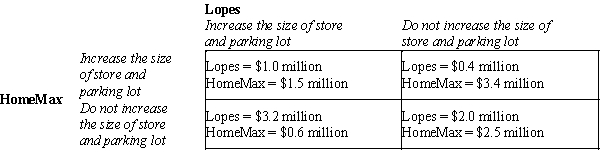 -Refer to Table 17-13. Suppose the owners of Lopes and HomeMax meet for a friendly game of golf one afternoon and happen to discuss a strategy to optimize growth related profit. They should both agree to
 (Multiple Choice)
4.9/5 (79)
(79) Table 17-9
The table shows the demand schedule for a particular product. 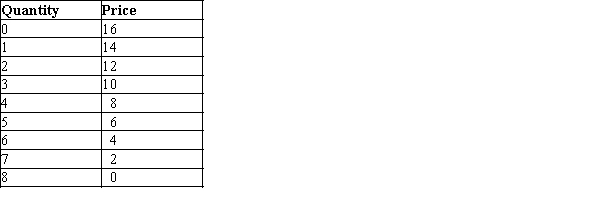 -Refer to Table 17-9. Suppose the market for this product is served by two firms that have formed a cartel. If the marginal cost of production is $0 and there is no fixed cost, the combined profit of the cartel will be
 (Multiple Choice)
4.9/5 (80)
(80) Very often, the reason that players can solve the prisoners' dilemma and reach the most profitable outcome is that
(Multiple Choice)
4.7/5 (95)
(95) A dominant strategy is a strategy that is best for a player in a game regardless of the strategies chosen by the other players.
(True/False)
4.7/5 (74)
(74) Figure 17-3. Hector and Bart are roommates. On a particular day, their apartment needs to be cleaned. Each person has to decide whether to take part in cleaning. At the end of the day, either the apartment will be completely clean (if one or both roommates take part in cleaning), or it will remain dirty (if neither roommate cleans). With happiness measured on a scale of 1 (very unhappy) to 10 (very happy), the possible outcomes are as follows: 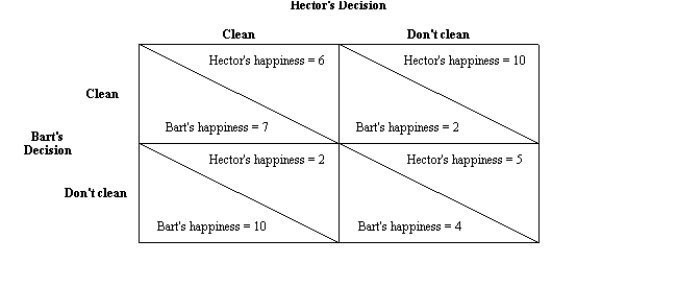 -Refer to Figure 17-3. In pursuing his own self-interest, Bart will
 (Multiple Choice)
4.8/5 (87)
(87) Cartels with a small number of firms have a greater probability of reaching the monopoly outcome than do cartels with a larger number of firms.
(True/False)
4.8/5 (84)
(84) In a duopoly situation, the logic of self-interest results in a total output level that
(Multiple Choice)
4.9/5 (88)
(88) Table 17-21
The Chicken Game is named for a contest in which drivers test their courage by driving straight at each other. John and Paul have a common interest to avoid crashing into each other, but they also have a personal, competing interest to not turn first to demonstrate their courage to those observing the contest. The payoff table for this situation is provided below. The payoffs are shown as (John, Paul).  -Refer to Table 17-21. If John chooses Drive Straight, what will Paul choose to do and what will Paul's payoff equal?
 (Multiple Choice)
4.9/5 (90)
(90) Table 17-5
The information in the table below shows the total demand for premium-channel digital cable TV subscriptions in a small urban market. Assume that each digital cable TV operator pays a fixed cost of $200,000 (per year) to provide premium digital channels in the market area and that the marginal cost of providing the premium channel service to a household is zero.
-Refer to Table 17-5. Assume that there are two profit-maximizing digital cable TV companies operating in this market. Further assume that they are not able to collude on the price and quantity of premium digital channel subscriptions to sell. How much profit will each firm earn when this market reaches a Nash equilibrium?
-Refer to Table 17-5. Assume that there are two profit-maximizing digital cable TV companies operating in this market. Further assume that they are not able to collude on the price and quantity of premium digital channel subscriptions to sell. How much profit will each firm earn when this market reaches a Nash equilibrium? (Multiple Choice)
4.9/5 (67)
(67) 
Filters
- Essay(0)
- Multiple Choice(0)
- Short Answer(0)
- True False(0)
- Matching(0)