



 Chat with AI
Exam 17: Oligopoly

Exam 1: Ten Principles of Economics455 Questions
Exam 2: Thinking Like an Economist645 Questions
Exam 3: Interdependence and the Gains From Trade550 Questions
Exam 4: The Market Forces of Supply and Demand693 Questions
Exam 5: Elasticity and Its Application625 Questions
Exam 6: Supply, Demand, and Government Policies671 Questions
Exam 7: Consumers, Producers, and the Efficiency of Markets547 Questions
Exam 8: Application: The Costs of Taxation507 Questions
Exam 9: Application: International Trade521 Questions
Exam 10: Externalities543 Questions
Exam 11: Public Goods and Common Resources453 Questions
Exam 12: The Design of the Tax System563 Questions
Exam 13: The Costs of Production649 Questions
Exam 14: Firms in Competitive Markets608 Questions
Exam 15: Monopoly662 Questions
Exam 16: Monopolistic Competition649 Questions
Exam 17: Oligopoly522 Questions
Exam 18: The Markets for the Factors of Production592 Questions
Exam 19: Earnings and Discrimination511 Questions
Exam 20: Income Inequality and Poverty478 Questions
Exam 21: The Theory of Consumer Choice568 Questions
Exam 22: Frontiers in Microeconomics461 Questions
Select questions type


Table 17-6
Imagine a small town in which only two residents, Kunal and Naj, own wells that produce safe drinking water. Each week Kunal and Naj work together to decide how many gallons of water to pump, to bring the water to town, and to sell it at whatever price the market will bear. Assume Kunal and Naj can pump as much water as they want without cost so that the marginal cost of water equals zero.
The weekly town demand schedule and total revenue schedule for water are shown in the table below. 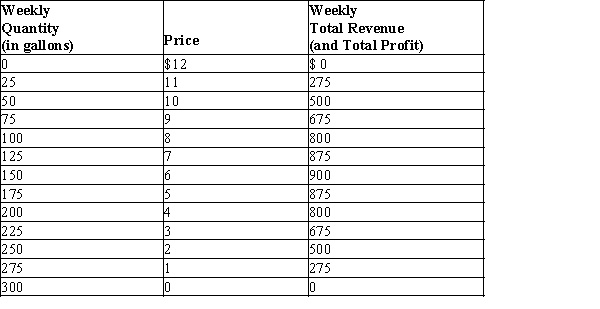 -Refer to Table 17-6. If the market for water were perfectly competitive instead of monopolistic, how many gallons of water would be produced and sold?
 (Multiple Choice)
4.9/5  (78)
(78) Oligopolies can end up looking like competitive markets if the number of firms is
(Multiple Choice)
4.8/5 (72)
(72) Table 17-17
This table shows a game played between two firms, Firm A and Firm B. In this game each firm must decide how much output (Q) to produce: 2 units or 3 units. The profit for each firm is given in the table as (Profit for Firm A, Profit for Firm B).  -Refer to Table 17-17. Which of the following outcomes represent the Nash equilibrium in this game?
 (Multiple Choice)
4.9/5 (80)
(80) A situation in which firms choose their best strategy given the strategies chosen by the other firms in the market is called
(Multiple Choice)
4.8/5 (81)
(81) Table 17-21
The Chicken Game is named for a contest in which drivers test their courage by driving straight at each other. John and Paul have a common interest to avoid crashing into each other, but they also have a personal, competing interest to not turn first to demonstrate their courage to those observing the contest. The payoff table for this situation is provided below. The payoffs are shown as (John, Paul).  -Refer to Table 17-21. If Paul chooses Turn, what will John choose to do and what will John's payoff equal?
 (Multiple Choice)
4.8/5 (78)
(78) In choosing among alternative courses of action, Raj must consider how others might respond to the action he takes. In the language of game theory, we say that Raj must think
(Multiple Choice)
4.8/5 (81)
(81) Table 17-33
Suppose that Robert and Howard own the only two movie studios in California. Each producer must choose between a low budget and a high budget strategy for his next film. The economic profit from each strategy is indicated in the table below:
Howard
Low budget High budget  -Refer to Table 17-33. Is there a Nash equilibrium? If so, describe it.
 (Essay)
4.9/5 (87)
(87) Which of the controversial business practices, resale price maintenance, predatory pricing, or tying, was a part of a long-running antitrust lawsuit against Microsoft and why?
(Essay)
4.9/5 (78)
(78) If the output effect is larger than the price effect, an individual firm will __________ production.
(Short Answer)
4.8/5 (79)
(79) An agreement among firms in a market about quantities to produce or prices to charge is called
(Multiple Choice)
4.8/5 (76)
(76) Table 17-11
Only two firms, ABC and XYZ, sell a particular product. The table below shows the demand curve for their product. Each firm has the same constant marginal cost of $8 and zero fixed cost. 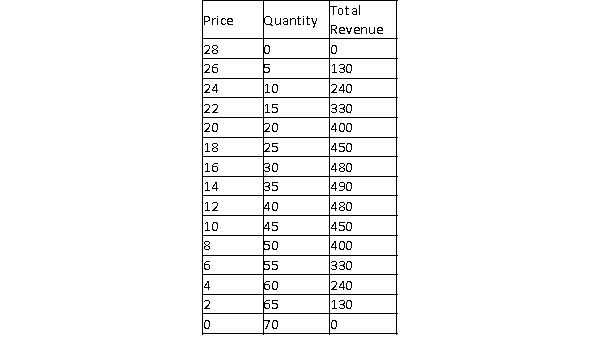 -Refer to Table 17-11. If this market were perfectly competitive instead of oligopolistic, what quantity would be produced?
 (Multiple Choice)
4.7/5 (84)
(84) Game theory is useful to analyze oligopoly markets because
(Multiple Choice)
4.8/5 (91)
(91) A special kind of imperfectly competitive market that has only two firms is called
(Multiple Choice)
4.8/5 (81)
(81) Table 17-6
Imagine a small town in which only two residents, Kunal and Naj, own wells that produce safe drinking water. Each week Kunal and Naj work together to decide how many gallons of water to pump, to bring the water to town, and to sell it at whatever price the market will bear. Assume Kunal and Naj can pump as much water as they want without cost so that the marginal cost of water equals zero.
The weekly town demand schedule and total revenue schedule for water are shown in the table below.
-Refer to Table 17-6. Suppose the town enacts new antitrust laws that prohibit Kunal and Naj from operating as a monopolist. Once the Nash equilibrium is reached, how much profit will each producer earn?
-Refer to Table 17-6. Suppose the town enacts new antitrust laws that prohibit Kunal and Naj from operating as a monopolist. Once the Nash equilibrium is reached, how much profit will each producer earn? (Multiple Choice)
4.7/5 (74)
(74) Table 17-27
Each year the United States considers renewal of Most Favored Nation (MFN) trading status with Farland (a mythical nation). Historically, legislators have made threats of not renewing MFN status because of human rights abuses in Farland. The non-renewal of MFN trading status is likely to involve some retaliatory measures by Farland. The payoff table below shows the potential economic gains associated with a game in which Farland may impose trade sanctions against U.S. firms and the United States may not renew MFN status with Farland. The table contains the dollar value of all trade-flow benefits to the United States and Farland. 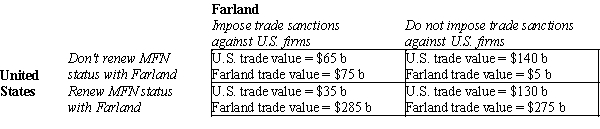 -Refer to Table 17-27. Pursuing its own best interests, Farland will impose trade sanctions against U.S. firms
 (Multiple Choice)
4.7/5 (67)
(67) We must be knowledgeable of how people behave in strategic situations if we are to understand
(Multiple Choice)
4.9/5 (83)
(83) Table 17-22
Brian and Matt own the only two bicycle repair shops in town. Each must choose between a low price for repair work and a high price. The annual economic profit from each strategy is indicated in the table. The profits are shown as (Matt, Brian) in each cell.  -Refer to Table 17-22. Which of the following statements is correct if Brian and Matt will play this game only once?
 (Multiple Choice)
5.0/5 (75)
(75) 
Filters
- Essay(0)
- Multiple Choice(0)
- Short Answer(0)
- True False(0)
- Matching(0)