



 Chat with AI
Exam 17: Oligopoly

Exam 1: Ten Principles of Economics455 Questions
Exam 2: Thinking Like an Economist645 Questions
Exam 3: Interdependence and the Gains From Trade550 Questions
Exam 4: The Market Forces of Supply and Demand693 Questions
Exam 5: Elasticity and Its Application625 Questions
Exam 6: Supply, Demand, and Government Policies671 Questions
Exam 7: Consumers, Producers, and the Efficiency of Markets547 Questions
Exam 8: Application: The Costs of Taxation507 Questions
Exam 9: Application: International Trade521 Questions
Exam 10: Externalities543 Questions
Exam 11: Public Goods and Common Resources453 Questions
Exam 12: The Design of the Tax System563 Questions
Exam 13: The Costs of Production649 Questions
Exam 14: Firms in Competitive Markets608 Questions
Exam 15: Monopoly662 Questions
Exam 16: Monopolistic Competition649 Questions
Exam 17: Oligopoly522 Questions
Exam 18: The Markets for the Factors of Production592 Questions
Exam 19: Earnings and Discrimination511 Questions
Exam 20: Income Inequality and Poverty478 Questions
Exam 21: The Theory of Consumer Choice568 Questions
Exam 22: Frontiers in Microeconomics461 Questions
Select questions type


Table 17-3
Imagine a small town in a remote area where only two residents, Maria and Miguel, own dairies that produce milk that is safe to drink. Each week Maria and Miguel work together to decide how many gallons of milk to produce. They bring milk to town and sell it at whatever price the market will bear. To keep things simple, suppose that Maria and Miguel can produce as much milk as they want without cost so that the marginal cost is zero. The weekly town demand schedule and total revenue schedule for milk is shown in the table below: 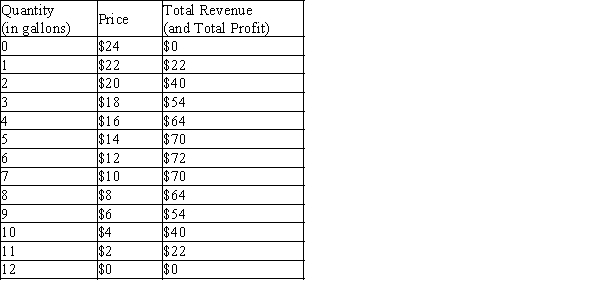 -Refer to Table 17-3. Suppose the town enacts new antitrust laws that prohibit Maria and Miguel from operating as a monopoly. How much profit will Miguel and Maria each earn once they reach a Nash equilibrium?
 (Multiple Choice)
4.8/5  (63)
(63) Table 17-8
For a certain small town, the table shows the demand schedule for water. Assume the marginal cost of supplying water is constant at $4 per bottle and there are no other costs. 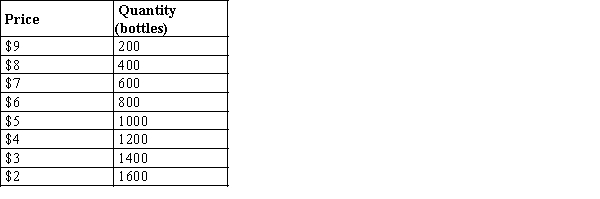 -Refer to Table 17-8. If there were many suppliers of bottled water, what would be the price and quantity?
 (Multiple Choice)
4.9/5 (86)
(86) As the number of firms in a cartel increases, the easier it is to enforce the cartel agreement.
(True/False)
4.9/5 (67)
(67) Nike and Reebok (athletic shoe companies) are considering whether to advertise during the Super Bowl. Devise a simple prisoners' dilemma game to demonstrate the strategic considerations that are relevant to this decision. Does the repeated game scenario differ from a single period game? Is it possible that a repeated game (without collusive agreements) could lead to an outcome that is better than a single-period game? Explain the circumstances in which this may be true.
(Essay)
4.8/5 (77)
(77) For a firm, strategic interactions with other firms in the market become more important as the number of firms in the market becomes larger.
(True/False)
5.0/5 (79)
(79) Suppose that Barack and Michelle are duopolists. Barack is producing 300 units of output, and Michelle is producing 400 units of output. When Michelle produces 400 units, Barack maximizes profit by producing 300 units. When Barack produces 300 units of output, Michelle maximizes profit by producing 400 units. Barack and Michelle are
(Multiple Choice)
4.7/5 (71)
(71) Table 17-12
The table shows the town of Driveaway's demand schedule for gasoline. Assume the town's gasoline seller(s) incurs a cost of $2 for each gallon sold, with no fixed cost. 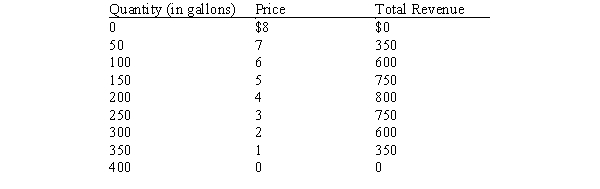 -Refer to Table 17-12. If the market for gasoline in Driveaway is a monopoly, then the monopolist's maximum profit is
 (Multiple Choice)
4.8/5 (63)
(63) Assume that Bart's Batteries has entered into a resale price maintenance agreement with Radio Shanty but not with Prime Purchase. In this case,
(Multiple Choice)
4.8/5 (85)
(85) Table 17-5
The information in the table below shows the total demand for premium-channel digital cable TV subscriptions in a small urban market. Assume that each digital cable TV operator pays a fixed cost of $200,000 (per year) to provide premium digital channels in the market area and that the marginal cost of providing the premium channel service to a household is zero. 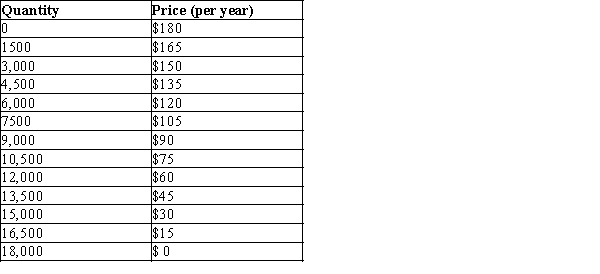 -Refer to Table 17-5. Assume there are two profit-maximizing digital cable TV companies operating in this market. Further assume that they are not able to collude on the price and quantity of premium digital channel subscriptions to sell. How many premium digital channel cable TV subscriptions will be sold altogether when this market reaches a Nash equilibrium?
 (Multiple Choice)
4.9/5 (87)
(87) Scenario 17-2.
Imagine that two oil companies, BQ and Exxoff, own adjacent oil fields. Under the fields is a common pool of oil worth $144 million. Drilling a well to recover oil costs $5 million per well. If each company drills one well, each will get half of the oil and earn a $67 million profit ($72 million in revenue - $5 million in costs). Assume that having X percent of the total wells means that a company will collect X percent of the total revenue.
-Refer to Scenario 17-2. If BQ and Exxoff are able to successfully cooperate to maximize their joint profits, BQ will earn
(Multiple Choice)
4.9/5 (76)
(76) Chrissy and Marvin are competitors in a local market and each is trying to decide if it is worthwhile to advertise. If both of them advertise, each will earn a profit of $10,000. If neither of them advertise, each will earn a profit of $20,000. If one advertises and the other doesn't, then the one who advertises will earn a profit of $30,000 and the other will earn $14,000. To earn the highest profit, Chrissy
(Multiple Choice)
4.9/5 (86)
(86) Table 17-36
The information in the table shows the total demand for water service in Takoma. Assume that there are two companies operating in Takoma. Each company that provides these services incurs an annual fixed cost of $400 and that the marginal cost of providing the service to each customer is exactly $2.00. Figures listed are for an annual service contract.
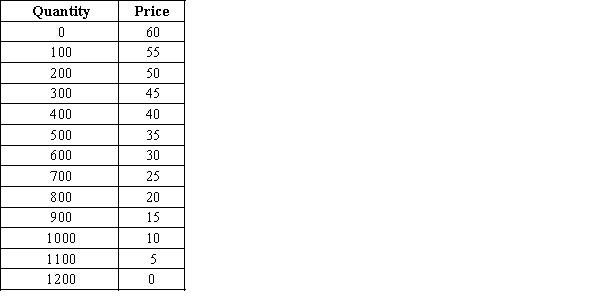 -Refer to Table 17-36. If there were only one water service provide in this market, and this single firm maximizes profits, the company will
 (Multiple Choice)
4.7/5 (83)
(83) Table 17-7
The information in the table below shows the total demand for internet radio subscriptions in a small urban market. Assume that each company that provides these subscriptions incurs an annual fixed cost of $20,000 (per year) and that the marginal cost of providing an additional subscription is always $16. 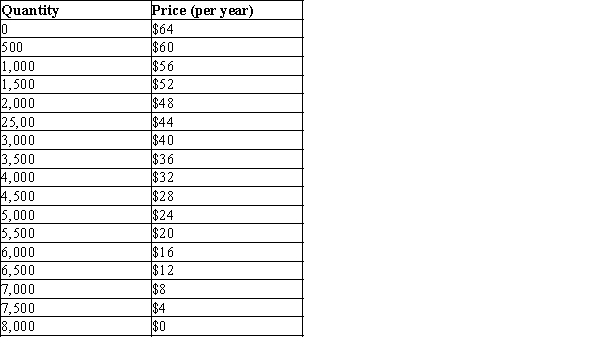 -Refer to Table 17-7. Assume there are two internet radio providers that operate in this market. If they are able to collude on the quantity of subscriptions that will be sold and on the price that will be charged for subscriptions, then their agreement will stipulate that
 (Multiple Choice)
4.8/5 (73)
(73) If duopolists individually pursue their own self-interest when deciding how much to produce, the amount they will produce collectively will
(Multiple Choice)
5.0/5 (84)
(84) An agreement among firms regarding price and/or production levels is called
(Multiple Choice)
4.9/5 (80)
(80) Table 17-34
Suppose that two oil companies - BP and Exxon - own adjacent natural gas fields. The profits that each firm earns depends on both the number of wells it drills and the number of wells drilled by the other firm. The table below lists each firm's individual profits:
Exxon
Drill one well Drill two wells  -Refer to Table 17-34. Is there a Nash equilibrium? If so, describe it.
 (Essay)
4.8/5 (66)
(66) Table 17-18
This table shows a game played between two firms, Firm A and Firm B. In this game each firm must decide how much output (Q) to produce: 10 units or 12 units. The profit for each firm is given in the table as (Profit for Firm A, Profit for Firm B).  -Refer to Table 17-18. The Nash equilibrium for this game is
 (Multiple Choice)
4.8/5 (74)
(74) 
Filters
- Essay(0)
- Multiple Choice(0)
- Short Answer(0)
- True False(0)
- Matching(0)