



 Chat with AI
Exam 17: Oligopoly

Exam 1: Ten Principles of Economics455 Questions
Exam 2: Thinking Like an Economist645 Questions
Exam 3: Interdependence and the Gains From Trade550 Questions
Exam 4: The Market Forces of Supply and Demand693 Questions
Exam 5: Elasticity and Its Application625 Questions
Exam 6: Supply, Demand, and Government Policies671 Questions
Exam 7: Consumers, Producers, and the Efficiency of Markets547 Questions
Exam 8: Application: The Costs of Taxation507 Questions
Exam 9: Application: International Trade521 Questions
Exam 10: Externalities543 Questions
Exam 11: Public Goods and Common Resources453 Questions
Exam 12: The Design of the Tax System563 Questions
Exam 13: The Costs of Production649 Questions
Exam 14: Firms in Competitive Markets608 Questions
Exam 15: Monopoly662 Questions
Exam 16: Monopolistic Competition649 Questions
Exam 17: Oligopoly522 Questions
Exam 18: The Markets for the Factors of Production592 Questions
Exam 19: Earnings and Discrimination511 Questions
Exam 20: Income Inequality and Poverty478 Questions
Exam 21: The Theory of Consumer Choice568 Questions
Exam 22: Frontiers in Microeconomics461 Questions
Select questions type


Much of the research on game theory in recent decades was driven by attempts to analyze actions of players during
(Multiple Choice)
4.8/5  (83)
(83) Scenario 17-6
Assume that a local telecommunications company sells high speed internet access and cable television. The company's only two customers are Taylor and Tim. Taylor is willing to pay $50 per month for high speed internet access and $50 per month for cable television. Tim is willing to pay only $20 per month for high speed internet access, but is willing to pay $70 per month for cable television. Assume that the telecommunications company can provide each of these products at zero marginal cost.
-Refer to Scenario 17-6. If the telecommunications provider is able to use tying to price high speed internet access and cable television, what is the profit-maximizing price to charge for the "tied" good?
(Short Answer)
4.7/5 (81)
(81) Table 17-32
Suppose that Angelina and Brad own the only two professional photography stores in town. Each must choose between a low price and a high price for senior photo packages. The annual economic profit from each strategy is indicated in the table below:
Angelina
Low price High price  -Refer to Table 17-32. Is there a Nash equilibrium? If so, describe it.
 (Essay)
4.8/5 (70)
(70) Hot dog vendors on the beach fail to cooperate with one another on the quantity of hot dogs they should sell to earn monopoly profits. A consequence of their failure is that, relative to the outcome the vendors would like, (i)
The quantity of hot dogs supplied is closer to the socially optimal level.
(ii)
The price of hot dogs is closer to marginal cost.
(iii)
The hot dog market at the beach is less competitive.
(Multiple Choice)
4.9/5 (75)
(75) Table 17-21
The Chicken Game is named for a contest in which drivers test their courage by driving straight at each other. John and Paul have a common interest to avoid crashing into each other, but they also have a personal, competing interest to not turn first to demonstrate their courage to those observing the contest. The payoff table for this situation is provided below. The payoffs are shown as (John, Paul).  -Refer to Table 17-21. If John chooses Turn, what will Paul choose to do and what will Paul's payoff equal?
 (Multiple Choice)
4.7/5 (94)
(94) In a prisoner's dilemma, the Nash Equilibrium might not have a dominant strategy for either player.
(True/False)
4.7/5 (79)
(79) Table 17-4
The table shows the town of Mauston's demand schedule for gasoline. For simplicity, assume the town's gasoline seller(s) incur no costs in selling gasoline. 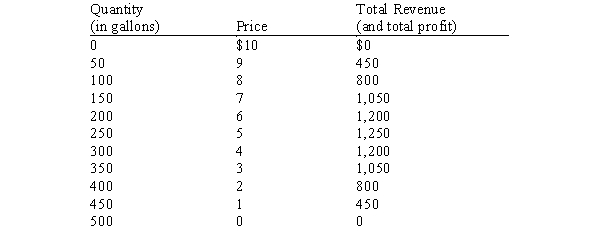 -Refer to Table 17-4. If there are exactly two sellers of gasoline in Mauston and if they collude, then which of the following outcomes is most likely?
 (Multiple Choice)
4.7/5 (74)
(74) Table 17-19
Consider a small town that has two grocery stores from which residents can choose to buy a loaf of bread. The store owners each must make a decision to set a high bread price or a low bread price. The payoff table, showing profit per week, is provided below. The profit in each cell is shown as (Store 1, Store 2).  -Refer to Table 17-19. What is the Nash Equilibrium of this price-setting game?
 (Multiple Choice)
4.9/5 (81)
(81) Table 17-15
This table shows a game played between two players, A and B. The payoffs in the table are shown as (Payoff to A, Payoff to B).  -Refer to Table 17-15. If player B chooses Right, player A should choose
 (Multiple Choice)
4.9/5 (74)
(74) Table 17-2
Imagine a small town in which only two residents, Abby and Brad, own wells that produce safe drinking water. Each week Abby and Brad work together to decide how many gallons of water to pump. They bring water to town and sell it at whatever price the market will bear. To keep things simple, suppose that Abby and Brad can pump as much water as they want without cost so that the marginal cost is zero. The weekly town demand schedule and total revenue schedule for water is shown in the table below: 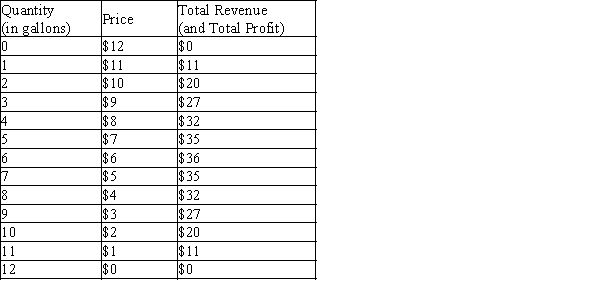 -Refer to Table 17-2. If this market for water were perfectly competitive instead of monopolistic, what would be the price for water?
 (Multiple Choice)
4.8/5 (70)
(70) Figure 17-3. Hector and Bart are roommates. On a particular day, their apartment needs to be cleaned. Each person has to decide whether to take part in cleaning. At the end of the day, either the apartment will be completely clean (if one or both roommates take part in cleaning), or it will remain dirty (if neither roommate cleans). With happiness measured on a scale of 1 (very unhappy) to 10 (very happy), the possible outcomes are as follows: 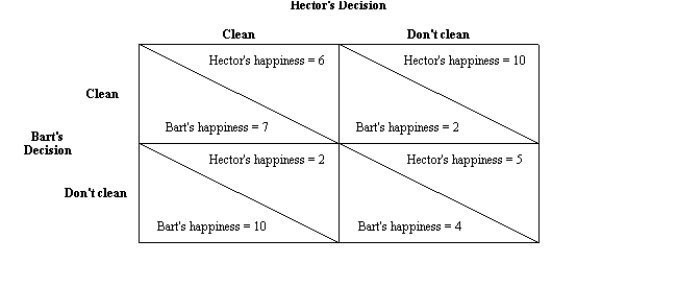 -Refer to Figure 17-3. If this game is played only once, then the most likely outcome is that
 (Multiple Choice)
5.0/5 (72)
(72) Which of the following statements about oligopolies is not correct?
(Multiple Choice)
4.8/5 (70)
(70) The players in a two-person game are choosing between Strategy X and Strategy Y. If the second player chooses Strategy X, the first player's best outcome is to select X. If the second player chooses Strategy Y, the first player's best outcome is to select X. For the first player, Strategy X is called a
(Multiple Choice)
4.8/5 (65)
(65) Table 17-28
Suppose that two firms determine that each could lower its costs and increase its profits if both reduced their advertising budgets. But in order for the plan to work, each firm must agree to refrain from advertising. Each firm believes that advertising works by increasing the demand for the firm's product, but each firm also believes that if neither firm advertises, the cost savings will outweigh the lost sales. The table below lists each firm's individual profits:
Firm A
Breaks agreement Maintains agreement
and advertises and does not advertise  -Refer to Table 17-28. What is the outcome of this game?
 (Multiple Choice)
4.9/5 (81)
(81) Some business practices that appear to reduce competition, such as resale price maintenance, may have legitimate economic purposes.
(True/False)
4.8/5 (65)
(65) In a particular town, Comvision and Veriview are the only two providers of cable TV service. Comvision and Veriview constitute a
(Multiple Choice)
4.8/5 (88)
(88) Table 17-19
Consider a small town that has two grocery stores from which residents can choose to buy a loaf of bread. The store owners each must make a decision to set a high bread price or a low bread price. The payoff table, showing profit per week, is provided below. The profit in each cell is shown as (Store 1, Store 2).
-Refer to Table 17-19. If grocery store 1 sets a high price, what price should grocery store 2 set? And what will grocery store 2's payoff equal?
-Refer to Table 17-19. If grocery store 1 sets a high price, what price should grocery store 2 set? And what will grocery store 2's payoff equal? (Multiple Choice)
4.8/5 (73)
(73) Table 17-18
This table shows a game played between two firms, Firm A and Firm B. In this game each firm must decide how much output (Q) to produce: 10 units or 12 units. The profit for each firm is given in the table as (Profit for Firm A, Profit for Firm B).  -Refer to Table 17-18. The dominant strategy For Firm A is to produce
 (Multiple Choice)
4.8/5 (83)
(83) 
Filters
- Essay(0)
- Multiple Choice(0)
- Short Answer(0)
- True False(0)
- Matching(0)