



 Chat with AI
Exam 17: Oligopoly

Exam 1: Ten Principles of Economics455 Questions
Exam 2: Thinking Like an Economist645 Questions
Exam 3: Interdependence and the Gains From Trade550 Questions
Exam 4: The Market Forces of Supply and Demand693 Questions
Exam 5: Elasticity and Its Application625 Questions
Exam 6: Supply, Demand, and Government Policies671 Questions
Exam 7: Consumers, Producers, and the Efficiency of Markets547 Questions
Exam 8: Application: The Costs of Taxation507 Questions
Exam 9: Application: International Trade521 Questions
Exam 10: Externalities543 Questions
Exam 11: Public Goods and Common Resources453 Questions
Exam 12: The Design of the Tax System563 Questions
Exam 13: The Costs of Production649 Questions
Exam 14: Firms in Competitive Markets608 Questions
Exam 15: Monopoly662 Questions
Exam 16: Monopolistic Competition649 Questions
Exam 17: Oligopoly522 Questions
Exam 18: The Markets for the Factors of Production592 Questions
Exam 19: Earnings and Discrimination511 Questions
Exam 20: Income Inequality and Poverty478 Questions
Exam 21: The Theory of Consumer Choice568 Questions
Exam 22: Frontiers in Microeconomics461 Questions
Select questions type


Table 17-10
The table shows the demand schedule for a particular product. 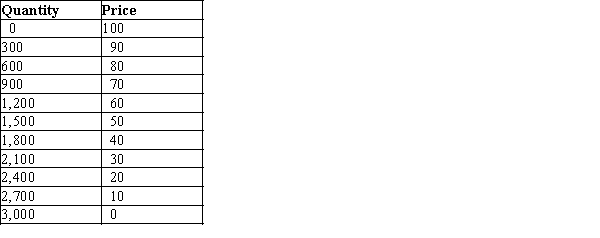 -Refer to Table 17-10. Suppose the market for this product is served by two firms who have formed a cartel and are colluding to set the price and quantity in this market. If the marginal cost to produce this product is constant at $40 per unit, then what price will the cartel set in this market?
 (Multiple Choice)
4.8/5  (68)
(68) If duopoly firms that are not colluding were able to successfully collude, then
(Multiple Choice)
4.7/5 (78)
(78) Table 17-37
Two restaurants with a focus on Mexican dining operate in Texama. Both Mitch's Mexican and Tim's Tacos need to decide whether to add Zesty Queso or Fresh Guacamole to their menus. The circumstances are that each firm wants to add only one of the two choices on their menu. Below you will find the profits for the stores, shown as: (1) the payoff to Mitch; (2) the payoff to Tim. 
-Refer to Table 17-37. If Mitch's Mexican chooses Zesty Queso then Tim's Tacos will select its best strategy and choose ____ ; if Mitch's Mexican chooses Fresh Guacamole then Tim's Tacos will select its best strategy and choose _____.
-Refer to Table 17-37. If Mitch's Mexican chooses Zesty Queso then Tim's Tacos will select its best strategy and choose ____ ; if Mitch's Mexican chooses Fresh Guacamole then Tim's Tacos will select its best strategy and choose _____. (Multiple Choice)
4.9/5 (91)
(91) Figure 17-5. Two companies, ABC and QRS, are sellers in the same market. Each company decides whether to charge a high price or a low price. In the figure, the dollar amounts are payoffs and they represent annual profits for the two companies. 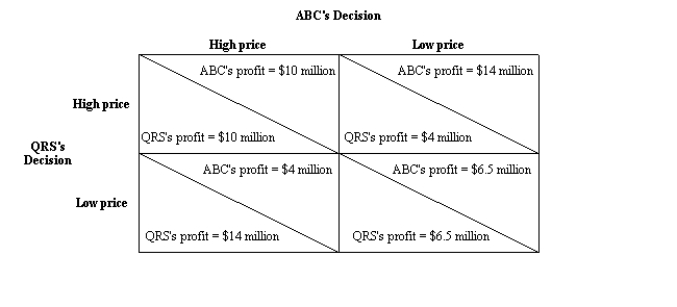 -Refer to Figure 17-5. Suppose we observe that the outcome of the game is one in which each company earns a profit of $10 million. This outcome
 (Multiple Choice)
4.9/5 (83)
(83) Table 17-14
This table shows a game played between two players, A and B. The payoffs in the table are shown as (Payoff to A, Payoff to B).  -Refer to Table 17-14. If both players choose their best strategies, player A will earn a payoff of
 (Multiple Choice)
4.7/5 (73)
(73) What effect does the number of firms in an oligopoly have on the characteristics of the market?
(Essay)
4.8/5 (85)
(85) Table 17-3
Imagine a small town in a remote area where only two residents, Maria and Miguel, own dairies that produce milk that is safe to drink. Each week Maria and Miguel work together to decide how many gallons of milk to produce. They bring milk to town and sell it at whatever price the market will bear. To keep things simple, suppose that Maria and Miguel can produce as much milk as they want without cost so that the marginal cost is zero. The weekly town demand schedule and total revenue schedule for milk is shown in the table below: 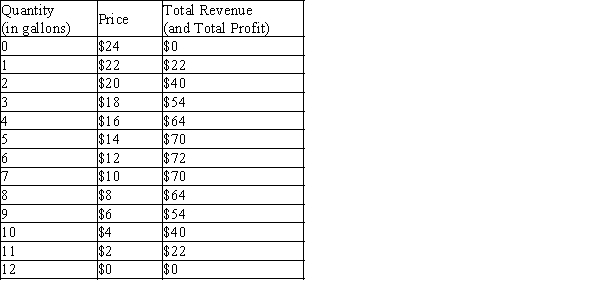 -Refer to Table 17-3. If this market for milk were perfectly competitive instead of monopolistic, how many gallons of milk would be produced and sold?
 (Multiple Choice)
4.9/5 (92)
(92) Table 17-30
Imagine a small town in which only two residents, Abby and Brad, own wells that produce safe drinking water. Each week Abby and Brad work together to decide how many gallons of water to pump. They bring water to town and sell it at whatever price the market will bear. To keep things simple, suppose that Abby and Brad can pump as much water as they want without cost so that the marginal cost is zero. The weekly town demand schedule and total revenue schedule for water is shown in the table below: 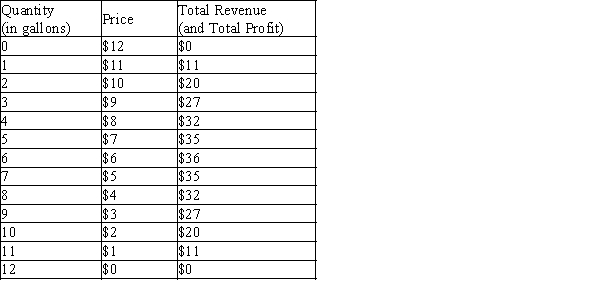 -Refer to Table 17-30. Discuss the difference between the monopoly outcome and the Nash equilibrium.
 (Essay)
4.8/5 (68)
(68) Consider a game of the "Jack and Jill" type in which a market is a duopoly and each firm decides to produce either a "high" quantity of output or a "low" quantity of output. If the two firms successfully reach and maintain the cooperative outcome of the game, then
(Multiple Choice)
4.8/5 (87)
(87) Scenario 17-2.
Imagine that two oil companies, BQ and Exxoff, own adjacent oil fields. Under the fields is a common pool of oil worth $144 million. Drilling a well to recover oil costs $5 million per well. If each company drills one well, each will get half of the oil and earn a $67 million profit ($72 million in revenue - $5 million in costs). Assume that having X percent of the total wells means that a company will collect X percent of the total revenue.
-Refer to Scenario 17-2. If BQ were to drill a second well and Exxoff also drilled a second well, what would BQ's profit be?
(Multiple Choice)
4.8/5 (88)
(88) In the prisoners' dilemma game with Bonnie and Clyde as the players, the likely outcome is one
(Multiple Choice)
4.9/5 (82)
(82) Table 17-2
Imagine a small town in which only two residents, Abby and Brad, own wells that produce safe drinking water. Each week Abby and Brad work together to decide how many gallons of water to pump. They bring water to town and sell it at whatever price the market will bear. To keep things simple, suppose that Abby and Brad can pump as much water as they want without cost so that the marginal cost is zero. The weekly town demand schedule and total revenue schedule for water is shown in the table below: 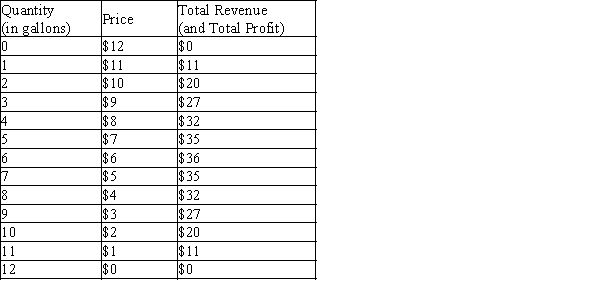 -Refer to Table 17-2. Suppose that Abby and Brad work together to operate as a profit-maximizing monopolist. How many gallons of water will be produced and sold?
 (Multiple Choice)
4.8/5 (75)
(75) The argument that consumers will not be willing to pay any more for two items sold as one than they would for the two items sold separately is used to justify the legality of which of the following?
(Multiple Choice)
4.8/5 (74)
(74) Figure 17-4. Aaron and Ed are roommates. After a big snowstorm, their driveway needs to be shoveled. Each person has to decide whether to take part in shoveling the driveway. At the end of the day, either the driveway will be shoveled (if one or both roommates take part in shoveling), or it will remain unshoveled (if neither roommate shovels). With happiness measured on a scale of 1 (very unhappy) to 10 (very happy), the possible outcomes are as follows: 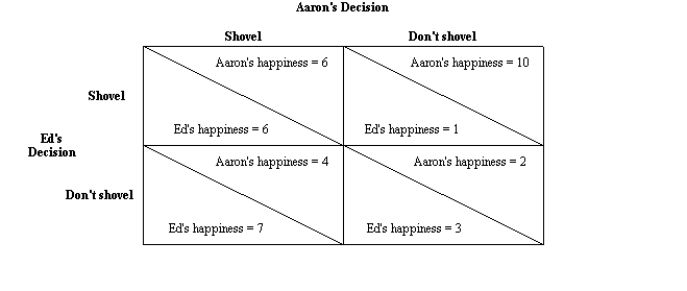 -Refer to Figure 17-4. The dominant strategy for Ed is to
 (Multiple Choice)
4.9/5 (89)
(89) Ford and General Motors are considering expanding into the Vietnamese automobile market. Devise a simple prisoners' dilemma game to demonstrate the strategic considerations that are relevant to this decision.
(Essay)
4.7/5 (91)
(91) Figure 17-3. Hector and Bart are roommates. On a particular day, their apartment needs to be cleaned. Each person has to decide whether to take part in cleaning. At the end of the day, either the apartment will be completely clean (if one or both roommates take part in cleaning), or it will remain dirty (if neither roommate cleans). With happiness measured on a scale of 1 (very unhappy) to 10 (very happy), the possible outcomes are as follows: 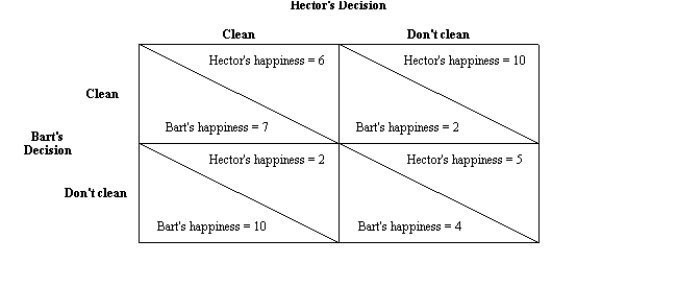 -Refer to Figure 17-3. The possible outcome in which both Hector and Bart clean is analogous to which of the following outcomes of the duopoly game?
 (Multiple Choice)
4.9/5 (87)
(87) Game theory is just as necessary for understanding competitive or monopoly markets as it is for understanding oligopolistic markets.
(True/False)
4.9/5 (84)
(84) Table 17-11
Only two firms, ABC and XYZ, sell a particular product. The table below shows the demand curve for their product. Each firm has the same constant marginal cost of $8 and zero fixed cost. 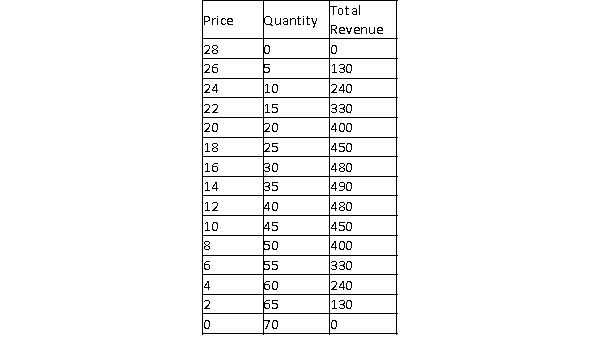 -Refer to Table 17-11. ABC and XYZ agree to jointly maximize profits. If ABC and XYZ each break the agreement and each produce 5 more than agreed upon, how much less profit does each make, compared to the profit at to the cartel output?
 (Multiple Choice)
4.8/5 (72)
(72) 
Filters
- Essay(0)
- Multiple Choice(0)
- Short Answer(0)
- True False(0)
- Matching(0)