



 Chat with AI
Exam 17: Oligopoly

Exam 1: Ten Principles of Economics455 Questions
Exam 2: Thinking Like an Economist645 Questions
Exam 3: Interdependence and the Gains From Trade550 Questions
Exam 4: The Market Forces of Supply and Demand693 Questions
Exam 5: Elasticity and Its Application625 Questions
Exam 6: Supply, Demand, and Government Policies671 Questions
Exam 7: Consumers, Producers, and the Efficiency of Markets547 Questions
Exam 8: Application: The Costs of Taxation507 Questions
Exam 9: Application: International Trade521 Questions
Exam 10: Externalities543 Questions
Exam 11: Public Goods and Common Resources453 Questions
Exam 12: The Design of the Tax System563 Questions
Exam 13: The Costs of Production649 Questions
Exam 14: Firms in Competitive Markets608 Questions
Exam 15: Monopoly662 Questions
Exam 16: Monopolistic Competition649 Questions
Exam 17: Oligopoly522 Questions
Exam 18: The Markets for the Factors of Production592 Questions
Exam 19: Earnings and Discrimination511 Questions
Exam 20: Income Inequality and Poverty478 Questions
Exam 21: The Theory of Consumer Choice568 Questions
Exam 22: Frontiers in Microeconomics461 Questions
Select questions type


Table 17-14
This table shows a game played between two players, A and B. The payoffs in the table are shown as (Payoff to A, Payoff to B).  -Refer to Table 17-14. Which of the following statements about this game is true?
 (Multiple Choice)
4.7/5  (83)
(83) A dominant strategy exists for at least one player in every game.
(True/False)
4.9/5 (78)
(78) If two firms comprise the entire soft drink market, the market would be a(n)
(Multiple Choice)
4.8/5 (78)
(78) When strategic interactions are important to pricing and production decisions, a typical firm will
(Multiple Choice)
4.7/5 (72)
(72) Table 17-1
Imagine a small town in which only two residents, Rochelle and Alec, own wells that produce safe drinking water. Each week Rochelle and Alec work together to decide how many gallons of water to pump. They bring the water to town and sell it at whatever price the market will bear. To keep things simple, suppose that Rochelle and Alec can pump as much water as they want without cost so that the marginal cost of water equals zero. The town's weekly demand schedule and total revenue schedule for water is shown in the table below: 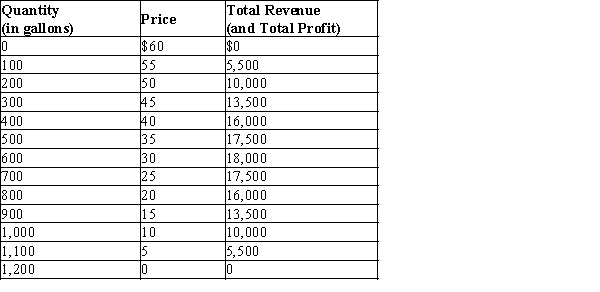 -Refer to Table 17-1. What is the socially efficient quantity of water?
 (Multiple Choice)
4.9/5 (77)
(77) Economists claim that a resale price maintenance agreement is not anti-competitive because
(Multiple Choice)
4.8/5 (82)
(82) Scenario 17-3.
Consider two countries, Kinglandia and Rovinastan, that are engaged in an arms race. Each country must decide whether to build new weapons or to disarm existing weapons. Each country prefers to have more arms than the other because a large arsenal gives it more influence in world affairs. But each country also prefers to live in a world safe from the other country's weapons. The following table shows the possible outcomes for each decision combination. The numbers in each cell represent the country's ranking of the outcome (10 = best outcome, 1 = worst outcome). 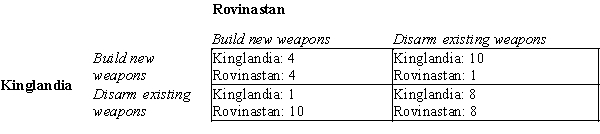 -Refer to Scenario 17-3. Which of these statements is correct? (i)
Kinglandia is better off building new weapons if Rovinastan builds new weapons.
(ii)
Kinglandia is better off building new weapons if Rovinastan disarms existing weapons.
(iii)
Rovinastan is only better off building new weapons if Kinglandia builds new weapons.
-Refer to Scenario 17-3. Which of these statements is correct? (i)
Kinglandia is better off building new weapons if Rovinastan builds new weapons.
(ii)
Kinglandia is better off building new weapons if Rovinastan disarms existing weapons.
(iii)
Rovinastan is only better off building new weapons if Kinglandia builds new weapons. (Multiple Choice)
4.9/5 (74)
(74) As the number of firms in an oligopoly increases, the price approaches
(Multiple Choice)
4.9/5 (66)
(66) Suppose the market for home-grown peppers in the town of Smallville is comprised of two farmers. Explain why they might try to collude.
(Essay)
4.7/5 (87)
(87) Scenario 17-4.
Consider two cigarette companies, PM Inc. and Brown Inc. If neither company advertises, the two companies split the market and earn $50 million each. If they both advertise, they again split the market, but profits are lower by $10 million since each company must bear the cost of advertising. Yet if one company advertises while the other does not, the one that advertises attracts customers from the other. In this case, the company that advertises earns $60 million while the company that does not advertise earns only $30 million.
-Refer to Scenario 17-4. If these two companies collude and agree upon the best joint strategy,
(Multiple Choice)
4.9/5 (77)
(77) The Sherman Antitrust Act prohibits price-fixing in the sense that
(Multiple Choice)
4.8/5 (92)
(92) Which of these situations produces the largest profits for oligopolists?
(Multiple Choice)
4.9/5 (83)
(83) The game that oligopolists play in trying to reach the oligopoly outcome is similar to the game that the two prisoners play in the prisoners' dilemma.
(True/False)
4.9/5 (79)
(79) In the prisoners' dilemma game with Bonnie and Clyde as the players, the likely outcome is
(Multiple Choice)
4.7/5 (87)
(87) Table 17-28
Suppose that two firms determine that each could lower its costs and increase its profits if both reduced their advertising budgets. But in order for the plan to work, each firm must agree to refrain from advertising. Each firm believes that advertising works by increasing the demand for the firm's product, but each firm also believes that if neither firm advertises, the cost savings will outweigh the lost sales. The table below lists each firm's individual profits:
Firm A
Breaks agreement Maintains agreement
and advertises and does not advertise  -Refer to Table 17-28. Does either Firm A or Firm B have a dominant strategy?
 (Multiple Choice)
4.9/5 (94)
(94) Figure 17-1 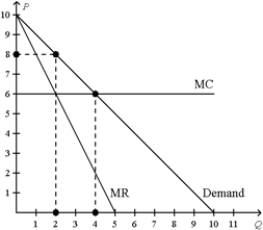 -Refer to Figure 17-1. Suppose this market is served by a duopoly in which each firm faces the marginal cost curve shown in the diagram. The marginal revenue curve that a monopolist would face in this market is also shown. Which of the following statements is true?
 (Multiple Choice)
4.7/5 (75)
(75) Figure 17-5. Two companies, ABC and QRS, are sellers in the same market. Each company decides whether to charge a high price or a low price. In the figure, the dollar amounts are payoffs and they represent annual profits for the two companies. 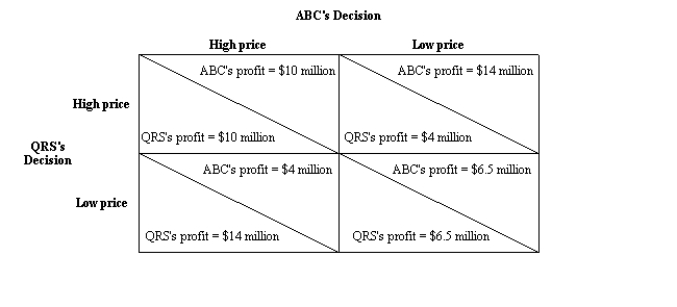 -Refer to Figure 17-5. Suppose the outcome of the game is one in which ABC's profit is $4 million and QRS's profit is $14 million. The most likely explanation for this outcome is that
 (Multiple Choice)
4.8/5 (70)
(70) If four firms comprise the entire golf club industry, the market would be
(Multiple Choice)
4.9/5 (86)
(86) Scenario 17-3.
Consider two countries, Kinglandia and Rovinastan, that are engaged in an arms race. Each country must decide whether to build new weapons or to disarm existing weapons. Each country prefers to have more arms than the other because a large arsenal gives it more influence in world affairs. But each country also prefers to live in a world safe from the other country's weapons. The following table shows the possible outcomes for each decision combination. The numbers in each cell represent the country's ranking of the outcome (10 = best outcome, 1 = worst outcome).
-Refer to Scenario 17-3. Suppose the two countries agreed to disarm existing weapons. In reality these two countries may have a hard time keeping this agreement due to which of the following reasons? (i)
Even though Kinglandia has no incentive to cheat on the agreement, Rovinastan has an incentive to cheat on the agreement.
(ii)
Much like the prisoners' dilemma, both countries are better off reneging on the agreement and building new weapons.
(iii)
Both countries want to increase their world power by building new weapons.
-Refer to Scenario 17-3. Suppose the two countries agreed to disarm existing weapons. In reality these two countries may have a hard time keeping this agreement due to which of the following reasons? (i)
Even though Kinglandia has no incentive to cheat on the agreement, Rovinastan has an incentive to cheat on the agreement.
(ii)
Much like the prisoners' dilemma, both countries are better off reneging on the agreement and building new weapons.
(iii)
Both countries want to increase their world power by building new weapons. (Multiple Choice)
4.9/5 (74)
(74) 
Filters
- Essay(0)
- Multiple Choice(0)
- Short Answer(0)
- True False(0)
- Matching(0)