



 Chat with AI
Exam 17: Oligopoly

Exam 1: Ten Principles of Economics455 Questions
Exam 2: Thinking Like an Economist645 Questions
Exam 3: Interdependence and the Gains From Trade550 Questions
Exam 4: The Market Forces of Supply and Demand693 Questions
Exam 5: Elasticity and Its Application625 Questions
Exam 6: Supply, Demand, and Government Policies671 Questions
Exam 7: Consumers, Producers, and the Efficiency of Markets547 Questions
Exam 8: Application: The Costs of Taxation507 Questions
Exam 9: Application: International Trade521 Questions
Exam 10: Externalities543 Questions
Exam 11: Public Goods and Common Resources453 Questions
Exam 12: The Design of the Tax System563 Questions
Exam 13: The Costs of Production649 Questions
Exam 14: Firms in Competitive Markets608 Questions
Exam 15: Monopoly662 Questions
Exam 16: Monopolistic Competition649 Questions
Exam 17: Oligopoly522 Questions
Exam 18: The Markets for the Factors of Production592 Questions
Exam 19: Earnings and Discrimination511 Questions
Exam 20: Income Inequality and Poverty478 Questions
Exam 21: The Theory of Consumer Choice568 Questions
Exam 22: Frontiers in Microeconomics461 Questions
Select questions type


Table 17-10
The table shows the demand schedule for a particular product. 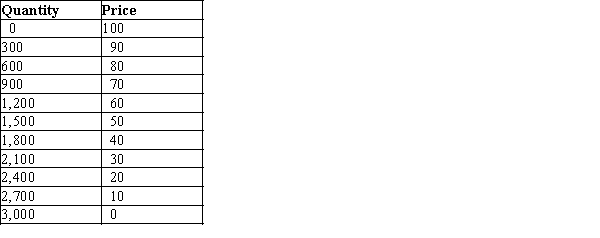 -Refer to Table 17-10. Suppose the market for this product is served by two firms who have formed a cartel and are colluding to set the price and quantity in this market. If the marginal cost to produce this product is constant at $40 per unit and there is no fixed cost, then what will the combined profit of the cartel be?
 (Multiple Choice)
4.8/5  (76)
(76) Table 17-20
Nadia and Maddie are two college roommates who both prefer a clean common space in their dorm room, but neither enjoys cleaning. The roommates must each make a decision to either clean or not clean the dorm room's common space. The payoff table for this situation is provided below, where the higher a player's payoff number, the better off that player is. The payoffs in each cell are shown as (payoff for Nadia, payoff for Maddie).  -Refer to Table 17-20. What is Nadia's dominant strategy?
 (Multiple Choice)
4.7/5 (90)
(90) Table 17-21
The Chicken Game is named for a contest in which drivers test their courage by driving straight at each other. John and Paul have a common interest to avoid crashing into each other, but they also have a personal, competing interest to not turn first to demonstrate their courage to those observing the contest. The payoff table for this situation is provided below. The payoffs are shown as (John, Paul).  -Refer to Table 17-21. What is Paul's dominant strategy?
 (Multiple Choice)
5.0/5 (68)
(68) In a prisoner's dilemma, only one firm has a dominant strategy.
(True/False)
4.8/5 (64)
(64) Table 17-11
Only two firms, ABC and XYZ, sell a particular product. The table below shows the demand curve for their product. Each firm has the same constant marginal cost of $8 and zero fixed cost. 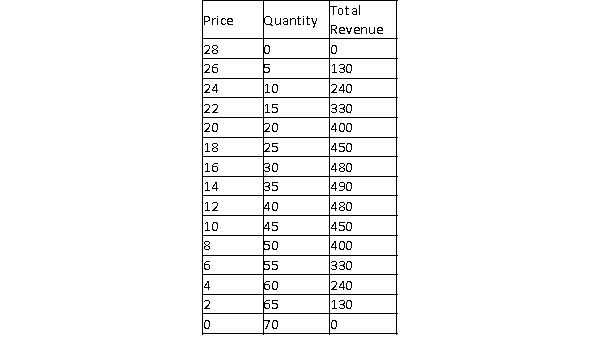 -Refer to Table 17-11. How much less do each of these firms earn in the Nash equilibrium than if they jointly maximize profits?
 (Multiple Choice)
5.0/5 (77)
(77) Table 17-36
The information in the table shows the total demand for water service in Takoma. Assume that there are two companies operating in Takoma. Each company that provides these services incurs an annual fixed cost of $400 and that the marginal cost of providing the service to each customer is exactly $2.00. Figures listed are for an annual service contract.
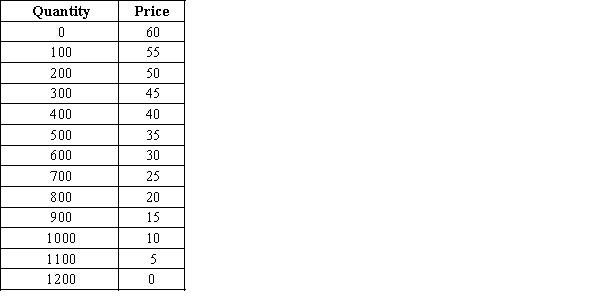 -Refer to Table 17-36. Assume there are two profit-maximizing water service providers in this market who had formed a successful cartel. Now assume that the cartel breaks down, so that they are not able to collude on the price and quantity of service contracts to sell. How much profit will each firm earn when this market reaches a Nash equilibrium?
 (Multiple Choice)
4.8/5 (78)
(78) In a typical cartel agreement, the cartel maximizes profit when it
(Multiple Choice)
4.8/5 (91)
(91) Which strategy was the most successful in the prisoners' dilemma tournament?
(Short Answer)
4.9/5 (92)
(92) Table 17-8
For a certain small town, the table shows the demand schedule for water. Assume the marginal cost of supplying water is constant at $4 per bottle and there are no other costs. 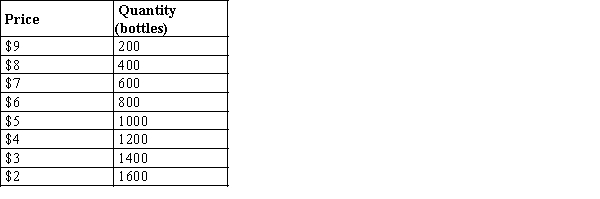 -Refer to Table 17-8. If there are two suppliers of water, Victor and Sami, and if they have successfully formed a cartel and split the market evenly, then how many bottles will Sami supply?
 (Multiple Choice)
4.8/5 (75)
(75) Scenario 17-3.
Consider two countries, Kinglandia and Rovinastan, that are engaged in an arms race. Each country must decide whether to build new weapons or to disarm existing weapons. Each country prefers to have more arms than the other because a large arsenal gives it more influence in world affairs. But each country also prefers to live in a world safe from the other country's weapons. The following table shows the possible outcomes for each decision combination. The numbers in each cell represent the country's ranking of the outcome (10 = best outcome, 1 = worst outcome). 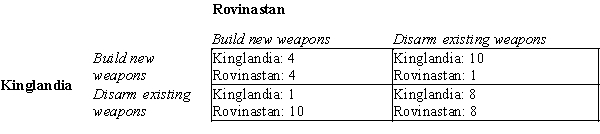 -Refer to Scenario 17-3. If each country only makes a choice of whether to build or disarm one time and Rovinastan chooses to build new weapons, then Kinglandia will
 (Multiple Choice)
4.9/5 (76)
(76) In pursing its own interest, an oligopoly firm will decide to increase production by 1 unit as long as
(Multiple Choice)
4.8/5 (73)
(73) A lack of cooperation by oligopolists trying to maintain monopoly profits
(Multiple Choice)
4.9/5 (69)
(69) Table 17-3
Imagine a small town in a remote area where only two residents, Maria and Miguel, own dairies that produce milk that is safe to drink. Each week Maria and Miguel work together to decide how many gallons of milk to produce. They bring milk to town and sell it at whatever price the market will bear. To keep things simple, suppose that Maria and Miguel can produce as much milk as they want without cost so that the marginal cost is zero. The weekly town demand schedule and total revenue schedule for milk is shown in the table below: 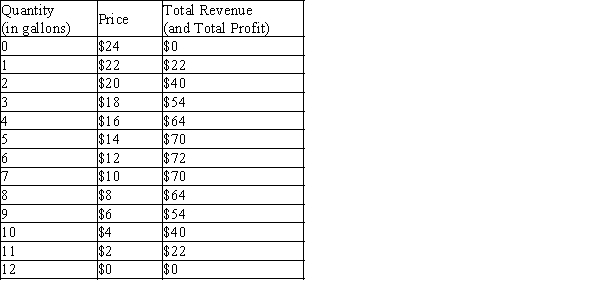 -Refer to Table 17-3. If this market for milk were perfectly competitive instead of monopolistic, what would be the price for milk?
 (Multiple Choice)
4.8/5 (79)
(79) Government regulators might suspect a firm of engaging in predatory pricing if it charges prices that seem to be too __________.
(Short Answer)
4.8/5 (76)
(76) Table 17-20
Nadia and Maddie are two college roommates who both prefer a clean common space in their dorm room, but neither enjoys cleaning. The roommates must each make a decision to either clean or not clean the dorm room's common space. The payoff table for this situation is provided below, where the higher a player's payoff number, the better off that player is. The payoffs in each cell are shown as (payoff for Nadia, payoff for Maddie).
-Refer to Table 17-20. What is the Nash Equilibrium in this dorm room cleaning game?
-Refer to Table 17-20. What is the Nash Equilibrium in this dorm room cleaning game? (Multiple Choice)
4.9/5 (75)
(75) When a group of firms acts in unison to maximize profits as if they were a monopoly, they form a __________.
(Short Answer)
4.8/5 (75)
(75) Table 17-27
Each year the United States considers renewal of Most Favored Nation (MFN) trading status with Farland (a mythical nation). Historically, legislators have made threats of not renewing MFN status because of human rights abuses in Farland. The non-renewal of MFN trading status is likely to involve some retaliatory measures by Farland. The payoff table below shows the potential economic gains associated with a game in which Farland may impose trade sanctions against U.S. firms and the United States may not renew MFN status with Farland. The table contains the dollar value of all trade-flow benefits to the United States and Farland. 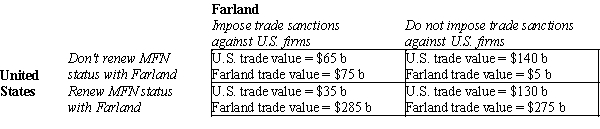 -Refer to Table 17-27. When this game reaches a Nash equilibrium, the value of trade flow benefits will be
 (Multiple Choice)
4.8/5 (78)
(78) 
Filters
- Essay(0)
- Multiple Choice(0)
- Short Answer(0)
- True False(0)
- Matching(0)