



 Chat with AI
Exam 17: Oligopoly

Exam 1: Ten Principles of Economics455 Questions
Exam 2: Thinking Like an Economist645 Questions
Exam 3: Interdependence and the Gains From Trade550 Questions
Exam 4: The Market Forces of Supply and Demand693 Questions
Exam 5: Elasticity and Its Application625 Questions
Exam 6: Supply, Demand, and Government Policies671 Questions
Exam 7: Consumers, Producers, and the Efficiency of Markets547 Questions
Exam 8: Application: The Costs of Taxation507 Questions
Exam 9: Application: International Trade521 Questions
Exam 10: Externalities543 Questions
Exam 11: Public Goods and Common Resources453 Questions
Exam 12: The Design of the Tax System563 Questions
Exam 13: The Costs of Production649 Questions
Exam 14: Firms in Competitive Markets608 Questions
Exam 15: Monopoly662 Questions
Exam 16: Monopolistic Competition649 Questions
Exam 17: Oligopoly522 Questions
Exam 18: The Markets for the Factors of Production592 Questions
Exam 19: Earnings and Discrimination511 Questions
Exam 20: Income Inequality and Poverty478 Questions
Exam 21: The Theory of Consumer Choice568 Questions
Exam 22: Frontiers in Microeconomics461 Questions
Select questions type


Table 17-13
Two home-improvement stores (Lopes and HomeMax) in a growing urban area are interested in expanding their market share. Both are interested in expanding the size of their store and parking lot to accommodate potential growth in their customer base. The following game depicts the strategic outcomes that result from the game. Increases in annual profits of the two home-improvement stores are shown in the table below. 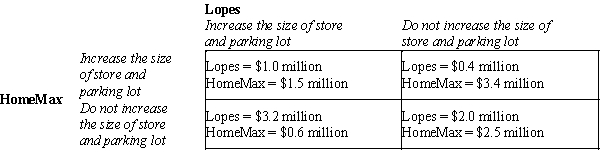 -Refer to Table 17-13. Suppose the owners of Lopes and HomeMax meet for a friendly game of golf one afternoon and happen to discuss a strategy to optimize growth related profit. If they both agree to cooperate on a strategy that maximizes their joint profits, annual profit will grow by
 (Multiple Choice)
4.9/5  (89)
(89) Table 17-29
Suppose that two firms, Wild Willy's Wonderdrink (Firm W) and Hyper Hank's Hydration (Firm H), comprise the market for energy drinks. Each firm determines that it could lower its costs and increase its profits if both firms reduced their advertising budgets. But for the plan to work, each firm must agree to refrain from advertising. Each firm believes that advertising works by increasing the demand for the firm's energy drinks, but each firm also believes that if neither firm advertises, the cost savings will outweigh the lost sales. The table below lists each firm's individual profits:
Firm W
Breaks agreement Maintains agreement
and advertises and does not advertise  -Refer to Table 17-29. Which of the following statement(s) correctly characterizes the outcome of this game?
 (Multiple Choice)
4.8/5 (79)
(79) Table 17-4
The table shows the town of Mauston's demand schedule for gasoline. For simplicity, assume the town's gasoline seller(s) incur no costs in selling gasoline. 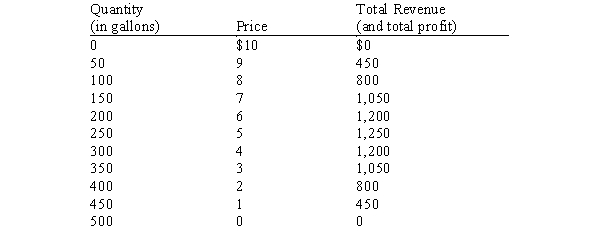 -Refer to Table 17-4. Suppose there are exactly two sellers of gasoline in Mauston: Shellon and Standstop. If Shellon sells 150 gallons and Standstop sells 200 gallons, then
 (Multiple Choice)
4.9/5 (83)
(83) Game theory is necessary to understand which kinds of markets?
(Multiple Choice)
5.0/5 (68)
(68) Figure 17-5. Two companies, ABC and QRS, are sellers in the same market. Each company decides whether to charge a high price or a low price. In the figure, the dollar amounts are payoffs and they represent annual profits for the two companies. 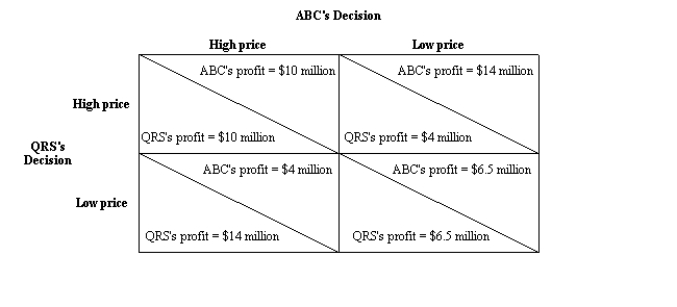 -Refer to Figure 17-5. In what sense is the game involving ABC and QRS similar to the prisoners' dilemma game involving Bonnie and Clyde?
 (Multiple Choice)
5.0/5 (81)
(81) Table 17-37
Two restaurants with a focus on Mexican dining operate in Texama. Both Mitch's Mexican and Tim's Tacos need to decide whether to add Zesty Queso or Fresh Guacamole to their menus. The circumstances are that each firm wants to add only one of the two choices on their menu. Below you will find the profits for the stores, shown as: (1) the payoff to Mitch; (2) the payoff to Tim. 
-Refer to Table 17-37. Based upon the information from the table, you can conclude that this game is an example of
-Refer to Table 17-37. Based upon the information from the table, you can conclude that this game is an example of (Multiple Choice)
4.9/5 (86)
(86) Table 17-9
The table shows the demand schedule for a particular product. 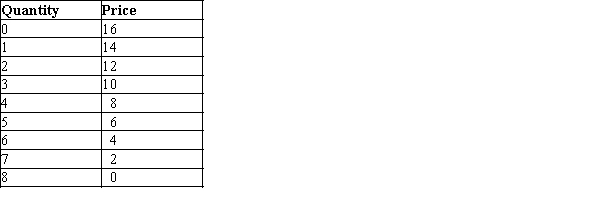 -Refer to Table 17-9. If the marginal cost of production in this market is $4, what is the socially efficient quantity of output?
 (Multiple Choice)
4.9/5 (86)
(86) Which of the following is correct? When oligopolies collude
(Multiple Choice)
4.9/5 (87)
(87) Table 17-4
The table shows the town of Mauston's demand schedule for gasoline. For simplicity, assume the town's gasoline seller(s) incur no costs in selling gasoline.
-Refer to Table 17-4. If there are exactly four sellers of gasoline in Mauston and if they collude, then which of the following outcomes is most likely?
-Refer to Table 17-4. If there are exactly four sellers of gasoline in Mauston and if they collude, then which of the following outcomes is most likely? (Multiple Choice)
4.9/5 (66)
(66) Figure 17-5. Two companies, ABC and QRS, are sellers in the same market. Each company decides whether to charge a high price or a low price. In the figure, the dollar amounts are payoffs and they represent annual profits for the two companies.
-Refer to Figure 17-5. The situation faced by ABC and QRS is
-Refer to Figure 17-5. The situation faced by ABC and QRS is (Multiple Choice)
4.7/5 (72)
(72) Table 17-23
Two bottled beverage manufacturers (Firm A and Firm B) determine that they could lower their costs, and thus increase their profits, if they reduced their advertising budgets. But for the plan to work, each firm must agree to refrain from advertising. Each firm believes that advertising works by increasing the demand for the firm's product, but each firm also believes that if neither firm advertises, the costs savings will outweigh the lost sales. Listed in the table below are the individual profits for each firm. 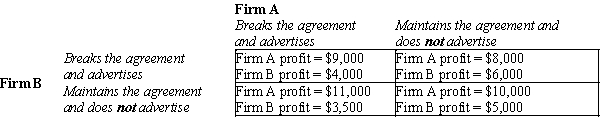 -Refer to Table 17-23. At the Nash equilibrium, how much profit will Firm A earn?
 (Multiple Choice)
4.8/5 (76)
(76) If the output effect from increased production is larger than the price effect, then an oligopolist would increase production.
(True/False)
4.9/5 (77)
(77) Table 17-27
Each year the United States considers renewal of Most Favored Nation (MFN) trading status with Farland (a mythical nation). Historically, legislators have made threats of not renewing MFN status because of human rights abuses in Farland. The non-renewal of MFN trading status is likely to involve some retaliatory measures by Farland. The payoff table below shows the potential economic gains associated with a game in which Farland may impose trade sanctions against U.S. firms and the United States may not renew MFN status with Farland. The table contains the dollar value of all trade-flow benefits to the United States and Farland. 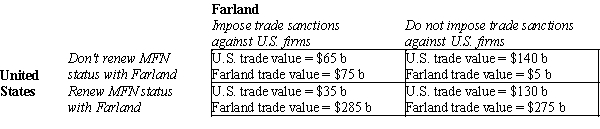 -Refer to Table 17-27. This particular game
 (Multiple Choice)
4.9/5 (92)
(92) If a market is a duopoly and additional firms enter and do not cooperate, then
(Multiple Choice)
4.8/5 (68)
(68) Some people consider the NCAA (National Collegiate Athletic Association) to be a __________ in the market for college athletics.
(Short Answer)
4.8/5 (87)
(87) Figure 17-5. Two companies, ABC and QRS, are sellers in the same market. Each company decides whether to charge a high price or a low price. In the figure, the dollar amounts are payoffs and they represent annual profits for the two companies.
-Refer to Figure 17-5. If the two companies make their pricing decisions independently, then it is likely that ABC will
-Refer to Figure 17-5. If the two companies make their pricing decisions independently, then it is likely that ABC will (Multiple Choice)
4.9/5 (85)
(85) Game theory is important for understanding which of the following market types?
(Multiple Choice)
4.7/5 (75)
(75) 
Filters
- Essay(0)
- Multiple Choice(0)
- Short Answer(0)
- True False(0)
- Matching(0)