



 Chat with AI
Exam 17: Oligopoly

Exam 1: Ten Principles of Economics455 Questions
Exam 2: Thinking Like an Economist645 Questions
Exam 3: Interdependence and the Gains From Trade550 Questions
Exam 4: The Market Forces of Supply and Demand693 Questions
Exam 5: Elasticity and Its Application625 Questions
Exam 6: Supply, Demand, and Government Policies671 Questions
Exam 7: Consumers, Producers, and the Efficiency of Markets547 Questions
Exam 8: Application: The Costs of Taxation507 Questions
Exam 9: Application: International Trade521 Questions
Exam 10: Externalities543 Questions
Exam 11: Public Goods and Common Resources453 Questions
Exam 12: The Design of the Tax System563 Questions
Exam 13: The Costs of Production649 Questions
Exam 14: Firms in Competitive Markets608 Questions
Exam 15: Monopoly662 Questions
Exam 16: Monopolistic Competition649 Questions
Exam 17: Oligopoly522 Questions
Exam 18: The Markets for the Factors of Production592 Questions
Exam 19: Earnings and Discrimination511 Questions
Exam 20: Income Inequality and Poverty478 Questions
Exam 21: The Theory of Consumer Choice568 Questions
Exam 22: Frontiers in Microeconomics461 Questions
Select questions type


An oligopolist will increase production if the output effect is
(Multiple Choice)
4.8/5  (70)
(70) Suppose that Bieber and Rihanna are duopolists in the music industry. In May, they agree to work together as a monopolist, charging the monopoly price for their music and producing the monopoly quantity of songs. By June, each singer is considering breaking the agreement. What would you expect to happen next?
(Multiple Choice)
4.8/5 (71)
(71) Table 17-12
The table shows the town of Driveaway's demand schedule for gasoline. Assume the town's gasoline seller(s) incurs a cost of $2 for each gallon sold, with no fixed cost. 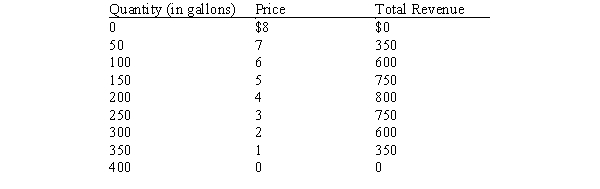 -Refer to Table 17-12. Suppose there are exactly two sellers of gasoline in Driveaway: Amogo and Spilmerica. If Amogo sells 150 gallons and Spilmerica sells 100 gallons, then
 (Multiple Choice)
4.7/5 (88)
(88) Table 17-27
Each year the United States considers renewal of Most Favored Nation (MFN) trading status with Farland (a mythical nation). Historically, legislators have made threats of not renewing MFN status because of human rights abuses in Farland. The non-renewal of MFN trading status is likely to involve some retaliatory measures by Farland. The payoff table below shows the potential economic gains associated with a game in which Farland may impose trade sanctions against U.S. firms and the United States may not renew MFN status with Farland. The table contains the dollar value of all trade-flow benefits to the United States and Farland. 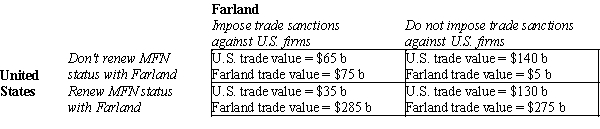 -Refer to Table 17-27. If both countries follow a dominant strategy, the value of trade flow benefits for Farland will be
 (Multiple Choice)
4.9/5 (68)
(68) Table 17-1
Imagine a small town in which only two residents, Rochelle and Alec, own wells that produce safe drinking water. Each week Rochelle and Alec work together to decide how many gallons of water to pump. They bring the water to town and sell it at whatever price the market will bear. To keep things simple, suppose that Rochelle and Alec can pump as much water as they want without cost so that the marginal cost of water equals zero. The town's weekly demand schedule and total revenue schedule for water is shown in the table below: 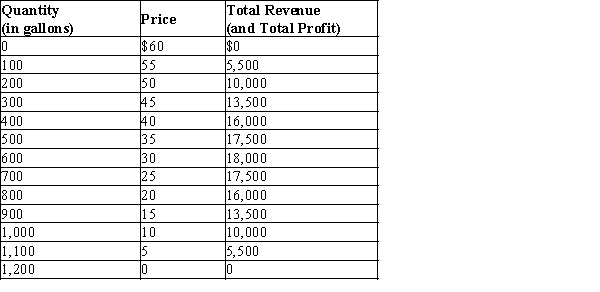 -Refer to Table 17-1. If this market for water were perfectly competitive instead of monopolistic, what price would be charged?
 (Multiple Choice)
4.9/5 (74)
(74) Scenario 17-2.
Imagine that two oil companies, BQ and Exxoff, own adjacent oil fields. Under the fields is a common pool of oil worth $144 million. Drilling a well to recover oil costs $5 million per well. If each company drills one well, each will get half of the oil and earn a $67 million profit ($72 million in revenue - $5 million in costs). Assume that having X percent of the total wells means that a company will collect X percent of the total revenue.
-Refer to Scenario 17-2. If BQ were to drill a second well, what would its profit be if Exxoff did not drill a second well?
(Multiple Choice)
4.9/5 (99)
(99) Assume that Samorola has entered into an enforceable resale price maintenance agreement with Trint and U-Mobile. Which of the following will always be true?
(Multiple Choice)
4.8/5 (89)
(89) Suppose three firms form a cartel and agree to charge a specific price for their output. Each individual firm has an incentive to maintain the agreement because the firm's individual profits will be the greatest under the cartel arrangement.
(True/False)
4.8/5 (90)
(90) Table 17-19
Consider a small town that has two grocery stores from which residents can choose to buy a loaf of bread. The store owners each must make a decision to set a high bread price or a low bread price. The payoff table, showing profit per week, is provided below. The profit in each cell is shown as (Store 1, Store 2).  -Refer to Table 17-19. If grocery store 2 sets a high price, what price should grocery store 1 set? And what will grocery store 1's payoff equal?
 (Multiple Choice)
5.0/5 (87)
(87) Scenario 17-2.
Imagine that two oil companies, BQ and Exxoff, own adjacent oil fields. Under the fields is a common pool of oil worth $144 million. Drilling a well to recover oil costs $5 million per well. If each company drills one well, each will get half of the oil and earn a $67 million profit ($72 million in revenue - $5 million in costs). Assume that having X percent of the total wells means that a company will collect X percent of the total revenue.
-Refer to Scenario 17-2. If each firm is permitted to drill two wells at most, the firms are in a Nash equilibrium when
(Multiple Choice)
4.8/5 (93)
(93) Table 17-21
The Chicken Game is named for a contest in which drivers test their courage by driving straight at each other. John and Paul have a common interest to avoid crashing into each other, but they also have a personal, competing interest to not turn first to demonstrate their courage to those observing the contest. The payoff table for this situation is provided below. The payoffs are shown as (John, Paul).  -Refer to Table 17-21. How many Nash equilibria are there in this Chicken game?
 (Multiple Choice)
4.9/5 (80)
(80) Table 17-21
The Chicken Game is named for a contest in which drivers test their courage by driving straight at each other. John and Paul have a common interest to avoid crashing into each other, but they also have a personal, competing interest to not turn first to demonstrate their courage to those observing the contest. The payoff table for this situation is provided below. The payoffs are shown as (John, Paul).
-Refer to Table 17-21. What is John's dominant strategy?
-Refer to Table 17-21. What is John's dominant strategy? (Multiple Choice)
4.8/5 (73)
(73) Table 17-29
Suppose that two firms, Wild Willy's Wonderdrink (Firm W) and Hyper Hank's Hydration (Firm H), comprise the market for energy drinks. Each firm determines that it could lower its costs and increase its profits if both firms reduced their advertising budgets. But for the plan to work, each firm must agree to refrain from advertising. Each firm believes that advertising works by increasing the demand for the firm's energy drinks, but each firm also believes that if neither firm advertises, the cost savings will outweigh the lost sales. The table below lists each firm's individual profits:
Firm W
Breaks agreement Maintains agreement
and advertises and does not advertise  -Refer to Table 17-29. Which of the following statements does not correctly characterize the outcome of this game?
 (Multiple Choice)
4.8/5 (82)
(82) The Clayton Act of 1914 allows those harmed by illegal arrangements to restrain trade to
(Multiple Choice)
4.8/5 (85)
(85) Explain the practice of resale price maintenance and discuss why it is controversial.
(Essay)
4.8/5 (94)
(94) In a prisoner's dilemma situation where firms are setting prices, the dominant strategy is always to charge the price that leads to maximum profits for all firms.
(True/False)
4.9/5 (84)
(84) 
Filters
- Essay(0)
- Multiple Choice(0)
- Short Answer(0)
- True False(0)
- Matching(0)