



 Chat with AI
Exam 17: Oligopoly

Exam 1: Ten Principles of Economics455 Questions
Exam 2: Thinking Like an Economist645 Questions
Exam 3: Interdependence and the Gains From Trade550 Questions
Exam 4: The Market Forces of Supply and Demand693 Questions
Exam 5: Elasticity and Its Application625 Questions
Exam 6: Supply, Demand, and Government Policies671 Questions
Exam 7: Consumers, Producers, and the Efficiency of Markets547 Questions
Exam 8: Application: The Costs of Taxation507 Questions
Exam 9: Application: International Trade521 Questions
Exam 10: Externalities543 Questions
Exam 11: Public Goods and Common Resources453 Questions
Exam 12: The Design of the Tax System563 Questions
Exam 13: The Costs of Production649 Questions
Exam 14: Firms in Competitive Markets608 Questions
Exam 15: Monopoly662 Questions
Exam 16: Monopolistic Competition649 Questions
Exam 17: Oligopoly522 Questions
Exam 18: The Markets for the Factors of Production592 Questions
Exam 19: Earnings and Discrimination511 Questions
Exam 20: Income Inequality and Poverty478 Questions
Exam 21: The Theory of Consumer Choice568 Questions
Exam 22: Frontiers in Microeconomics461 Questions
Select questions type


Table 17-13
Two home-improvement stores (Lopes and HomeMax) in a growing urban area are interested in expanding their market share. Both are interested in expanding the size of their store and parking lot to accommodate potential growth in their customer base. The following game depicts the strategic outcomes that result from the game. Increases in annual profits of the two home-improvement stores are shown in the table below. 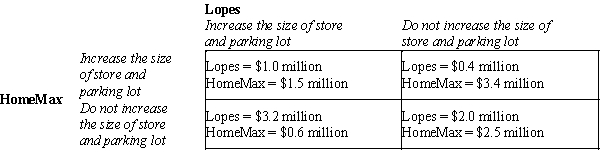 -Refer to Table 17-13. When this game reaches a Nash equilibrium, annual profit will grow by
 (Multiple Choice)
4.8/5  (82)
(82) In some games, the noncooperative equilibrium is bad for the players and bad for society.
(True/False)
4.9/5 (79)
(79) Table 17-3
Imagine a small town in a remote area where only two residents, Maria and Miguel, own dairies that produce milk that is safe to drink. Each week Maria and Miguel work together to decide how many gallons of milk to produce. They bring milk to town and sell it at whatever price the market will bear. To keep things simple, suppose that Maria and Miguel can produce as much milk as they want without cost so that the marginal cost is zero. The weekly town demand schedule and total revenue schedule for milk is shown in the table below: 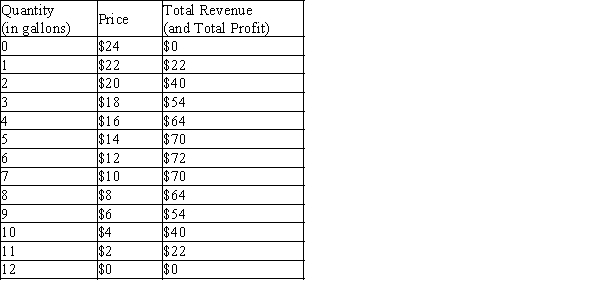 -Refer to Table 17-3. Suppose that Maria and Miguel work together in order to operate as a profit-maximizing monopolist. What price will they charge for milk?
 (Multiple Choice)
4.7/5 (64)
(64) Table 17-12
The table shows the town of Driveaway's demand schedule for gasoline. Assume the town's gasoline seller(s) incurs a cost of $2 for each gallon sold, with no fixed cost. 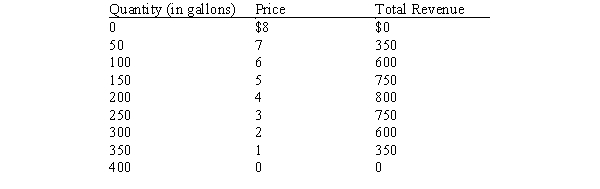 -Refer to Table 17-12. Suppose we observe that the price of a gallon of gasoline in Driveaway is $5; we observe as well that a particular seller's profit is $150. Given this observation, which of the following scenarios is most likely?
 (Multiple Choice)
4.9/5 (80)
(80) Table 17-29
Suppose that two firms, Wild Willy's Wonderdrink (Firm W) and Hyper Hank's Hydration (Firm H), comprise the market for energy drinks. Each firm determines that it could lower its costs and increase its profits if both firms reduced their advertising budgets. But for the plan to work, each firm must agree to refrain from advertising. Each firm believes that advertising works by increasing the demand for the firm's energy drinks, but each firm also believes that if neither firm advertises, the cost savings will outweigh the lost sales. The table below lists each firm's individual profits:
Firm W
Breaks agreement Maintains agreement
and advertises and does not advertise  -Refer to Table 17-29. What is the outcome of this game?
 (Multiple Choice)
4.8/5 (83)
(83) Assume that two firms in an oligopoly market are unable to collude. Once the Nash Equilibrium is reached
(Multiple Choice)
4.9/5 (69)
(69) Table 17-19
Consider a small town that has two grocery stores from which residents can choose to buy a loaf of bread. The store owners each must make a decision to set a high bread price or a low bread price. The payoff table, showing profit per week, is provided below. The profit in each cell is shown as (Store 1, Store 2).  -Refer to Table 17-19. If grocery store 1 sets a low price, what price should grocery store 2 set? And what will grocery store 2's payoff equal?
 (Multiple Choice)
4.8/5 (85)
(85) Table 17-8
For a certain small town, the table shows the demand schedule for water. Assume the marginal cost of supplying water is constant at $4 per bottle and there are no other costs. 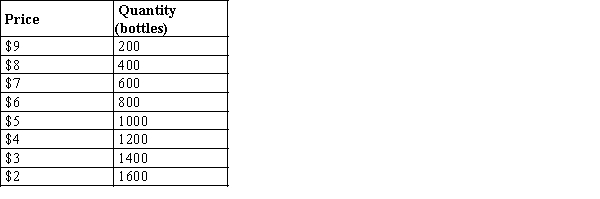 -Refer to Table 17-8. If there are two suppliers of water, Victor and Sami, and if they have successfully formed a cartel, then what would be the price and the market quantity?
 (Multiple Choice)
4.9/5 (73)
(73) Table 17-12
The table shows the town of Driveaway's demand schedule for gasoline. Assume the town's gasoline seller(s) incurs a cost of $2 for each gallon sold, with no fixed cost.
-Refer to Table 17-12. If there are exactly five sellers of gasoline in Driveaway and if they collude, then which of the following outcomes is most likely?
-Refer to Table 17-12. If there are exactly five sellers of gasoline in Driveaway and if they collude, then which of the following outcomes is most likely? (Multiple Choice)
4.8/5 (82)
(82) Scenario 17-5
Assume that a local restaurant sells two items, salads and steaks. The restaurant's only two customers on a particular day are Mr. Carnivore and Ms. Leafygreens. Mr. Carnivore is willing to pay $20 for a steak and $7 for a salad. Ms. Leafygreens is willing to pay only $8 for a steak, but is willing to pay $12 for a salad. Assume that the restaurant can provide each of these items at zero marginal cost.
-Refer to Scenario 17-5. If the restaurant is unable to use tying, what is the profit-maximizing price to charge for a steak?
(Multiple Choice)
4.9/5 (84)
(84) Table 17-13
Two home-improvement stores (Lopes and HomeMax) in a growing urban area are interested in expanding their market share. Both are interested in expanding the size of their store and parking lot to accommodate potential growth in their customer base. The following game depicts the strategic outcomes that result from the game. Increases in annual profits of the two home-improvement stores are shown in the table below.
-Refer to Table 17-13. Pursuing its own best interest, Lopes will
-Refer to Table 17-13. Pursuing its own best interest, Lopes will (Multiple Choice)
4.8/5 (72)
(72) Two CEOs from different firms in the same market collude to fix the price in the market. This action violates the
(Multiple Choice)
4.7/5 (66)
(66) Table 17-1
Imagine a small town in which only two residents, Rochelle and Alec, own wells that produce safe drinking water. Each week Rochelle and Alec work together to decide how many gallons of water to pump. They bring the water to town and sell it at whatever price the market will bear. To keep things simple, suppose that Rochelle and Alec can pump as much water as they want without cost so that the marginal cost of water equals zero. The town's weekly demand schedule and total revenue schedule for water is shown in the table below: 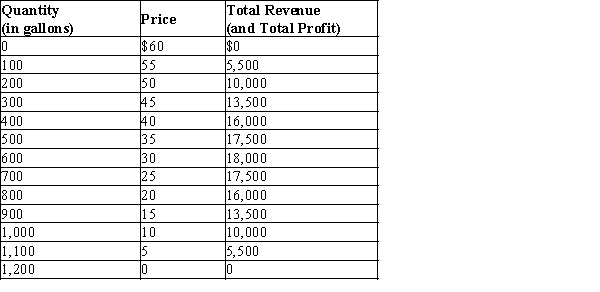 -Refer to Table 17-1. If the market for water were perfectly competitive instead of monopolistic, how many gallons of water would be produced and sold?
 (Multiple Choice)
4.8/5 (76)
(76) Table 17-36
The information in the table shows the total demand for water service in Takoma. Assume that there are two companies operating in Takoma. Each company that provides these services incurs an annual fixed cost of $400 and that the marginal cost of providing the service to each customer is exactly $2.00. Figures listed are for an annual service contract.
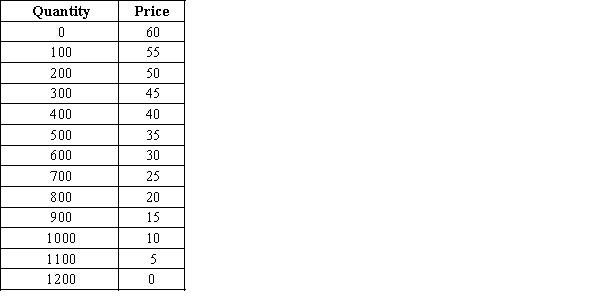 -Refer to Table 17-36. The two water service providers in Takoma are able to form a successful cartel. If they collude on the quantity of service contracts each sells and split the market equally,
 (Multiple Choice)
4.8/5 (75)
(75) 
Filters
- Essay(0)
- Multiple Choice(0)
- Short Answer(0)
- True False(0)
- Matching(0)