



 Chat with AI
Exam 17: Oligopoly

Exam 1: Ten Principles of Economics455 Questions
Exam 2: Thinking Like an Economist645 Questions
Exam 3: Interdependence and the Gains From Trade550 Questions
Exam 4: The Market Forces of Supply and Demand693 Questions
Exam 5: Elasticity and Its Application625 Questions
Exam 6: Supply, Demand, and Government Policies671 Questions
Exam 7: Consumers, Producers, and the Efficiency of Markets547 Questions
Exam 8: Application: The Costs of Taxation507 Questions
Exam 9: Application: International Trade521 Questions
Exam 10: Externalities543 Questions
Exam 11: Public Goods and Common Resources453 Questions
Exam 12: The Design of the Tax System563 Questions
Exam 13: The Costs of Production649 Questions
Exam 14: Firms in Competitive Markets608 Questions
Exam 15: Monopoly662 Questions
Exam 16: Monopolistic Competition649 Questions
Exam 17: Oligopoly522 Questions
Exam 18: The Markets for the Factors of Production592 Questions
Exam 19: Earnings and Discrimination511 Questions
Exam 20: Income Inequality and Poverty478 Questions
Exam 21: The Theory of Consumer Choice568 Questions
Exam 22: Frontiers in Microeconomics461 Questions
Select questions type


Table 17-31
Imagine a small town in a remote area where only two residents, Maria and Miguel, own dairies that produce milk that is safe to drink. Each week Maria and Miguel work together to decide how many gallons of milk to produce. They bring milk to town and sell it at whatever price the market will bear. To keep things simple, suppose that Maria and Miguel can produce as much milk as they want without cost so that the marginal cost is zero. The weekly town demand schedule and total revenue schedule for milk is shown in the table below: 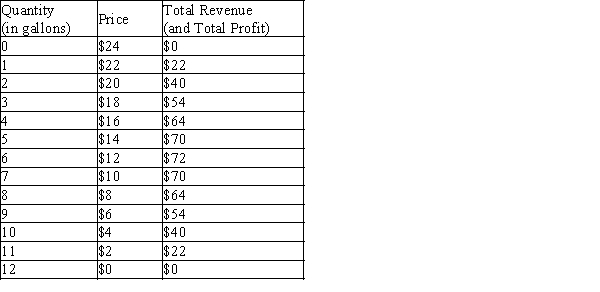 -Refer to Table 17-31. Briefly explain why each duopolist earns a lower profit at the Nash equilibrium than if they cooperated to produce the monopoly output.
 (Essay)
4.8/5  (76)
(76) Table 17-19
Consider a small town that has two grocery stores from which residents can choose to buy a loaf of bread. The store owners each must make a decision to set a high bread price or a low bread price. The payoff table, showing profit per week, is provided below. The profit in each cell is shown as (Store 1, Store 2).  -Refer to Table 17-19. What is grocery store 2's dominant strategy?
 (Multiple Choice)
4.7/5 (67)
(67) Figure 17-2. Two companies, Acme and Pinnacle, each decide whether to produce a good quality product or a poor quality product. In the figure, the dollar amounts are payoffs and they represent annual profits for the two companies. 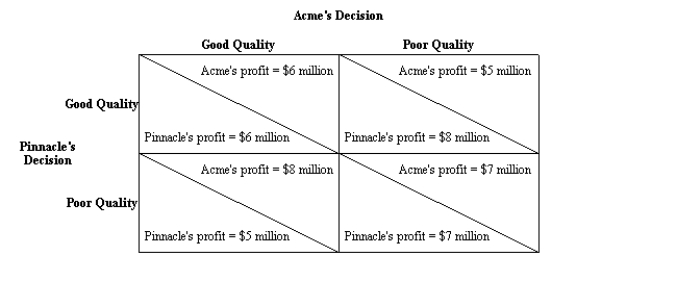 -Refer to Figure 17-2. The dominant strategy for Acme is to
 (Multiple Choice)
5.0/5 (77)
(77) Figure 17-1 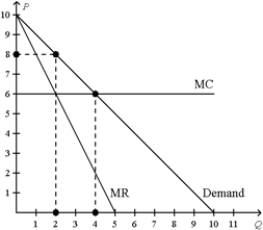 -Refer to Figure 17-1. Suppose this market is served by two firms who each face the marginal cost curve shown in the diagram. The marginal revenue curve that a monopolist would face in this market is also shown. If the firms are able to collude successfully,
 (Multiple Choice)
4.8/5 (88)
(88) Table 17-2
Imagine a small town in which only two residents, Abby and Brad, own wells that produce safe drinking water. Each week Abby and Brad work together to decide how many gallons of water to pump. They bring water to town and sell it at whatever price the market will bear. To keep things simple, suppose that Abby and Brad can pump as much water as they want without cost so that the marginal cost is zero. The weekly town demand schedule and total revenue schedule for water is shown in the table below: 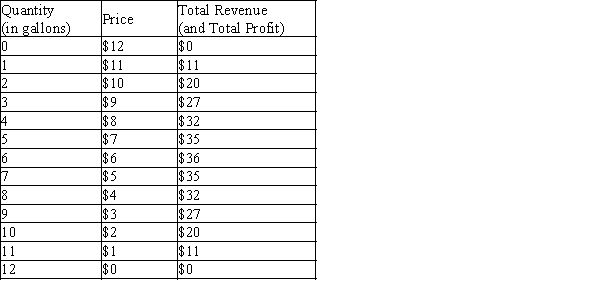 -Refer to Table 17-2. Suppose the town enacts new antitrust laws that prohibit Abby and Brad from operating as a monopoly. What will be the price of water once Abby and Brad reach a Nash equilibrium?
 (Multiple Choice)
4.9/5 (64)
(64) Table 17-23
Two bottled beverage manufacturers (Firm A and Firm B) determine that they could lower their costs, and thus increase their profits, if they reduced their advertising budgets. But for the plan to work, each firm must agree to refrain from advertising. Each firm believes that advertising works by increasing the demand for the firm's product, but each firm also believes that if neither firm advertises, the costs savings will outweigh the lost sales. Listed in the table below are the individual profits for each firm. 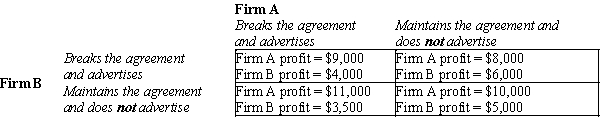 -Refer to Table 17-23. Suppose that the two firms, A and B, make an agreement to withhold any advertising for one month to lower each firm's costs and raise each firm's profits. If the firms reach the Nash equilibrium,
 (Multiple Choice)
5.0/5 (82)
(82) Figure 17-5. Two companies, ABC and QRS, are sellers in the same market. Each company decides whether to charge a high price or a low price. In the figure, the dollar amounts are payoffs and they represent annual profits for the two companies. 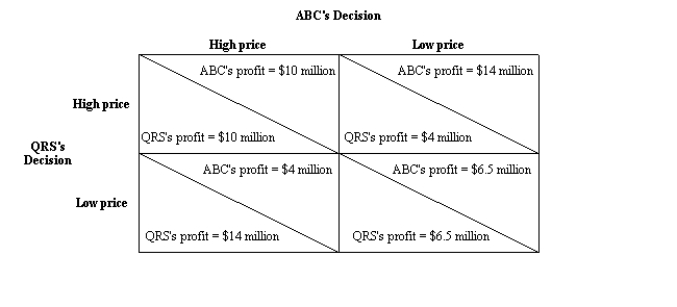 -Refer to Figure 17-5. If this game is played only once, then the most likely outcome is that
 (Multiple Choice)
4.8/5 (78)
(78) If all of the firms in an oligopoly successfully collude and form a cartel, then total profit for the cartel is equal to what it would be if the market were a monopoly.
(True/False)
5.0/5 (78)
(78) Table 17-1
Imagine a small town in which only two residents, Rochelle and Alec, own wells that produce safe drinking water. Each week Rochelle and Alec work together to decide how many gallons of water to pump. They bring the water to town and sell it at whatever price the market will bear. To keep things simple, suppose that Rochelle and Alec can pump as much water as they want without cost so that the marginal cost of water equals zero. The town's weekly demand schedule and total revenue schedule for water is shown in the table below: 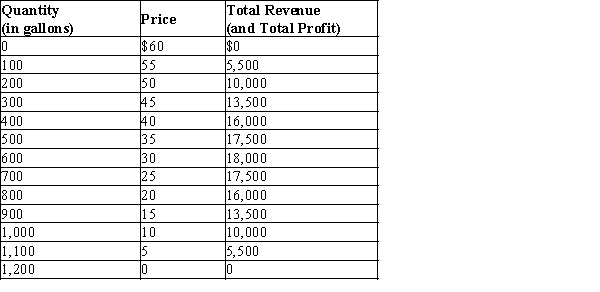 -Refer to Table 17-1. If Rochelle and Alec operate as a profit-maximizing monopoly in the market for water, how much profit will each of them earn, assuming that the two producers split the market equally?
 (Multiple Choice)
4.7/5 (80)
(80) The notion of a tit-for-tat strategy applies to a prisoners' dilemma game that is played repeatedly, but it does not apply if the game is played only once.
(True/False)
4.9/5 (81)
(81) Because oligopoly markets have only a few sellers, the actions of any one seller
(Multiple Choice)
5.0/5 (74)
(74) The equilibrium price in a market characterized by oligopoly is
(Multiple Choice)
4.7/5 (70)
(70) Scenario 17-6
Assume that a local telecommunications company sells high speed internet access and cable television. The company's only two customers are Taylor and Tim. Taylor is willing to pay $50 per month for high speed internet access and $50 per month for cable television. Tim is willing to pay only $20 per month for high speed internet access, but is willing to pay $70 per month for cable television. Assume that the telecommunications company can provide each of these products at zero marginal cost.
-Refer to Scenario 17-6. If the telecommunications company is unable to use tying, what is the profit-maximizing price to charge for high speed internet access?
(Short Answer)
4.8/5 (83)
(83) Figure 17-4. Aaron and Ed are roommates. After a big snowstorm, their driveway needs to be shoveled. Each person has to decide whether to take part in shoveling the driveway. At the end of the day, either the driveway will be shoveled (if one or both roommates take part in shoveling), or it will remain unshoveled (if neither roommate shovels). With happiness measured on a scale of 1 (very unhappy) to 10 (very happy), the possible outcomes are as follows: 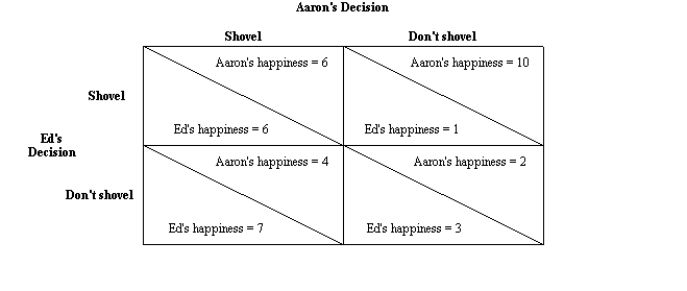 -Refer to Figure 17-4. In pursuing his own self-interest, Ed will
 (Multiple Choice)
4.9/5 (85)
(85) 
Filters
- Essay(0)
- Multiple Choice(0)
- Short Answer(0)
- True False(0)
- Matching(0)