



 Chat with AI
Exam 17: Oligopoly

Exam 1: Ten Principles of Economics455 Questions
Exam 2: Thinking Like an Economist645 Questions
Exam 3: Interdependence and the Gains From Trade550 Questions
Exam 4: The Market Forces of Supply and Demand693 Questions
Exam 5: Elasticity and Its Application625 Questions
Exam 6: Supply, Demand, and Government Policies671 Questions
Exam 7: Consumers, Producers, and the Efficiency of Markets547 Questions
Exam 8: Application: The Costs of Taxation507 Questions
Exam 9: Application: International Trade521 Questions
Exam 10: Externalities543 Questions
Exam 11: Public Goods and Common Resources453 Questions
Exam 12: The Design of the Tax System563 Questions
Exam 13: The Costs of Production649 Questions
Exam 14: Firms in Competitive Markets608 Questions
Exam 15: Monopoly662 Questions
Exam 16: Monopolistic Competition649 Questions
Exam 17: Oligopoly522 Questions
Exam 18: The Markets for the Factors of Production592 Questions
Exam 19: Earnings and Discrimination511 Questions
Exam 20: Income Inequality and Poverty478 Questions
Exam 21: The Theory of Consumer Choice568 Questions
Exam 22: Frontiers in Microeconomics461 Questions
Select questions type


When firms have agreements among themselves on the quantity to produce and the price at which to sell output, we refer to their form of organization as a
(Multiple Choice)
4.8/5  (78)
(78) Figure 17-5. Two companies, ABC and QRS, are sellers in the same market. Each company decides whether to charge a high price or a low price. In the figure, the dollar amounts are payoffs and they represent annual profits for the two companies. 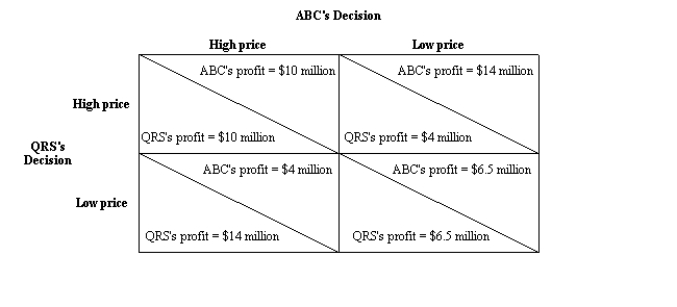 -Refer to Figure 17-5. If the two companies make their pricing decisions independently, then it is likely that QRS will
 (Multiple Choice)
4.7/5 (72)
(72) A particular cable TV company requires a household to subscribe to its high-speed Internet service if it subscribes to cable TV, and vice versa. This practice
(Multiple Choice)
4.7/5 (70)
(70) Table 17-26
Two prescription drug manufacturers (Firm A and Firm B) are faced with lawsuits from states to recover the healthcare related expenses associated with side-effects from its drugs. Each drug manufacturer has evidence that indicates that taking its prescription drug causes liver failure. State prosecutors do not have access to the same data used by drug manufacturers and thus will have difficulty recovering full costs without the help of at least one of the drug manufacturer's studies. Each firm has been presented with an opportunity to lower its liability in the suit if it cooperates with attorneys representing the states. 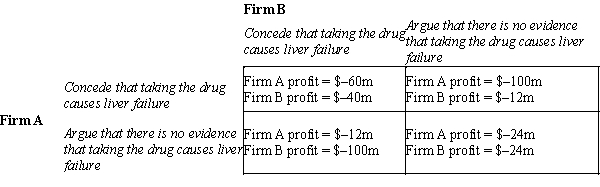 -Refer to Table 17-26. When this game reaches a Nash equilibrium, profits for Firm A and Firm B will be
 (Multiple Choice)
4.9/5 (81)
(81) Table 17-1
Imagine a small town in which only two residents, Rochelle and Alec, own wells that produce safe drinking water. Each week Rochelle and Alec work together to decide how many gallons of water to pump. They bring the water to town and sell it at whatever price the market will bear. To keep things simple, suppose that Rochelle and Alec can pump as much water as they want without cost so that the marginal cost of water equals zero. The town's weekly demand schedule and total revenue schedule for water is shown in the table below: 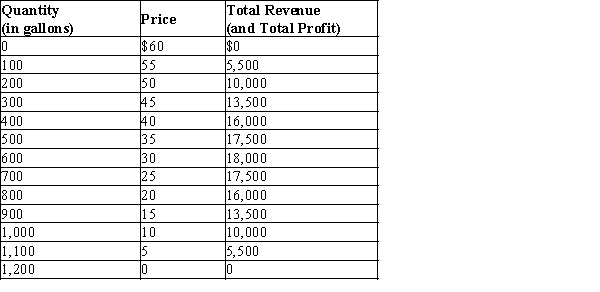 -Refer to Table 17-1. If Rochelle and Alec operate as a profit-maximizing monopoly in the market for water, what price will they charge?
 (Multiple Choice)
4.8/5 (82)
(82) Table 17-9
The table shows the demand schedule for a particular product. 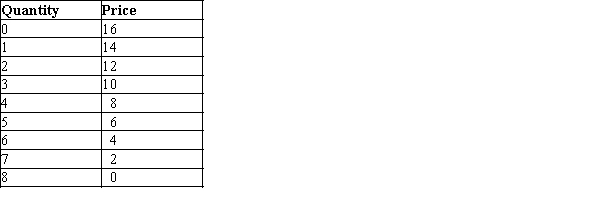 -Refer to Table 17-9. Suppose the market for this product is served by two firms that have formed a cartel. What price will the cartel charge in this market if the marginal cost of production is $4?
 (Multiple Choice)
4.9/5 (81)
(81) Scenario 17-1.
Assume that the countries of Irun and Urun are the only two producers of crude oil. Further assume that both countries have entered into an agreement to maintain certain production levels in order to maximize profits. In the world market for oil, the demand curve is downward sloping.
-Refer to Scenario 17-1. As long as the combined level of output is less than the Nash equilibrium level, both Irun and Urun have the individual incentive to
(Multiple Choice)
4.8/5 (92)
(92) Table 17-2
Imagine a small town in which only two residents, Abby and Brad, own wells that produce safe drinking water. Each week Abby and Brad work together to decide how many gallons of water to pump. They bring water to town and sell it at whatever price the market will bear. To keep things simple, suppose that Abby and Brad can pump as much water as they want without cost so that the marginal cost is zero. The weekly town demand schedule and total revenue schedule for water is shown in the table below: 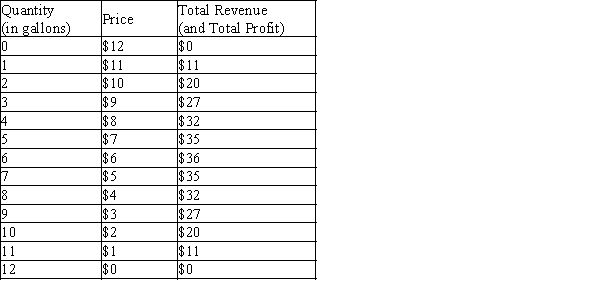 -Refer to Table 17-2. If this market for water were perfectly competitive instead of monopolistic, how many gallons of water would be produced and sold?
 (Multiple Choice)
4.9/5 (74)
(74) Table 17-4
The table shows the town of Mauston's demand schedule for gasoline. For simplicity, assume the town's gasoline seller(s) incur no costs in selling gasoline. 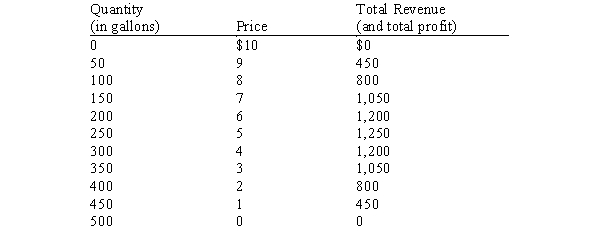 -Refer to Table 17-4. If the market for gasoline in Mauston is a monopoly, then the profit-maximizing monopolist will charge a price of
 (Multiple Choice)
4.8/5 (76)
(76) Table 17-12
The table shows the town of Driveaway's demand schedule for gasoline. Assume the town's gasoline seller(s) incurs a cost of $2 for each gallon sold, with no fixed cost. 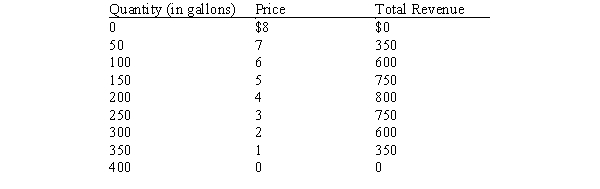 -Refer to Table 17-12. If the market for gasoline in Driveaway is perfectly competitive, then the equilibrium price of gasoline is
 (Multiple Choice)
4.9/5 (84)
(84) In the case of oligopolistic markets, self-interest makes cooperation difficult and it often leads to an undesirable outcome for the firms that are involved.
(True/False)
4.8/5 (79)
(79) Table 17-15
This table shows a game played between two players, A and B. The payoffs in the table are shown as (Payoff to A, Payoff to B).  -Refer to Table 17-15. Which of the following statements regarding this game is true?
 (Multiple Choice)
5.0/5 (76)
(76) Describe the output and price effects that influence the profit-maximizing decision faced by a firm in an oligopoly market. How does this differ from output and price effects in a monopoly market?
(Essay)
4.9/5 (76)
(76) Table 17-20
Nadia and Maddie are two college roommates who both prefer a clean common space in their dorm room, but neither enjoys cleaning. The roommates must each make a decision to either clean or not clean the dorm room's common space. The payoff table for this situation is provided below, where the higher a player's payoff number, the better off that player is. The payoffs in each cell are shown as (payoff for Nadia, payoff for Maddie).  -Refer to Table 17-20. If Maddie chooses not to clean, then Nadia will
 (Multiple Choice)
4.8/5 (88)
(88) Table 17-7
The information in the table below shows the total demand for internet radio subscriptions in a small urban market. Assume that each company that provides these subscriptions incurs an annual fixed cost of $20,000 (per year) and that the marginal cost of providing an additional subscription is always $16. 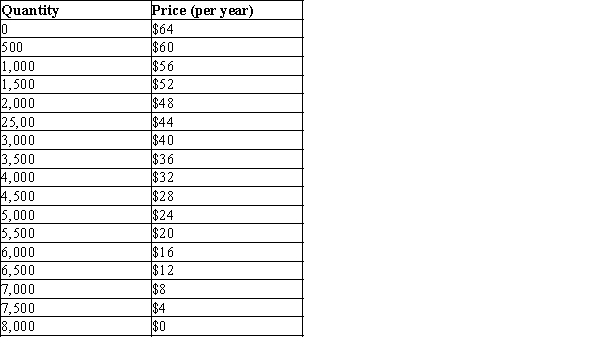 -Refer to Table 17-7. Suppose there is only one internet radio provider in this market and it seeks to maximize its profit. The company will
 (Multiple Choice)
4.9/5 (77)
(77) The essence of an oligopolistic market is that there are only a few sellers.
(True/False)
4.7/5 (80)
(80) The prisoners' dilemma is an important game to study because
(Multiple Choice)
4.8/5 (69)
(69) 
Filters
- Essay(0)
- Multiple Choice(0)
- Short Answer(0)
- True False(0)
- Matching(0)