



 Chat with AI
Exam 3: Interdependence and the Gains From Trade

Exam 1: Ten Principles of Economics455 Questions
Exam 2: Thinking Like an Economist645 Questions
Exam 3: Interdependence and the Gains From Trade550 Questions
Exam 4: The Market Forces of Supply and Demand693 Questions
Exam 5: Elasticity and Its Application625 Questions
Exam 6: Supply, Demand, and Government Policies671 Questions
Exam 7: Consumers, Producers, and the Efficiency of Markets547 Questions
Exam 8: Application: The Costs of Taxation507 Questions
Exam 9: Application: International Trade521 Questions
Exam 10: Externalities543 Questions
Exam 11: Public Goods and Common Resources453 Questions
Exam 12: The Design of the Tax System563 Questions
Exam 13: The Costs of Production649 Questions
Exam 14: Firms in Competitive Markets608 Questions
Exam 15: Monopoly662 Questions
Exam 16: Monopolistic Competition649 Questions
Exam 17: Oligopoly522 Questions
Exam 18: The Markets for the Factors of Production592 Questions
Exam 19: Earnings and Discrimination511 Questions
Exam 20: Income Inequality and Poverty478 Questions
Exam 21: The Theory of Consumer Choice568 Questions
Exam 22: Frontiers in Microeconomics461 Questions
Select questions type


Figure 3-15
Perry's Production Possibilities Frontier
Jordan's Production Possibilities Frontier 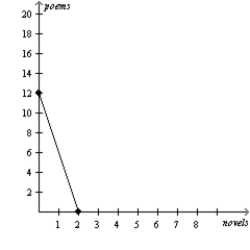
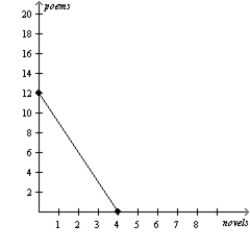 -Refer to Figure 3-15. Perry should specialize in the production of
 (Multiple Choice)
4.8/5  (88)
(88) Figure 3-26
Mary's Production Possibilities Frontier Kate's Production Possibilities Frontier 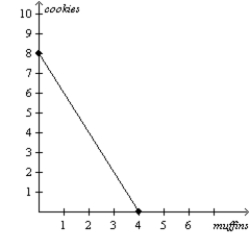
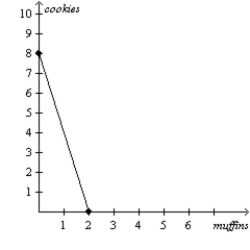 -Refer to Figure 3-26. What is Kate's opportunity cost of one muffin?
 (Short Answer)
4.9/5 (71)
(71) Table 3-26
Assume that Japan and Korea can switch between producing cars and producing airplanes at a constant rate.
 -Refer to Table 3-26. Japan's opportunity cost of one airplane is
 (Multiple Choice)
5.0/5 (82)
(82) When there are two people and each is capable of producing two goods, it is possible for one person to have a comparative advantage over the other in both goods.
(True/False)
4.9/5 (81)
(81) Adam Smith wrote that a person should never attempt to make at home what it will cost him more to make than to buy.
(True/False)
4.8/5 (73)
(73) Figure 3-14
Arturo's Production Possibilities Frontier
Dina's Production Possibilities Frontier 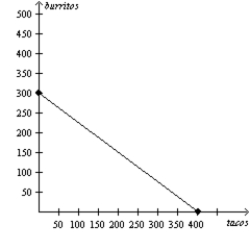
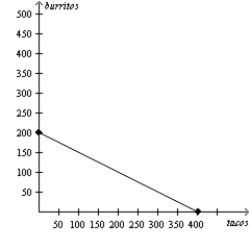 -Refer to Figure 3-14. Arturo should specialize in the production of
 (Multiple Choice)
4.8/5 (80)
(80) Table 3-9
Assume that Maya and Miguel can switch between producing mixers and producing toasters at a constant rate.
 -Refer to Table 3-9. We could use the information in the table to draw a production possibilities frontier for Maya and a second production possibilities frontier for Miguel. If we were to do this, measuring toasters along the horizontal axis, then
 (Multiple Choice)
4.8/5 (70)
(70) If Shawn can produce more donuts in one day than Sue can produce in one day, then
(Multiple Choice)
4.9/5 (78)
(78) As long as two people have different opportunity costs, each can gain from trade with the other, since trade allows each person to obtain a good at a price lower than his or her opportunity cost.
(True/False)
4.8/5 (90)
(90) Table 3-33
Chris and Tony's Production Opportunities  -Refer to Table 3-33 Chris and Tony both produce tomatoes and pasta sauce. The table shows their possible production per month if both work the same number of 8 hour days. If Chris and Tony both decide to specialize and produce only the good in which they have a comparative advantage, then
 (Multiple Choice)
4.7/5 (77)
(77) Table 3-25
Assume that Maya and Miguel can switch between producing mixers and producing toasters at a constant rate.
 -Refer to Table 3-25. The opportunity cost of 1 mixer for Maya is
 (Multiple Choice)
4.9/5 (80)
(80) A person can benefit from specialization and trade by obtaining a good at a price that is
(Multiple Choice)
4.8/5 (63)
(63) Olivia bakes cakes and Andrew grows corn. Olivia and Andrew both like to eat cake and eat corn. In which of the following cases is it impossible for both Olivia and Andrew to benefit from trade?
(Multiple Choice)
4.9/5 (69)
(69) The only two countries in the world, Alpha and Omega, face the following production possibilities frontiers.
Alpha's Production Possibilities Frontier
Omega's Production Possibilities Frontier 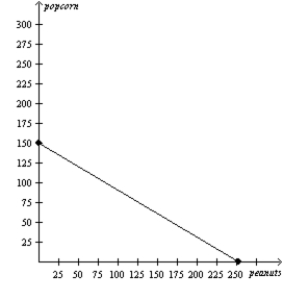
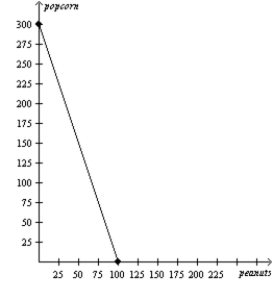 a.Assume that each country decides to use half of its resources in the production of each good. Show these points on the graphs for each country as point A.
b.If these countries choose not to trade, what would be the total world production of popcorn and peanuts?
c.Now suppose that each country decides to specialize in the good in which each has a comparative advantage. By specializing, what is the total world production of each product now?
d.If each country decides to trade 100 units of popcorn for 100 units of peanuts, show on the graphs the gain each country would receive from trade. Label these points B.
a.Assume that each country decides to use half of its resources in the production of each good. Show these points on the graphs for each country as point A.
b.If these countries choose not to trade, what would be the total world production of popcorn and peanuts?
c.Now suppose that each country decides to specialize in the good in which each has a comparative advantage. By specializing, what is the total world production of each product now?
d.If each country decides to trade 100 units of popcorn for 100 units of peanuts, show on the graphs the gain each country would receive from trade. Label these points B. (Essay)
4.9/5 (86)
(86) In most countries today, many goods and services consumed are imported from abroad, and many goods and services produced are exported to foreign customers.
(True/False)
4.9/5 (84)
(84) Table 3-41
 -Refer to Table 3-41. Which country has an absolute advantage in producing compasses?
 (Short Answer)
4.8/5 (85)
(85) Figure 3-16
Hosne's Production Possibilities Frontier
Merve's Production Possibilities Frontier 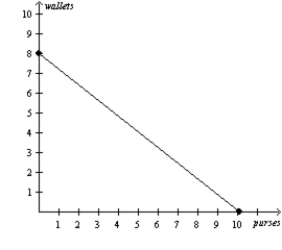
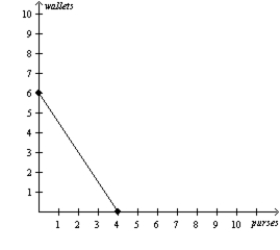 -Refer to Figure 3-16. At which of the following prices would both Hosne and Merve gain from trade with each other?
 (Multiple Choice)
4.9/5 (88)
(88) Table 3-22
Assume that Zimbabwe and Portugal can switch between producing toothbrushes and producing hairbrushes at a constant rate.  -Refer to Table 3-22. Zimbabwe has an absolute advantage in the production of
 (Multiple Choice)
4.8/5 (79)
(79) Figure 3-17
Maxine's Production Possibilities Frontier
Daisy's Production Possibilities Frontier 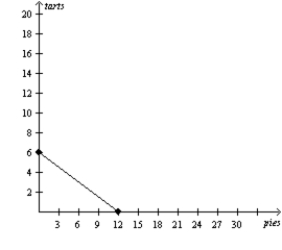
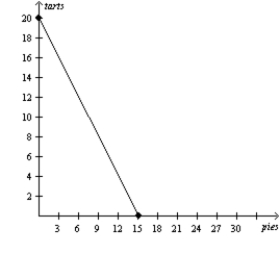 -Refer to Figure 3-17. If Maxine and Daisy switch from each person dividing her time equally between the production of pies and tarts to each person spending all of her time producing the good in which she has a comparative advantage, then total production of tarts will increase by
 (Multiple Choice)
5.0/5 (82)
(82) Figure 3-21
Uzbekistan's Production Possibilities Frontier
Azerbaijan's Production Possibilities Frontier 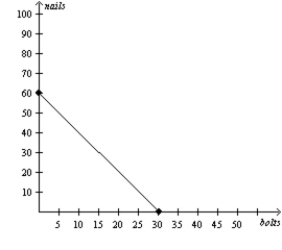
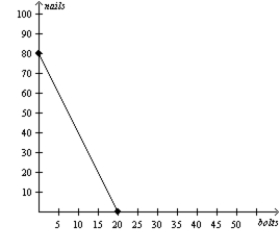 -Refer to Figure 3-21. Without trade, Uzbekistan produced and consumed 12 bolts and 36 nails and Azerbaijan produced and consumed 14 bolts and 24 nails. Then, each country agreed to specialize in the production of the good in which it has a comparative advantage and trade 16 bolts for 38 nails. As a result, Uzbekistan gained
 (Multiple Choice)
4.7/5 (75)
(75) 
Filters
- Essay(0)
- Multiple Choice(0)
- Short Answer(0)
- True False(0)
- Matching(0)