



 Chat with AI
Exam 3: Interdependence and the Gains From Trade

Exam 1: Ten Principles of Economics455 Questions
Exam 2: Thinking Like an Economist645 Questions
Exam 3: Interdependence and the Gains From Trade550 Questions
Exam 4: The Market Forces of Supply and Demand693 Questions
Exam 5: Elasticity and Its Application625 Questions
Exam 6: Supply, Demand, and Government Policies671 Questions
Exam 7: Consumers, Producers, and the Efficiency of Markets547 Questions
Exam 8: Application: The Costs of Taxation507 Questions
Exam 9: Application: International Trade521 Questions
Exam 10: Externalities543 Questions
Exam 11: Public Goods and Common Resources453 Questions
Exam 12: The Design of the Tax System563 Questions
Exam 13: The Costs of Production649 Questions
Exam 14: Firms in Competitive Markets608 Questions
Exam 15: Monopoly662 Questions
Exam 16: Monopolistic Competition649 Questions
Exam 17: Oligopoly522 Questions
Exam 18: The Markets for the Factors of Production592 Questions
Exam 19: Earnings and Discrimination511 Questions
Exam 20: Income Inequality and Poverty478 Questions
Exam 21: The Theory of Consumer Choice568 Questions
Exam 22: Frontiers in Microeconomics461 Questions
Select questions type


Figure 3-23
The graph below represents the various combinations of ham and cheese (in pounds) that the nation of Bonovia could produce in a given month. 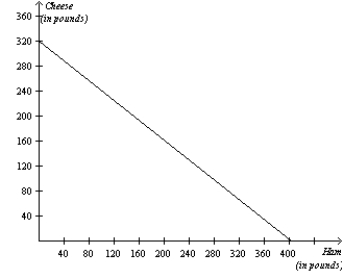 -Refer to Figure 3-23. The nation of Cropitia has a comparative advantage over Bonovia in producing ham if
 (Multiple Choice)
4.7/5  (84)
(84) Table 3-36  -Refer to Table 3-36. What is Antigua's opportunity cost of one umbrella?
 (Multiple Choice)
5.0/5 (81)
(81) Goods produced abroad and sold domestically are called exports and goods produced domestically and sold abroad are called imports.
(True/False)
4.9/5 (84)
(84) Figure 3-21
Uzbekistan's Production Possibilities Frontier
Azerbaijan's Production Possibilities Frontier 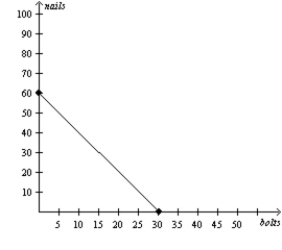
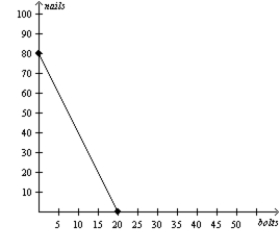 -Refer to Figure 3-21. Azerbaijan has an absolute advantage in the production of
 (Multiple Choice)
4.8/5 (68)
(68) Table 3-29
Juanita and Shantala run a business that programs and tests cellular phones. Assume that Juanita and Shantala can switch between programming and testing cellular phones at a constant rate. The following table applies.
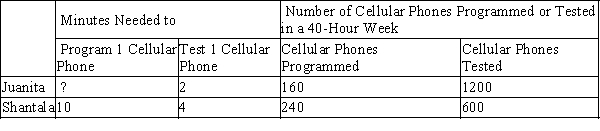 -Refer to Table 3-29. Juanita's opportunity cost of programming one cellular phone is testing
 (Multiple Choice)
5.0/5 (69)
(69) Figure 3-19
Chile's Production Possibilities Frontier
Colombia's Production Possibilities Frontier 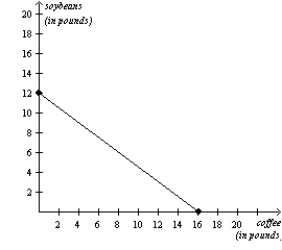
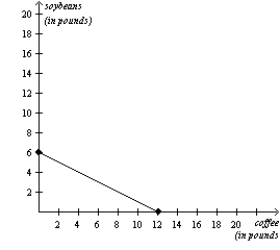 -Refer to Figure 3-19. At which of the following prices would both Chile and Colombia gain from trade with each other?
 (Multiple Choice)
4.9/5 (79)
(79) Table 3-27
Assume that Huang and Min can switch between producing parasols and producing porcelain plates at a constant rate.
 -Refer to Table 3-27. The opportunity cost of 1 parasol for Huang is
 (Multiple Choice)
4.9/5 (66)
(66) Figure 3-4
Lisa's Production Possibilities Frontier
Bryce's Production Possibilities Frontier 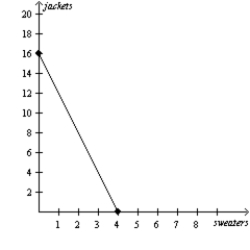
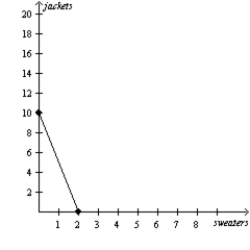 -Refer to Figure 3-4. If the production possibilities frontier shown for Lisa is for 4 months of work, then how long does it take Lisa to produce one jacket?
 (Multiple Choice)
4.8/5 (86)
(86) Table 3-23
Assume that the farmer and the rancher can switch between producing pork and producing tomatoes at a constant rate.
 -Refer to Table 3-23. The opportunity cost of 1 pound of tomatoes for the farmer is
 (Multiple Choice)
4.9/5 (87)
(87) Figure 3-19
Chile's Production Possibilities Frontier
Colombia's Production Possibilities Frontier
-Refer to Figure 3-19. Chile would incur an opportunity cost of 36 pounds of coffee if it increased its production of soybeans by
-Refer to Figure 3-19. Chile would incur an opportunity cost of 36 pounds of coffee if it increased its production of soybeans by (Multiple Choice)
5.0/5 (74)
(74) Table 3-2
Assume that England and Holland can switch between producing milk and oats at a constant rate.  -Refer to Table 3-2. We could use the information in the table to draw a production possibilities frontier for England and a second production possibilities frontier for Holland. If we were to do this, measuring milk along the horizontal axis, then
 (Multiple Choice)
4.9/5 (75)
(75) Table 3-24
Assume that England and Spain can switch between producing cheese and producing bread at a constant rate.

-Refer to Table 3-24. Without trade, England produced and consumed 32 units of cheese and 2 units of bread and Spain produced and consumed 6 units of cheese and 2 units of bread. Then, each country agreed to specialize in the production of the good in which it has a comparative advantage and trade 7 units of cheese for 2.5 units of bread. As a result, England gained
-Refer to Table 3-24. Without trade, England produced and consumed 32 units of cheese and 2 units of bread and Spain produced and consumed 6 units of cheese and 2 units of bread. Then, each country agreed to specialize in the production of the good in which it has a comparative advantage and trade 7 units of cheese for 2.5 units of bread. As a result, England gained (Multiple Choice)
4.9/5 (76)
(76) The most obvious benefit of specialization and trade is that they allow us to
(Multiple Choice)
4.8/5 (77)
(77) Table 3-38 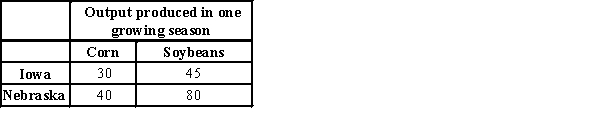 -Refer to Table 3-38. Iowa and Nebraska can both produce corn and soybeans, and can switch between the production of corn and soybeans at a constant rate. The table illustrates the amount of corn or soybeans each state can produce in one growing season. From the table we know that Iowa has a
 (Multiple Choice)
4.7/5 (72)
(72) Table 3-24
Assume that England and Spain can switch between producing cheese and producing bread at a constant rate.
-Refer to Table 3-24. England has an absolute advantage in the production of
-Refer to Table 3-24. England has an absolute advantage in the production of (Multiple Choice)
4.8/5 (86)
(86) Figure 3-4
Lisa's Production Possibilities Frontier
Bryce's Production Possibilities Frontier
-Refer to Figure 3-4. If Lisa and Bryce each divides his or her time equally between producing jackets and producing sweaters, then total production is
-Refer to Figure 3-4. If Lisa and Bryce each divides his or her time equally between producing jackets and producing sweaters, then total production is (Multiple Choice)
4.8/5 (70)
(70) Table 3-20
Assume that Brad and Theresa can switch between producing wheat and producing beef at a constant rate.  -Refer to Table 3-20. What is Theresa's opportunity cost of producing one bushel of wheat?
 (Multiple Choice)
4.7/5 (83)
(83) Figure 3-17
Maxine's Production Possibilities Frontier
Daisy's Production Possibilities Frontier 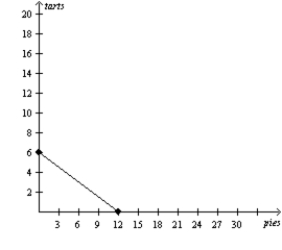
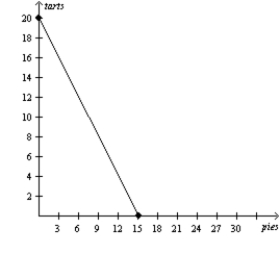 -Refer to Figure 3-17. Daisy has an absolute advantage in the production of
 (Multiple Choice)
4.8/5 (85)
(85) Economists use the term ______ to refer to the ability to produce a good at a lower opportunity cost than another producer.
(Short Answer)
4.9/5 (82)
(82) The gains from specialization and trade are based on absolute advantage.
(True/False)
4.7/5 (76)
(76) 
Filters
- Essay(0)
- Multiple Choice(0)
- Short Answer(0)
- True False(0)
- Matching(0)