



 Chat with AI
Exam 3: Interdependence and the Gains From Trade

Exam 1: Ten Principles of Economics455 Questions
Exam 2: Thinking Like an Economist645 Questions
Exam 3: Interdependence and the Gains From Trade550 Questions
Exam 4: The Market Forces of Supply and Demand693 Questions
Exam 5: Elasticity and Its Application625 Questions
Exam 6: Supply, Demand, and Government Policies671 Questions
Exam 7: Consumers, Producers, and the Efficiency of Markets547 Questions
Exam 8: Application: The Costs of Taxation507 Questions
Exam 9: Application: International Trade521 Questions
Exam 10: Externalities543 Questions
Exam 11: Public Goods and Common Resources453 Questions
Exam 12: The Design of the Tax System563 Questions
Exam 13: The Costs of Production649 Questions
Exam 14: Firms in Competitive Markets608 Questions
Exam 15: Monopoly662 Questions
Exam 16: Monopolistic Competition649 Questions
Exam 17: Oligopoly522 Questions
Exam 18: The Markets for the Factors of Production592 Questions
Exam 19: Earnings and Discrimination511 Questions
Exam 20: Income Inequality and Poverty478 Questions
Exam 21: The Theory of Consumer Choice568 Questions
Exam 22: Frontiers in Microeconomics461 Questions
Select questions type


Figure 3-24
The production possibilities frontiers below show how much Bob and Betty can each produce in 8 hours of time.
Bob's Production Possibilities Frontier
Betty's Production Possibilities Frontier 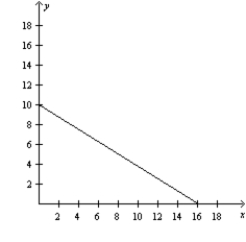
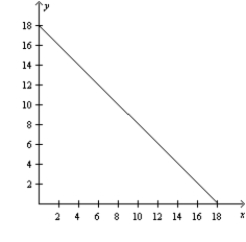 -Refer to Figure 3-24. Bob has
 (Multiple Choice)
4.8/5  (69)
(69) Specialization and trade can make everyone better off if a person can obtain goods at prices that are less than that person's opportunity cost.
(True/False)
4.8/5 (79)
(79) Figure 3-3
Arturo's Production Possibilities Frontier
Dina's Production Possibilities Frontier 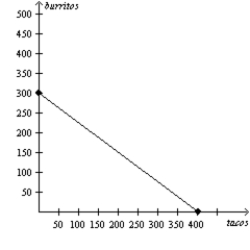
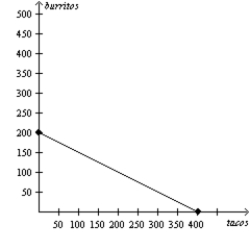 -Refer to Figure 3-3. If Arturo and Dina both spend all of their time producing tacos, then total production is
 (Multiple Choice)
4.7/5 (82)
(82) Table 3-37 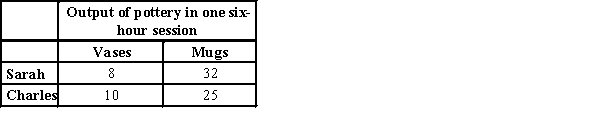
-Refer to Table 3-37. Sarah and Charles are both potters and each can switch between the production of vases and mugs at a constant rate. The table shows the total number of vases or decorative mugs that each person can produce in a six-hour session of producing pottery. Sarah and Charles could benefit from trading with each other if they traded at a price of
-Refer to Table 3-37. Sarah and Charles are both potters and each can switch between the production of vases and mugs at a constant rate. The table shows the total number of vases or decorative mugs that each person can produce in a six-hour session of producing pottery. Sarah and Charles could benefit from trading with each other if they traded at a price of (Multiple Choice)
4.9/5 (94)
(94) Figure 3-17
Maxine's Production Possibilities Frontier
Daisy's Production Possibilities Frontier 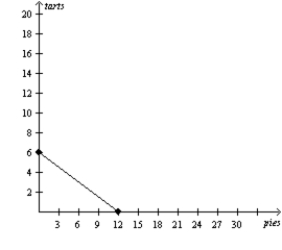
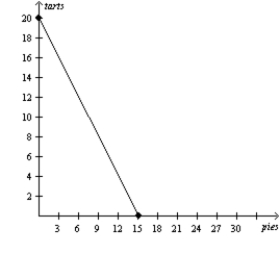 -Refer to Figure 3-17. Suppose Daisy decides to increase her production of pies by 6. What is the opportunity cost of this decision?
 (Multiple Choice)
4.9/5 (73)
(73) Suppose that a worker in Boatland can produce either 5 units of wheat or 25 units of fish per year, and a worker in Farmland can produce either 25 units of wheat or 5 units of fish per year. There are 30 workers in each country. No trade occurs between the two countries. Boatland produces and consumes 75 units of wheat and 375 units of fish per year while Farmland produces and consumes 375 units of wheat and 75 units of fish per year. If trade were to occur, Boatland would trade 90 units of fish to Farmland in exchange for 80 units of wheat. If Boatland now completely specializes in fish production, how many units of fish could it now consume along with the 80 units of imported wheat?
(Multiple Choice)
4.8/5 (70)
(70) Suppose the U.S. and Japan both produce airplanes and televisions and the U.S. has a comparative advantage in the production of airplanes while Japan has a comparative advantage in the production of televisions. If the U.S. exports airplanes to Japan and imports televisions from Japan,
(Multiple Choice)
4.8/5 (78)
(78) Table 3-23
Assume that the farmer and the rancher can switch between producing pork and producing tomatoes at a constant rate.
 -Refer to Table 3-23. The opportunity cost of 1 pound of pork for the rancher is
 (Multiple Choice)
4.8/5 (74)
(74) Trade can only benefit a nation if that nation has an absolute advantage in the production of that good.
(True/False)
4.7/5 (72)
(72) Unless two people who are producing two goods have exactly the same opportunity costs, then one person will have a comparative advantage in one good, and the other person will have a comparative advantage in the other good.
(True/False)
4.8/5 (79)
(79) Table 3-26
Assume that Japan and Korea can switch between producing cars and producing airplanes at a constant rate.
 -Refer to Table 3-26. Japan and Korea would not be able to gain from trade if Korea's opportunity cost of one car changed to
 (Multiple Choice)
5.0/5 (75)
(75) With eight hours of work Elmer can produce 20 pounds of carrots or 15 pounds of peas. With eight hours Bugs can produce 10 pounds of carrots or 7.5 pounds of peas. Can Elmer and Bugs gain from trade? Defend your answer.
(Essay)
4.8/5 (93)
(93) Suppose that a worker in Radioland can produce either 4 radios or 1 television per year and a worker in Teeveeland can produce either 2 radios or 5 televisions per year. Each nation has 100 workers, and each country specializes according to the principle of comparative advantage. If Radioland trades 100 televisions to Teeveeland in exchange for 100 radios each year, then each country's maximum consumption of new radios and televisions per year will be
(Multiple Choice)
4.7/5 (86)
(86) Suppose Jim and Tom can both produce baseball bats. If Jim's opportunity cost of producing baseball bats is lower than Tom's opportunity cost of producing baseball bats, then
(Multiple Choice)
4.7/5 (79)
(79) Figure 3-21
Uzbekistan's Production Possibilities Frontier
Azerbaijan's Production Possibilities Frontier 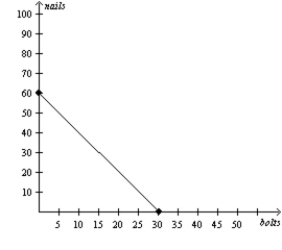
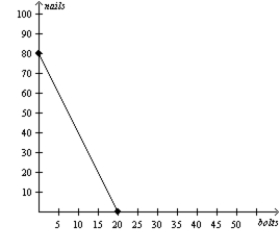 -Refer to Figure 3-21. Azerbaijan's opportunity cost of one bolt is
 (Multiple Choice)
4.8/5 (67)
(67) Table 3-35  -Refer to Table 3-35. Finland's opportunity cost of producing 1 unit of ham is
 (Multiple Choice)
4.7/5 (75)
(75) Figure 3-8
Chile's Production Possibilities Frontier
Colombia's Production Possibilities Frontier 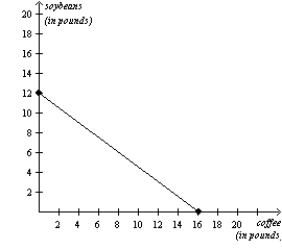
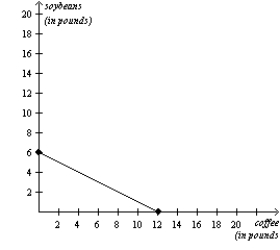 -Refer to Figure 3-8. If Chile and Colombia each divides its time equally between making coffee and making soybeans, then total production is
 (Multiple Choice)
4.9/5 (81)
(81) Table 3-31
 -Refer to Table 3-31. For the rancher, the opportunity cost of 1 pound of meat is
 (Multiple Choice)
4.9/5 (82)
(82) Table 3-23
Assume that the farmer and the rancher can switch between producing pork and producing tomatoes at a constant rate.
-Refer to Table 3-23. Assume that the farmer and the rancher each has 24 labor hours available. If each person spends all his time producing the good in which he has a comparative advantage and trade takes place at a price of 1 pound of pork for 2 pounds of tomatoes, then
-Refer to Table 3-23. Assume that the farmer and the rancher each has 24 labor hours available. If each person spends all his time producing the good in which he has a comparative advantage and trade takes place at a price of 1 pound of pork for 2 pounds of tomatoes, then (Multiple Choice)
4.8/5 (94)
(94) Table 3-28
Barb and Jim run a business that sets up and tests computers. Assume that Barb and Jim can switch between setting up and testing computers at a constant rate. The following table applies.
 -Refer to Table 3-28. Barb's opportunity cost of testing one computer is setting up
 (Multiple Choice)
4.7/5 (71)
(71) 
Filters
- Essay(0)
- Multiple Choice(0)
- Short Answer(0)
- True False(0)
- Matching(0)