



 Chat with AI
Exam 3: Interdependence and the Gains From Trade

Exam 1: Ten Principles of Economics455 Questions
Exam 2: Thinking Like an Economist645 Questions
Exam 3: Interdependence and the Gains From Trade550 Questions
Exam 4: The Market Forces of Supply and Demand693 Questions
Exam 5: Elasticity and Its Application625 Questions
Exam 6: Supply, Demand, and Government Policies671 Questions
Exam 7: Consumers, Producers, and the Efficiency of Markets547 Questions
Exam 8: Application: The Costs of Taxation507 Questions
Exam 9: Application: International Trade521 Questions
Exam 10: Externalities543 Questions
Exam 11: Public Goods and Common Resources453 Questions
Exam 12: The Design of the Tax System563 Questions
Exam 13: The Costs of Production649 Questions
Exam 14: Firms in Competitive Markets608 Questions
Exam 15: Monopoly662 Questions
Exam 16: Monopolistic Competition649 Questions
Exam 17: Oligopoly522 Questions
Exam 18: The Markets for the Factors of Production592 Questions
Exam 19: Earnings and Discrimination511 Questions
Exam 20: Income Inequality and Poverty478 Questions
Exam 21: The Theory of Consumer Choice568 Questions
Exam 22: Frontiers in Microeconomics461 Questions
Select questions type


Figure 3-18
Bintu's Production Possibilities Frontier
Juba's Production Possibilities Frontier 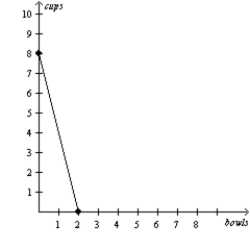
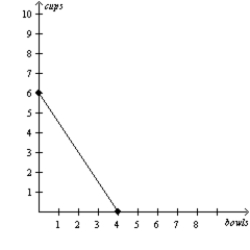 -Refer to Figure 3-18. Suppose Juba is willing to trade one bowl to Bintu for every two cups that Bintu makes and sends to Juba. Which of the following combinations of bowls and cups could Bintu then consume, assuming Bintu specializes in making cups and Juba specializes in making bowls?
 (Multiple Choice)
4.8/5  (74)
(74) Table 3-36  -Refer to Table 3-36. Antigua has an absolute advantage in the production of
 (Multiple Choice)
4.7/5 (86)
(86) Table 3-37 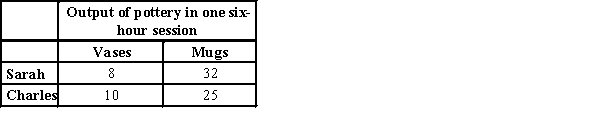
-Refer to Table 3-37. Sarah and Charles are both potters and each can switch between the production of vases and mugs at a constant rate. The table shows the total number of vases or decorative mugs that each person can produce in a six-hour session of producing pottery. Sarah's opportunity cost to produce one vase is
-Refer to Table 3-37. Sarah and Charles are both potters and each can switch between the production of vases and mugs at a constant rate. The table shows the total number of vases or decorative mugs that each person can produce in a six-hour session of producing pottery. Sarah's opportunity cost to produce one vase is (Multiple Choice)
4.8/5 (77)
(77) Table 3-26
Assume that Japan and Korea can switch between producing cars and producing airplanes at a constant rate.
 -Refer to Table 3-26. Japan's opportunity cost of one car is
 (Multiple Choice)
5.0/5 (86)
(86) Figure 3-8
Chile's Production Possibilities Frontier
Colombia's Production Possibilities Frontier 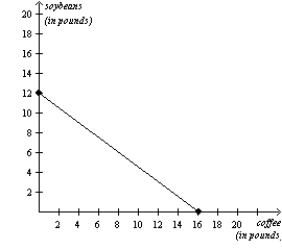
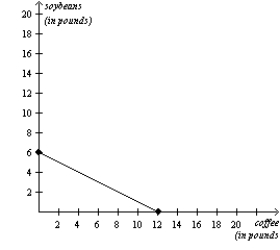 -Refer to Figure 3-8. If the production possibilities frontiers shown are each for one day of production, then which of the following combinations of coffee and soybeans could Chile and Colombia together make in a given day?
 (Multiple Choice)
4.9/5 (88)
(88) The principle of comparative advantage does not provide answers to certain questions. One of those questions is
(Multiple Choice)
4.7/5 (71)
(71) Figure 3-6
Maxine's Production Possibilities Frontier
Daisy's Production Possibilities Frontier 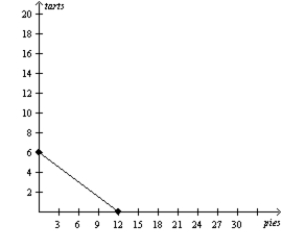
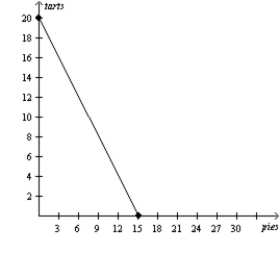 -Refer to Figure 3-6. If Maxine and Daisy each divides her time equally between making pies and making tarts, then total production is
 (Multiple Choice)
4.8/5 (84)
(84) Table 3-41
 -Refer to Table 3-41. If the two countries specialize and trade with each other, which country will import compasses?
 (Short Answer)
4.9/5 (84)
(84) Figure 3-2
Brazil's Production Possibilities Frontier 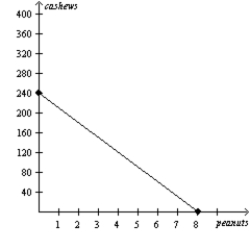 -Refer to Figure 3-2. If the production possibilities frontier shown is for two months of production, then which of the following combinations of peanuts and cashews could Brazil not produce in two months?
 (Multiple Choice)
4.9/5 (87)
(87) International trade may make some individuals in a nation better off, while other individuals are made worse off.
(True/False)
4.9/5 (82)
(82) Figure 3-17
Maxine's Production Possibilities Frontier
Daisy's Production Possibilities Frontier 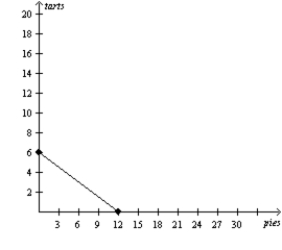
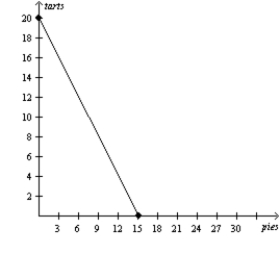 -Refer to Figure 3-17. Maxine has an absolute advantage in the production of
 (Multiple Choice)
4.8/5 (75)
(75) Table 3-5
Assume that Aruba and Iceland can switch between producing coolers and producing radios at a constant rate.  -Refer to Table 3-5. Which of the following represents Aruba's production possibilities frontier when 100 labor hours are available?
 (Multiple Choice)
4.9/5 (82)
(82) Table 3-30
Assume that Falda and Varick can switch between producing wheat and producing cloth at a constant rate.  -Refer to Table 3-30. Varick has an absolute advantage in the production of
 (Multiple Choice)
4.8/5 (63)
(63) Figure 3-19
Chile's Production Possibilities Frontier
Colombia's Production Possibilities Frontier 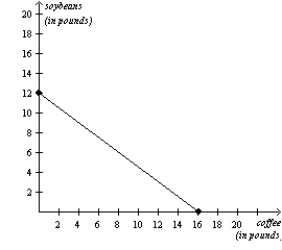
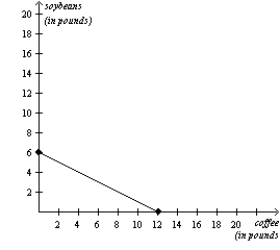 -Refer to Figure 3-19. If Chile and Colombia each spends all of its time producing the good in which it has a comparative advantage and the countries agree to trade 7 pounds of coffee for 5 pounds of soybeans, then Chile will consume
 (Multiple Choice)
4.8/5 (64)
(64) Table 3-31
 -Refer to Table 3-31. For the farmer, the opportunity cost of 1 pound of meat is
 (Multiple Choice)
4.8/5 (80)
(80) Table 3-21
Assume that Jamaica and Norway can switch between producing coolers and producing radios at a constant rate. The following table shows the number of coolers or number of radios each country can produce in one day.  -Refer to Table 3-21. Jamaica should specialize in the production of
 (Multiple Choice)
4.8/5 (77)
(77) Figure 3-22
Alice and Betty's Production Possibilities in one 8-hour day.
Alice's Production Possibilities Frontier
Betty's Production Possibilities Frontier 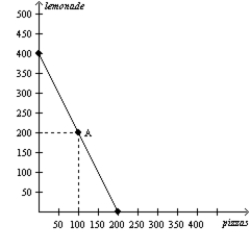
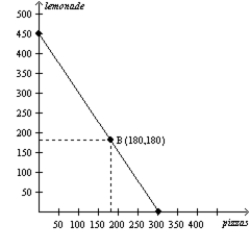 -Refer to Figure 3-22. Which of the following statements is correct regarding comparative advantage?
 (Multiple Choice)
4.8/5 (93)
(93) Table 3-16
The following table contains some production possibilities for an economy for a given month.  -Refer to Table 3-16. If the production possibilities frontier is bowed outward, then "?" could be
 (Multiple Choice)
4.9/5 (78)
(78) 
Filters
- Essay(0)
- Multiple Choice(0)
- Short Answer(0)
- True False(0)
- Matching(0)