



 Chat with AI
Exam 3: Interdependence and the Gains From Trade

Exam 1: Ten Principles of Economics455 Questions
Exam 2: Thinking Like an Economist645 Questions
Exam 3: Interdependence and the Gains From Trade550 Questions
Exam 4: The Market Forces of Supply and Demand693 Questions
Exam 5: Elasticity and Its Application625 Questions
Exam 6: Supply, Demand, and Government Policies671 Questions
Exam 7: Consumers, Producers, and the Efficiency of Markets547 Questions
Exam 8: Application: The Costs of Taxation507 Questions
Exam 9: Application: International Trade521 Questions
Exam 10: Externalities543 Questions
Exam 11: Public Goods and Common Resources453 Questions
Exam 12: The Design of the Tax System563 Questions
Exam 13: The Costs of Production649 Questions
Exam 14: Firms in Competitive Markets608 Questions
Exam 15: Monopoly662 Questions
Exam 16: Monopolistic Competition649 Questions
Exam 17: Oligopoly522 Questions
Exam 18: The Markets for the Factors of Production592 Questions
Exam 19: Earnings and Discrimination511 Questions
Exam 20: Income Inequality and Poverty478 Questions
Exam 21: The Theory of Consumer Choice568 Questions
Exam 22: Frontiers in Microeconomics461 Questions
Select questions type


Table 3-25
Assume that Maya and Miguel can switch between producing mixers and producing toasters at a constant rate.
 -Refer to Table 3-25. Maya has an absolute advantage in the production of
 (Multiple Choice)
4.9/5  (72)
(72) Figure 3-3
Arturo's Production Possibilities Frontier
Dina's Production Possibilities Frontier 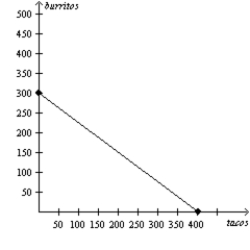
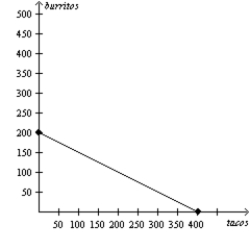 -Refer to Figure 3-3. If the production possibilities frontiers shown are each for one day of production, then which of the following combinations of tacos and burritos could Arturo and Dina together produce in a given day?
 (Multiple Choice)
4.8/5 (81)
(81) Figure 3-15
Perry's Production Possibilities Frontier
Jordan's Production Possibilities Frontier 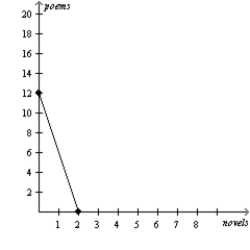
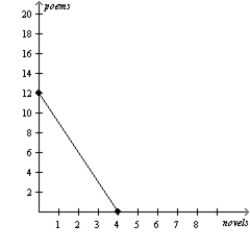 -Refer to Figure 3-15. The opportunity cost of 1 novel for Perry is
 (Multiple Choice)
4.9/5 (85)
(85) Table 3-22
Assume that Zimbabwe and Portugal can switch between producing toothbrushes and producing hairbrushes at a constant rate.  -Refer to Table 3-22. Zimbabwe and Portugal would not be able to gain from trade if Zimbabwe's opportunity cost of one toothbrush changed to
 (Multiple Choice)
4.8/5 (89)
(89) Table 3-32
US and French Production Opportunities  -Refer to Table 3-32 The US has a comparative advantage in the production of
 (Multiple Choice)
4.9/5 (72)
(72) Assume for the United States that the opportunity cost of each airplane is 50 cars. Which of these pairs of points could be on the United States' production possibilities frontier?
(Multiple Choice)
4.8/5 (84)
(84) Whenever a country has an absolute advantage in the production of a good, that implies that the country should specialize in the production of that good.
(True/False)
4.9/5 (85)
(85) Table 3-22
Assume that Zimbabwe and Portugal can switch between producing toothbrushes and producing hairbrushes at a constant rate.
-Refer to Table 3-22. Portugal has an absolute advantage in the production of
-Refer to Table 3-22. Portugal has an absolute advantage in the production of (Multiple Choice)
4.8/5 (75)
(75) Figure 3-22
Alice and Betty's Production Possibilities in one 8-hour day.
Alice's Production Possibilities Frontier
Betty's Production Possibilities Frontier 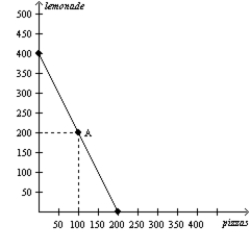
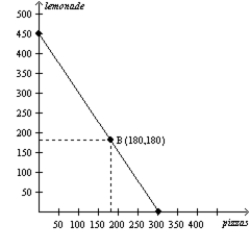 -Refer to Figure 3-22. Which of the following prices would result in an mutually advantageous trade for Alice and Betty?
 (Multiple Choice)
4.7/5 (69)
(69) If one producer is able to produce a good at a lower opportunity cost than some other producer, then the producer with the lower opportunity cost is said to have an absolute advantage in the production of that good.
(True/False)
4.8/5 (90)
(90) Figure 3-1
Panel (a)
Panel (b) 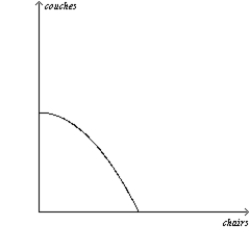
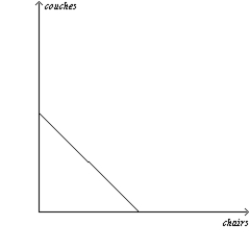 -Refer to Figure 3-1. The rate of tradeoff between producing chairs and producing couches depends on how many chairs and couches are being produced in
 (Multiple Choice)
4.9/5 (71)
(71) Table 3-12
Barb and Jim run a business that sets up and tests computers. Assume that Barb and Jim can switch between setting up and testing computers at a constant rate. The following table applies.
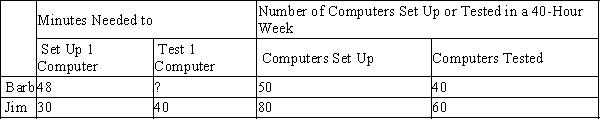
-Refer to Table 3-12. Which of the following points would not be on Barb's production possibilities frontier, based on a 40-hour week?
-Refer to Table 3-12. Which of the following points would not be on Barb's production possibilities frontier, based on a 40-hour week? (Multiple Choice)
4.8/5 (83)
(83) For a country producing two goods, the opportunity cost of one good will be the inverse of the opportunity cost of the other good.
(True/False)
4.8/5 (70)
(70) Suppose that a worker in Caninia can produce either 2 blankets or 8 meals per day, and a worker in Felinia can produce either 5 blankets or 1 meal per day. Each nation has 10 workers. For many years, the two countries traded, each completely specializing according to their respective comparative advantages. Now war has broken out between them and all trade has stopped. Without trade, Caninia produces and consumes 10 blankets and 40 meals per day and Felinia produces and consumes 25 blankets and 5 meals per day. The war has caused the combined daily output of the two countries to decline by
(Multiple Choice)
4.9/5 (81)
(81) Table 3-29
Juanita and Shantala run a business that programs and tests cellular phones. Assume that Juanita and Shantala can switch between programming and testing cellular phones at a constant rate. The following table applies.
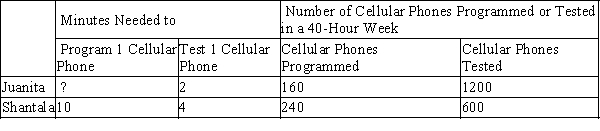 -Refer to Table 3-29. Juanita's opportunity cost of testing one cellular phone is programming
 (Multiple Choice)
4.8/5 (88)
(88) Two countries can achieve gains from trade even if one country has an absolute advantage in the production of both goods.
(True/False)
4.8/5 (69)
(69) Figure 3-7
Bintu's Production Possibilities Frontier
Juba's Production Possibilities Frontier 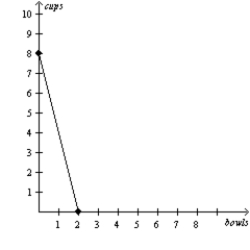
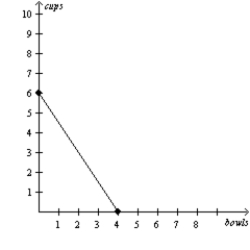 -Refer to Figure 3-7. If the production possibilities frontiers shown are each for 4 hours of work, then which of the following combinations of bowls and cups could Bintu and Juba together not make in a given 4-hour production period?
 (Multiple Choice)
4.9/5 (81)
(81) Scenario 3-1
The production possibilities frontiers below show how much Greg and Catherine can each produce in 8 hours of time.
Greg's Production Possibilities
Catherine's Production Possibilities 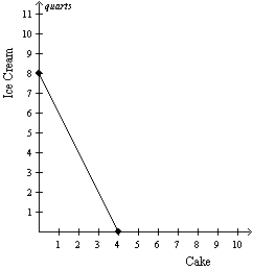
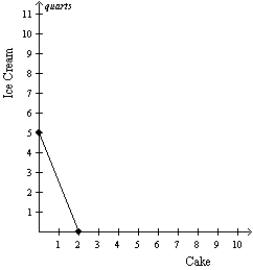 -Refer to Scenario 3-1. Which if any good(s) does Catherine have an absolute advantage producing?
 (Essay)
4.8/5 (73)
(73) 
Filters
- Essay(0)
- Multiple Choice(0)
- Short Answer(0)
- True False(0)
- Matching(0)